Emotional bias modification training decreased compulsive gaming thoughts and behaviors in people with internet gaming disorder
Emotional bias modification weakens game-related compulsivity and reshapes frontostriatal pathways
Randomized trialBenefit found
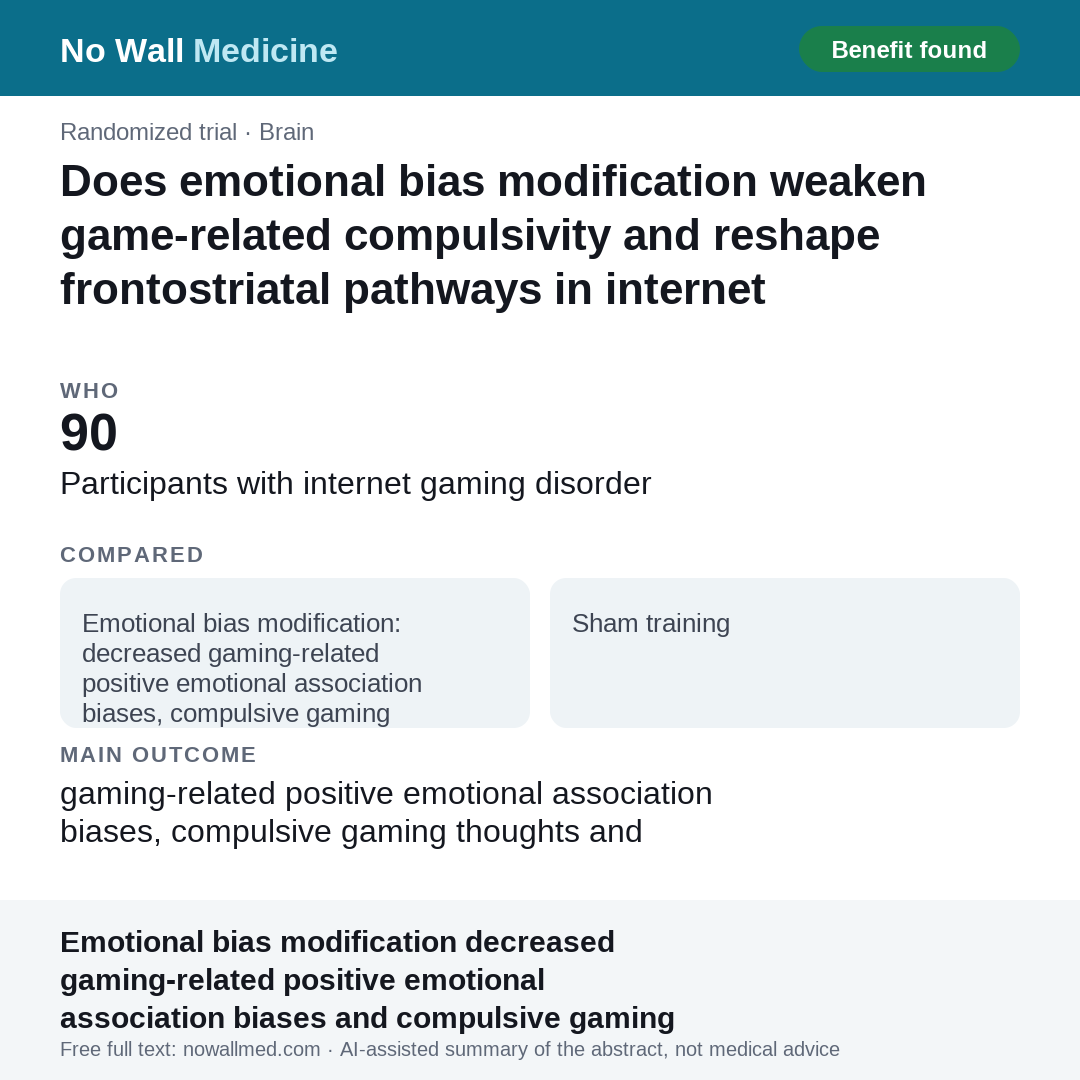
Does emotional bias modification weaken game-related compulsivity and reshape frontostriatal pathways in internet gaming disorder?
Who
90
Participants with internet gaming disorder
Compared
Emotional bias modification: decreased gaming-related positive emotional association biases, compulsive gaming thoughts and behaviours
Sham training
Main outcome
gaming-related positive emotional association biases, compulsive gaming thoughts and behaviours
Bottom line: Emotional bias modification decreased gaming-related positive emotional association biases and compulsive gaming thoughts and behaviours in internet gaming disorder.
Limitation: The therapeutic potential should be examined in larger, longer-term studies.
Brain · 2022-07-22Download image
Clinical question: Does emotional bias modification weaken game-related compulsivity and reshape frontostriatal pathways in internet gaming disorder?
Why it matters: It is unknown if modifying positive emotional associations through cognitive training can change the neurocognitive aspects of compulsivity in internet gaming disorder.
Key points
- Researchers studied 90 participants with internet gaming disorder who were randomly assigned to receive either emotional bias modification or sham training.
- The emotional bias modification training decreased gaming-related positive emotional association biases, compulsive gaming thoughts, and compulsive gaming behaviors compared to sham training.
- The training was associated with decreased activation in the bilateral dorsal striatum and altered connectivity between the left dorsal striatum and ventral prefrontal cortical regions.
Limitation the authors note: The authors state that the therapeutic potential should be examined in larger, longer-term studies.
Headline and key points written with AI from the paper’s abstract, with every number checked against it. Read the paper before relying on them.
Was this summary helpful?
Subject terms
Cite this article
Wu L, Xu J, Song K, Zhu L, Zhou N, Xu L. Emotional bias modification weakens game-related compulsivity and reshapes frontostriatal pathways. Brain. 2022. doi:10.1093/brain/awac267
Spotted a mistake? Suggest a correction
Top studies every Monday
The week’s key trials and guidelines in your specialties, plus any topics you follow. By email, free.
Get the weekly digest