Digital cognitive behavioral therapy for insomnia did not change facial expression recognition
Emotional Processing Following Digital Cognitive Behavioral Therapy for Insomnia in People With Depressive Symptoms: A Randomized Clinical Trial
Randomized clinical trialNo clear difference
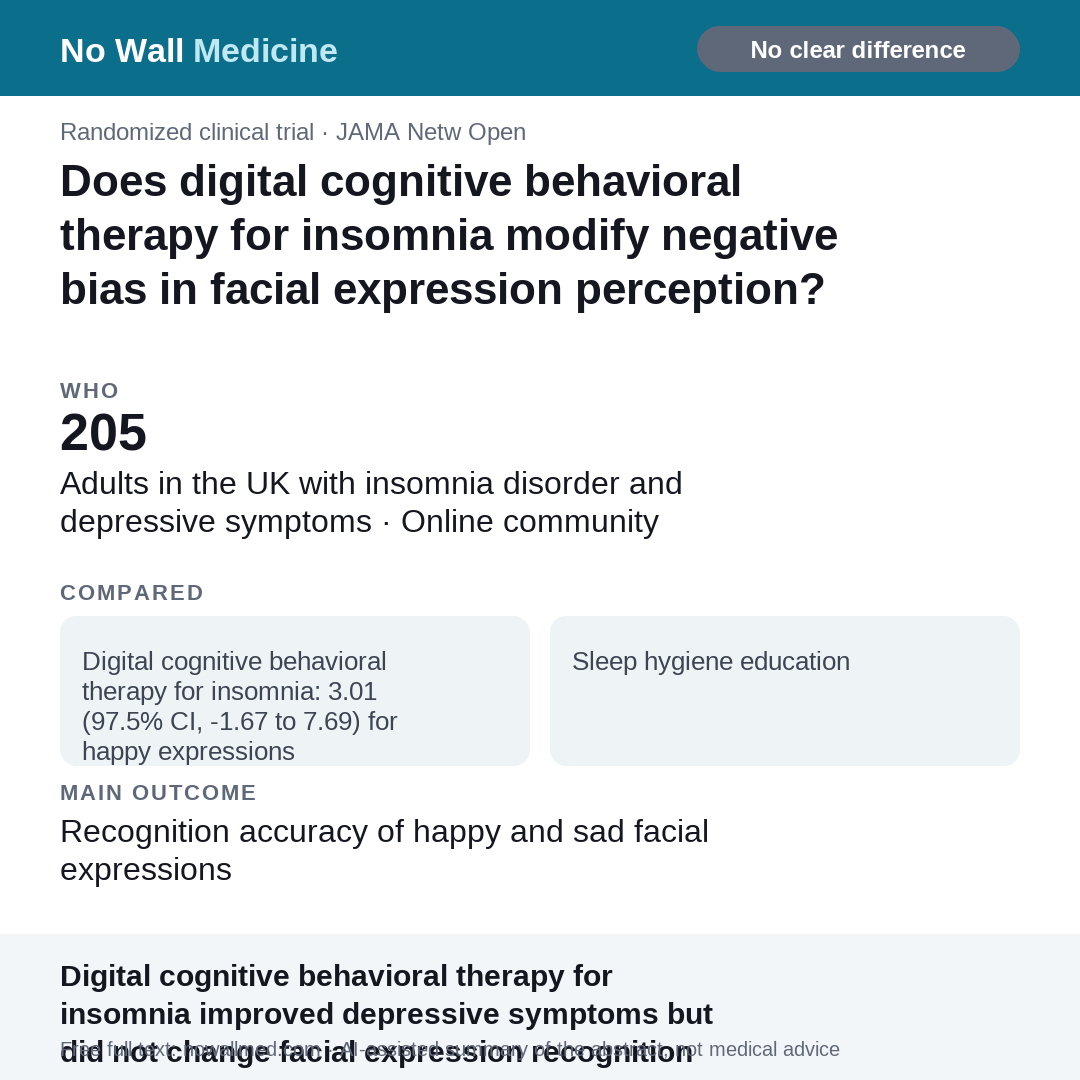
Does digital cognitive behavioral therapy for insomnia modify negative bias in facial expression perception?
Who
205
Adults in the UK with insomnia disorder and depressive symptoms · Online community recruitment in the United Kingdom
Compared
Digital cognitive behavioral therapy for insomnia: 3.01 (97.5% CI, -1.67 to 7.69) for happy expressions
Sleep hygiene education
Main outcome
Recognition accuracy of happy and sad facial expressions
Result: 3.01 (97.5% CI, -1.67 to 7.69)
Bottom line: Digital cognitive behavioral therapy for insomnia improved depressive symptoms but did not change facial expression recognition accuracy.
JAMA Netw Open · 2025-02-03Download image
Clinical question: Does digital cognitive behavioral therapy for insomnia modify negative bias in facial expression perception?
Why it matters: The mechanisms by which cognitive behavioral therapy for insomnia reduces depressive symptoms are not well understood
Key points
- 205 adults with insomnia and depressive symptoms were randomly assigned to digital cognitive behavioral therapy for insomnia or sleep hygiene education.
- Digital cognitive behavioral therapy for insomnia decreased depressive symptoms by 3.91 points and insomnia severity by 4.27 points at 10 weeks.
- Improvement in negative affect, emotional regulation difficulties, and worry at 5 weeks mediated the effect of therapy on depression severity at 10 weeks.
Limitation the authors note: The study had a relatively small sample size and short follow-up period
Headline and key points written with AI from the paper’s abstract, with every number checked against it. Read the paper before relying on them.
Topics
Cite this article
Tamm S, Tse KYK, Hellier J, Saunders KEA, Harmer CJ, Espie CA. Emotional Processing Following Digital Cognitive Behavioral Therapy for Insomnia in People With Depressive Symptoms: A Randomized Clinical Trial. JAMA Netw Open. 2025. doi:10.1001/jamanetworkopen.2024.61502
Spotted a mistake? Suggest a correction
Top studies every Monday
The week’s key trials and guidelines in your specialties, by email. Free.
Get the weekly digest