Citalopram administration was linked to reduced brain activity in fear processing regions
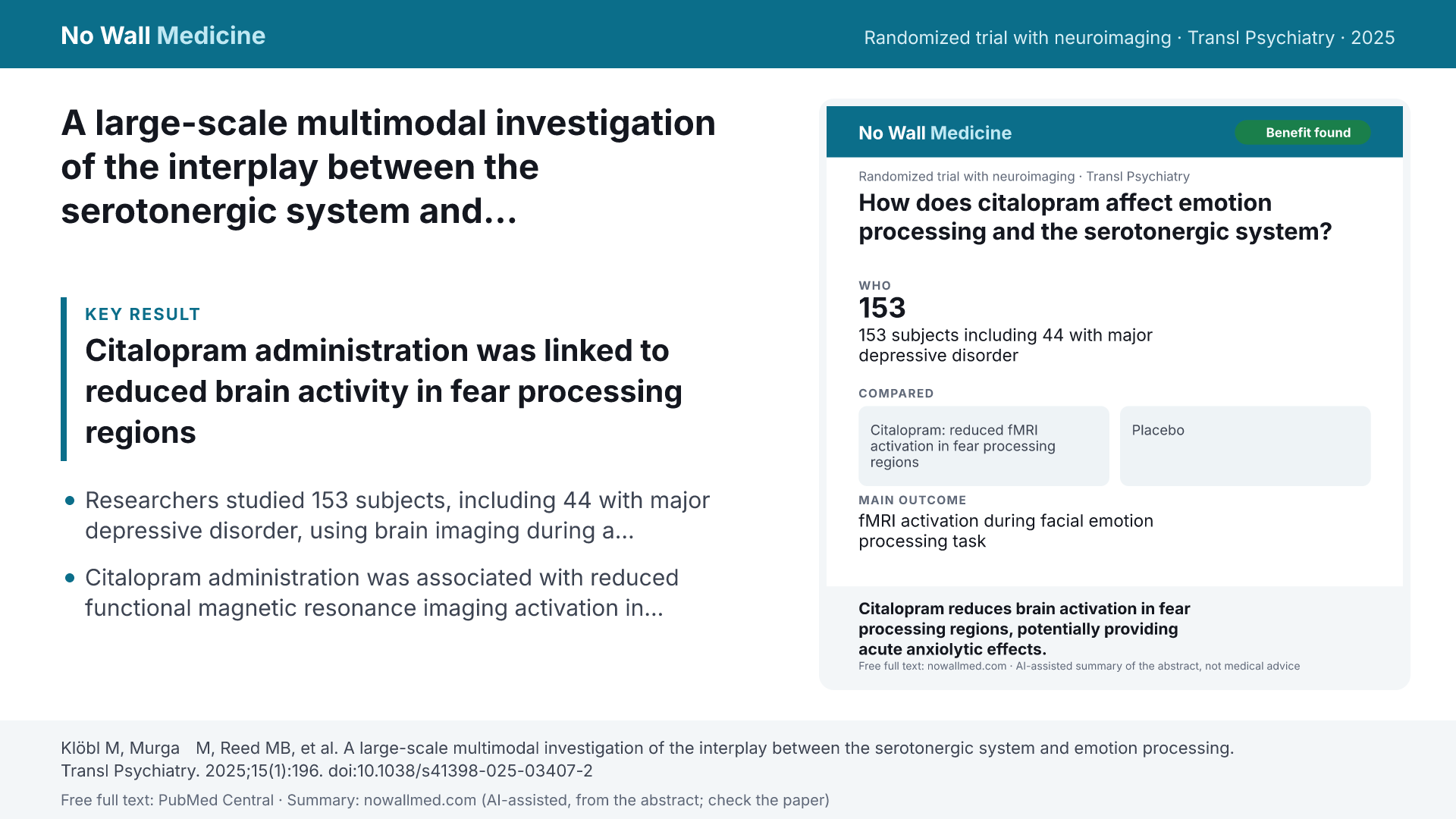
A large-scale multimodal investigation of the interplay between the serotonergic system and emotion processing
Randomized trial with neuroimagingBenefit found
How does citalopram affect emotion processing and the serotonergic system?
Who
153
153 subjects including 44 with major depressive disorder
Compared
Citalopram: reduced fMRI activation in fear processing regions
Placebo
Main outcome
fMRI activation during facial emotion processing task
Bottom line: Citalopram reduces brain activation in fear processing regions, potentially providing acute anxiolytic effects.
Transl Psychiatry · 2025-06-11Download image
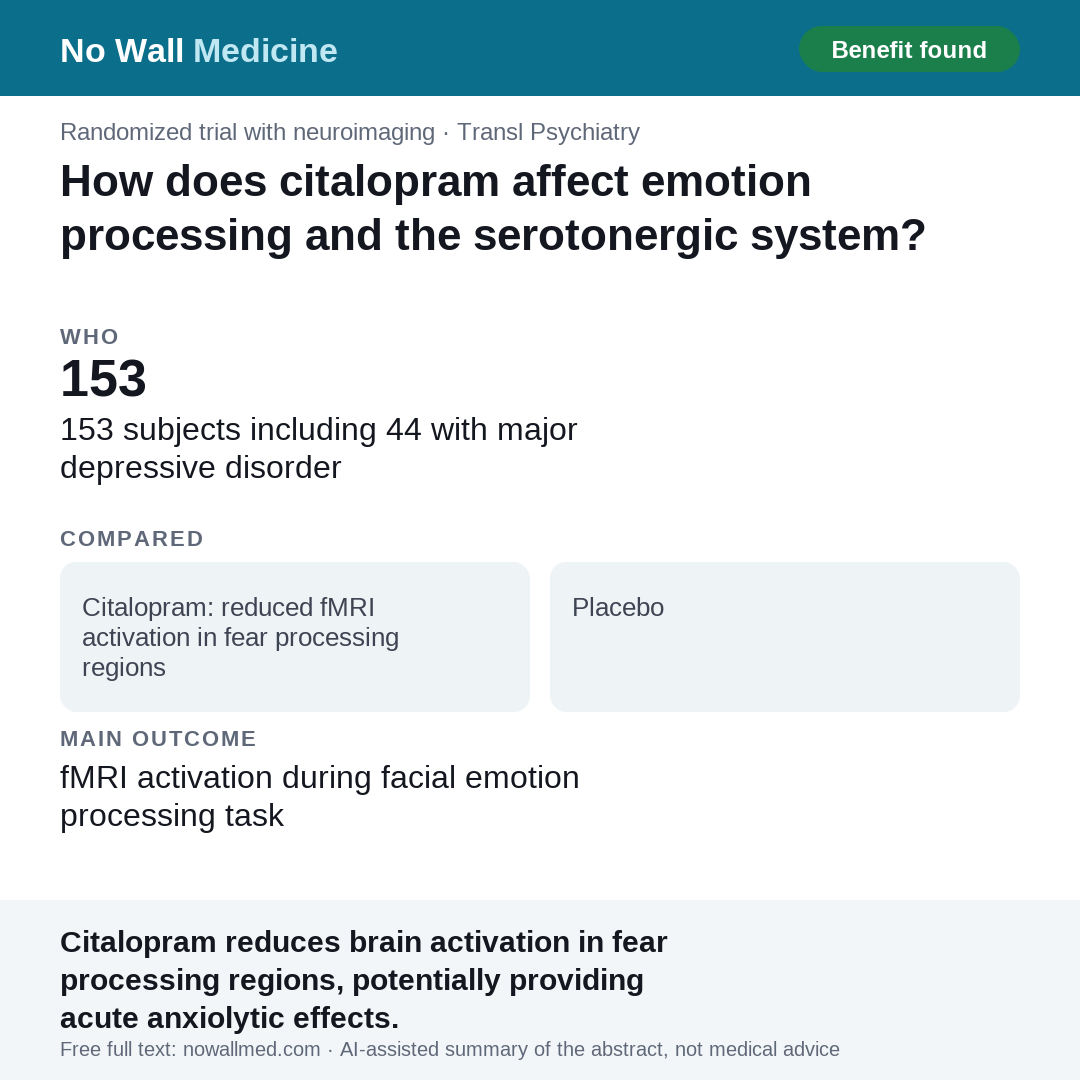
Clinical question: How does citalopram affect emotion processing and the serotonergic system?
Why it matters: The complex relationship between the serotonergic system, which involves serotonin, and how the brain processes emotions remains poorly understood.
Key points
- Researchers studied 153 subjects, including 44 with major depressive disorder, using brain imaging during a facial emotion task after receiving 8 mg of citalopram or a placebo.
- Citalopram administration was associated with reduced functional magnetic resonance imaging activation in fear processing regions, such as the anterior cingulate cortex, when viewing fearful faces.
- In patients with major depressive disorder, increased activations in the intraparietal and superior frontal sulcus were observed at baseline when viewing fearful versus happy faces.
Headline and key points written with AI from the paper’s abstract, with every number checked against it. Read the paper before relying on them.
Was this summary helpful?
Subject terms
Cite this article
Klöbl M, Murgaš M, Reed MB, et al. A large-scale multimodal investigation of the interplay between the serotonergic system and emotion processing. Transl Psychiatry. 2025. doi:10.1038/s41398-025-03407-2
Spotted a mistake? Suggest a correction