Enasidenib vs conventional care in older patients with late-stage mutant-IDH2 relapsed/refractory AML: a randomized phase 3 trial
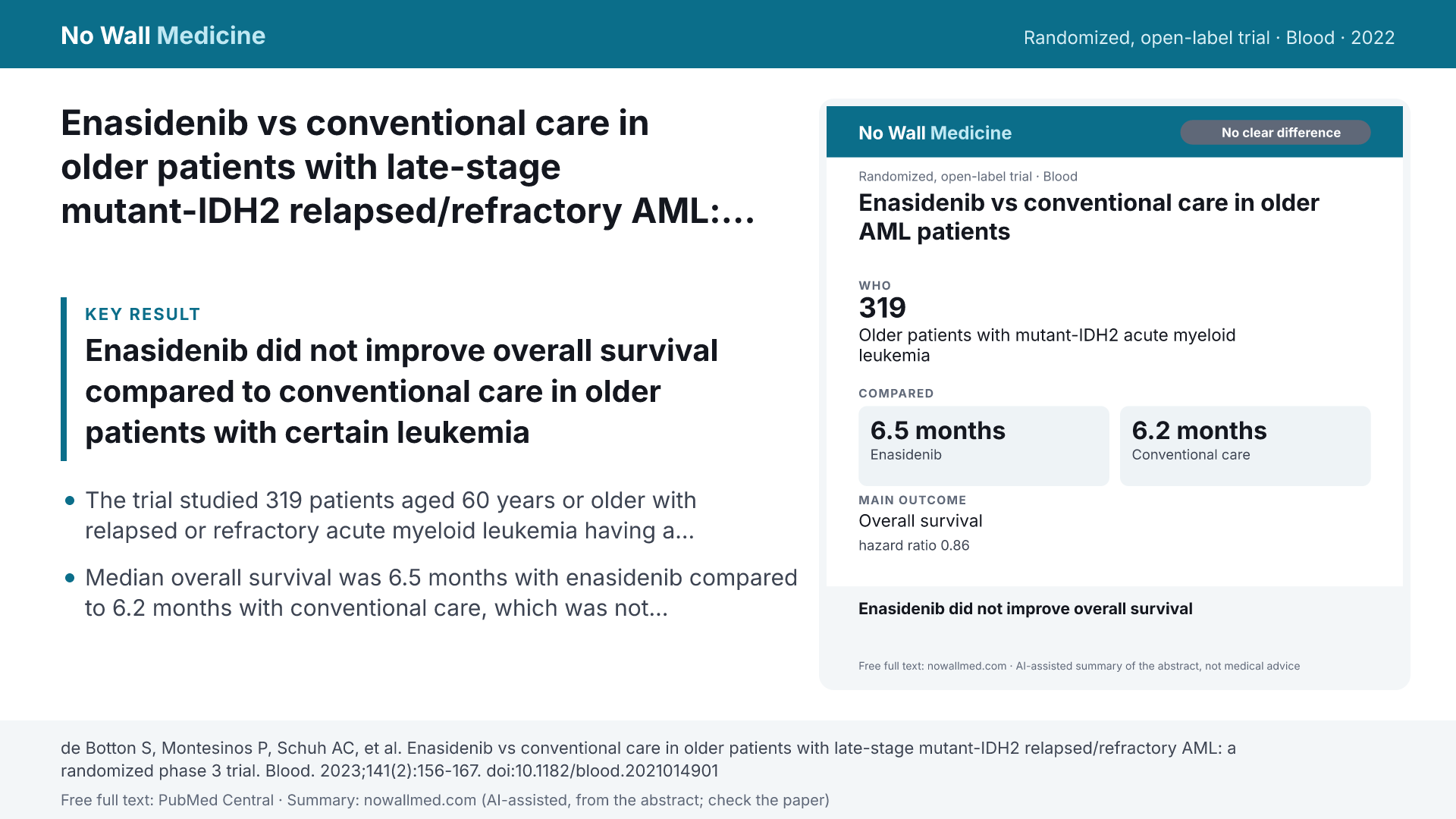
Key result: Enasidenib did not improve overall survival compared to conventional care in older patients with certain leukemia
Randomized, open-label trialNo clear difference
Enasidenib vs conventional care in older AML patients
Who
319
Older patients with mutant-IDH2 acute myeloid leukemia
Compared
6.5 monthsEnasidenib
6.2 monthsConventional care
Main outcome
Overall survival
Result: hazard ratio 0.86
Bottom line: Enasidenib did not improve overall survival
Limitation: Early dropout and subsequent therapies
Blood · 2022-06-18
Key points
- The trial studied 319 patients aged 60 years or older with relapsed or refractory acute myeloid leukemia having a specific mutation called IDH2.
- Median overall survival was 6.5 months with enasidenib compared to 6.2 months with conventional care, which was not a statistically significant difference.
- Enasidenib was associated with higher overall response rates of 40.5% compared to 9.9% for conventional care.
Limitation the authors note: The primary endpoint was not met because overall survival was confounded by early dropout and subsequent AML-directed therapies.
Discussion prompts
- Would these patients look like yours? Who was left out?
- Is the main outcome one that matters to patients?
- Is the difference large enough to change what you do?
Cite: de Botton S, Montesinos P, Schuh AC, et al. Enasidenib vs conventional care in older patients with late-stage mutant-IDH2 relapsed/refractory AML: a randomized phase 3 trial. Blood. 2023;141(2):156-167. doi:10.1182/blood.2021014901
Free full text: PubMed Central · Summary and visual abstract: nowallmed.com/a/enasidenib-vs-conventional-care-in-older-patients-with-late-stage-8eupbl/ (AI-assisted from the abstract; check the paper before relying on it).