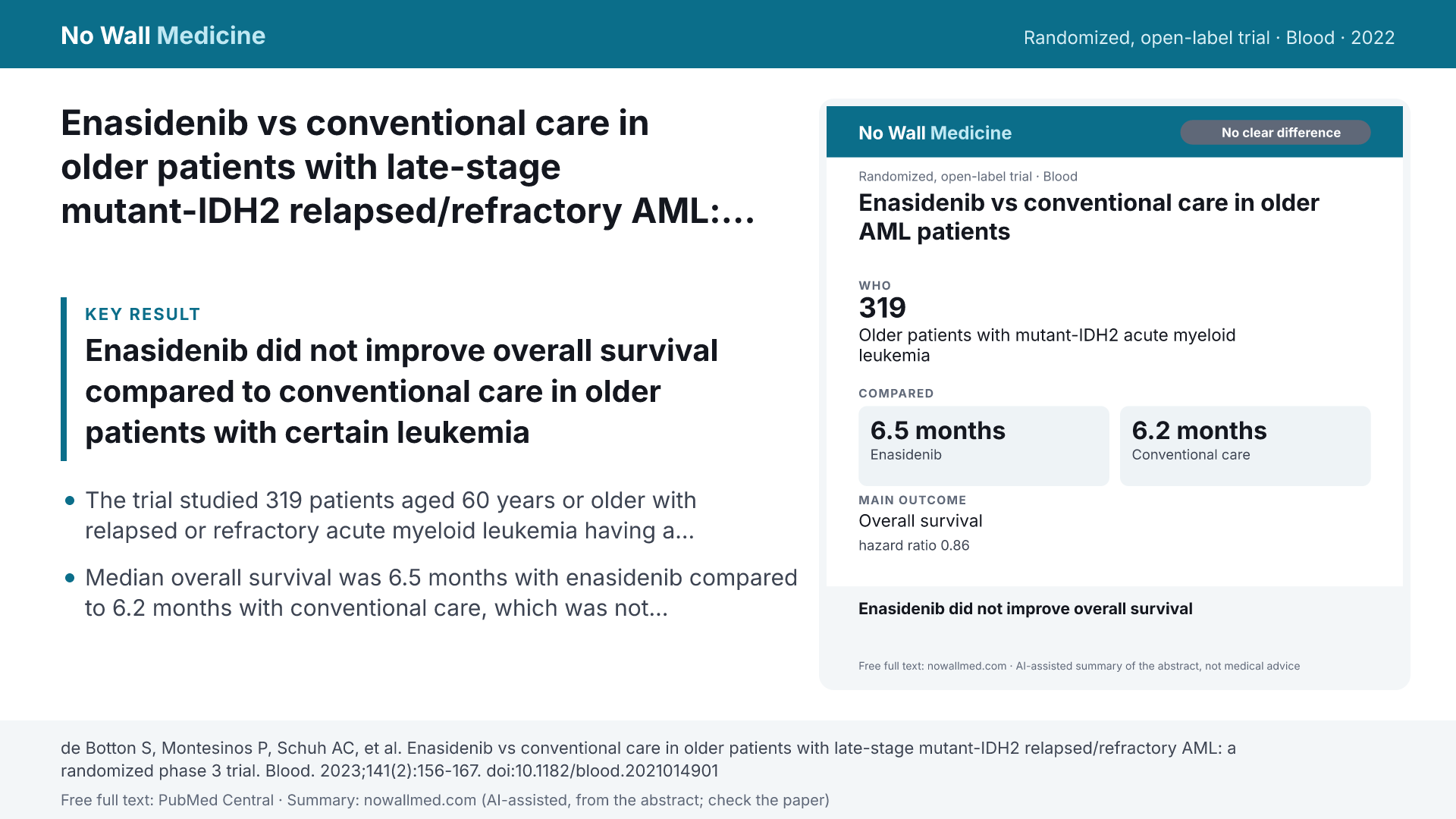
Enasidenib did not improve overall survival compared to conventional care in older patients with certain leukemia
Enasidenib vs conventional care in older patients with late-stage mutant-IDH2 relapsed/refractory AML: a randomized phase 3 trial
Randomized, open-label trialNo clear difference
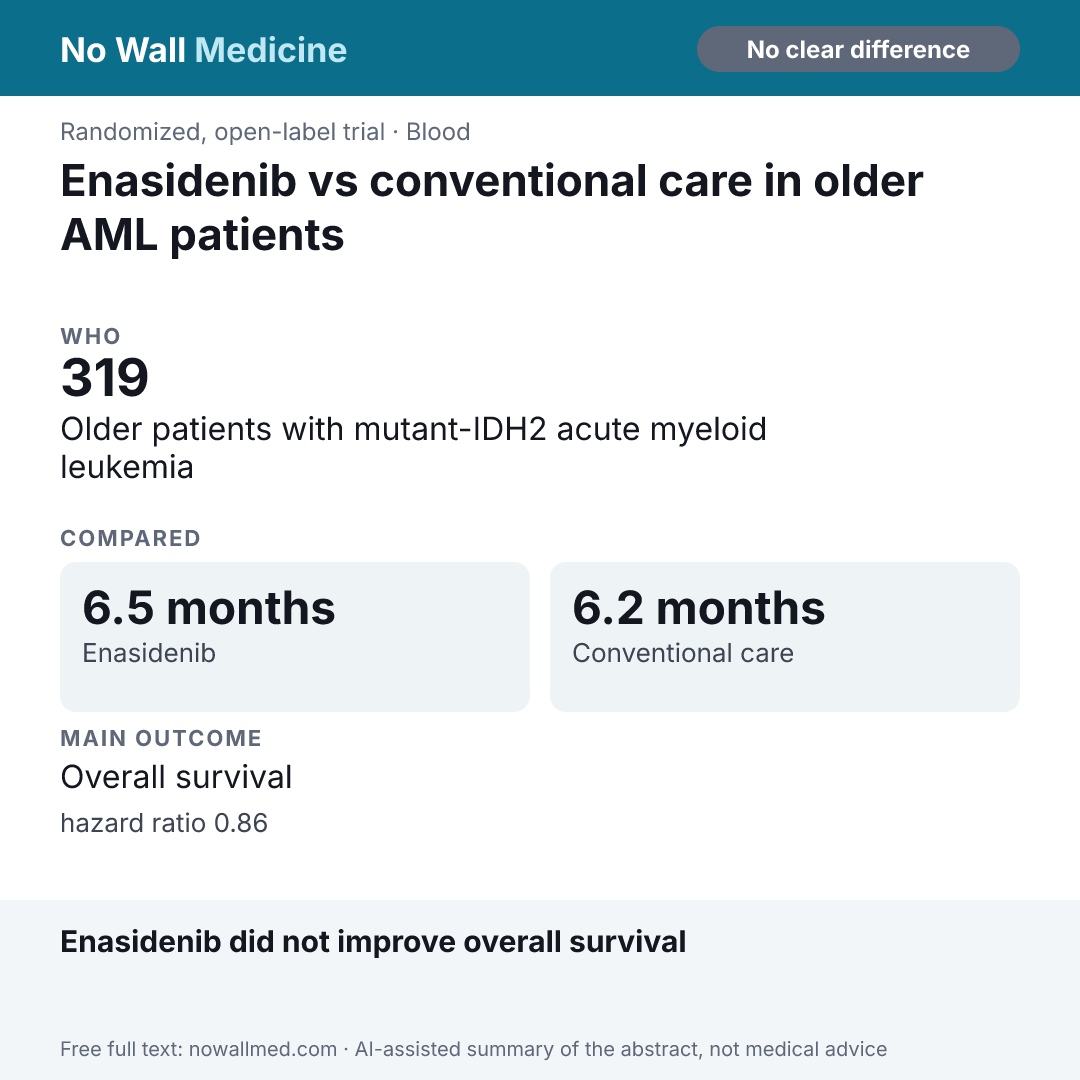
Enasidenib vs conventional care in older AML patients
Who
319
Older patients with mutant-IDH2 acute myeloid leukemia
Compared
6.5 monthsEnasidenib
6.2 monthsConventional care
Main outcome
Overall survival
Result: hazard ratio 0.86
Bottom line: Enasidenib did not improve overall survival
Limitation: Early dropout and subsequent therapies
Blood · 2022-06-18 · Save PNG
Key points
- The trial studied 319 patients aged 60 years or older with relapsed or refractory acute myeloid leukemia having a specific mutation called IDH2.
- Median overall survival was 6.5 months with enasidenib compared to 6.2 months with conventional care, which was not a statistically significant difference.
- Enasidenib was associated with higher overall response rates of 40.5% compared to 9.9% for conventional care.
Limitation the authors note: The primary endpoint was not met because overall survival was confounded by early dropout and subsequent AML-directed therapies.
Headline and key points written with AI from the paper’s abstract, with every number checked against it. Read the paper before relying on them.
Was this summary helpful?
Abstract
This open-label, randomized, phase 3 trial (NCT02577406) compared enasidenib, an oral IDH2 (isocitrate dehydrogenase 2) inhibitor, with conventional care regimens (CCRs) in patients aged ≥60 years with late-stage, mutant-IDH2 acute myeloid leukemia (AML) relapsed/refractory (R/R) to 2 or 3 prior AML-directed therapies. Patients were first preselected to a CCR (azacitidine, intermediate-dose cytarabine, low-dose cytarabine, or supportive care) and then randomized (1:1) to enasidenib 100 mg per day or CCR. The primary endpoint was overall survival (OS). Secondary endpoints included event-free survival (EFS), time to treatment failure (TTF), overall response rate (ORR), hematologic improvement (HI), and transfusion independence (TI). Overall, 319 patients were randomized to enasidenib (n = 158) or CCR (n = 161). The median age was 71 years, median (range) enasidenib exposure was 142 days (3 to 1270), and CCR was 36 days (1 to 1166). One enasidenib (0.6%) and 20 CCR (12%) patients received no randomized treatment, and 30% and 43%, respectively, received subsequent AML-directed therapies during follow-up. The median OS with enasidenib vs CCR was 6.5 vs 6.2 months (HR [hazard ratio], 0.86; P = .23); 1-year survival was 37.5% vs 26.1%. Enasidenib meaningfully improved EFS (median, 4.9 vs 2.6 months with CCR; HR, 0.68; P = .008), TTF (median, 4.9 vs 1.9 months; HR, 0.53; P < .001), ORR (40.5% vs 9.9%; P <.001), HI (42.4% vs 11.2%), and red blood cell (RBC)-TI (31.7% vs 9.3%). Enasidenib safety was consistent with prior reports. The primary study endpoint was not met, but OS was confounded by early dropout and subsequent AML-directed therapies. Enasidenib provided meaningful benefits in EFS, TTF, ORR, HI, and RBC-TI in this heavily pretreated older mutant-IDH2 R/R AML population.
Abstract reproduced under the article’s CC BY NC ND licence.
Subject terms
Headline, design, result, key points, caveat and citation as plain text.
Cite this article
de Botton S, Montesinos P, Schuh AC, et al. Enasidenib vs conventional care in older patients with late-stage mutant-IDH2 relapsed/refractory AML: a randomized phase 3 trial. Blood. 2022. doi:10.1182/blood.2021014901
Spotted a mistake? Suggest a correction