End-of-life experiences in the dying process: scoping and mixed-methods systematic review
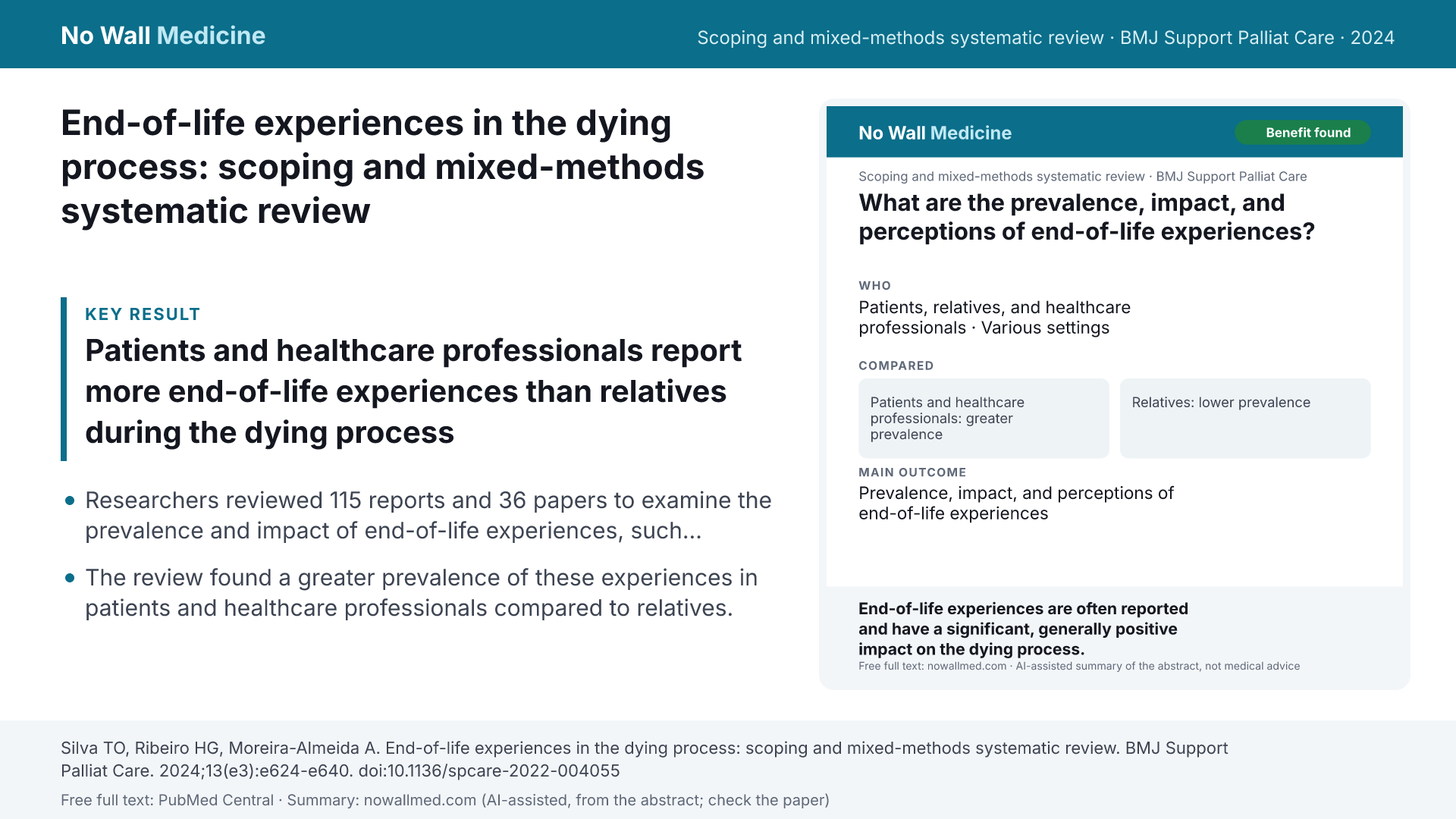
Key result: Patients and healthcare professionals report more end-of-life experiences than relatives during the dying process
Scoping and mixed-methods systematic reviewBenefit found
What are the prevalence, impact, and perceptions of end-of-life experiences?
Who
Patients, relatives, and healthcare professionals · Various settings
Compared
Patients and healthcare professionals: greater prevalence
Relatives: lower prevalence
Main outcome
Prevalence, impact, and perceptions of end-of-life experiences
Bottom line: End-of-life experiences are often reported and have a significant, generally positive impact on the dying process.
BMJ Support Palliat Care · 2024-01-08
Key points
- Researchers reviewed 115 reports and 36 papers to examine the prevalence and impact of end-of-life experiences, such as visions or dreams.
- The review found a greater prevalence of these experiences in patients and healthcare professionals compared to relatives.
- Most reported experiences involved visions of deceased friends or family and were interpreted as positive spiritual events.
Discussion prompts
- Would these patients look like yours? Who was left out?
- Is the main outcome one that matters to patients?
- Is the difference large enough to change what you do?
Cite: Silva TO, Ribeiro HG, Moreira-Almeida A. End-of-life experiences in the dying process: scoping and mixed-methods systematic review. BMJ Support Palliat Care. 2024;13(e3):e624-e640. doi:10.1136/spcare-2022-004055
Free full text: PubMed Central · Summary and visual abstract: nowallmed.com/a/end-of-life-experiences-in-the-dying-process-scoping-and-mixed-4qvfuy/ (AI-assisted from the abstract; check the paper before relying on it).