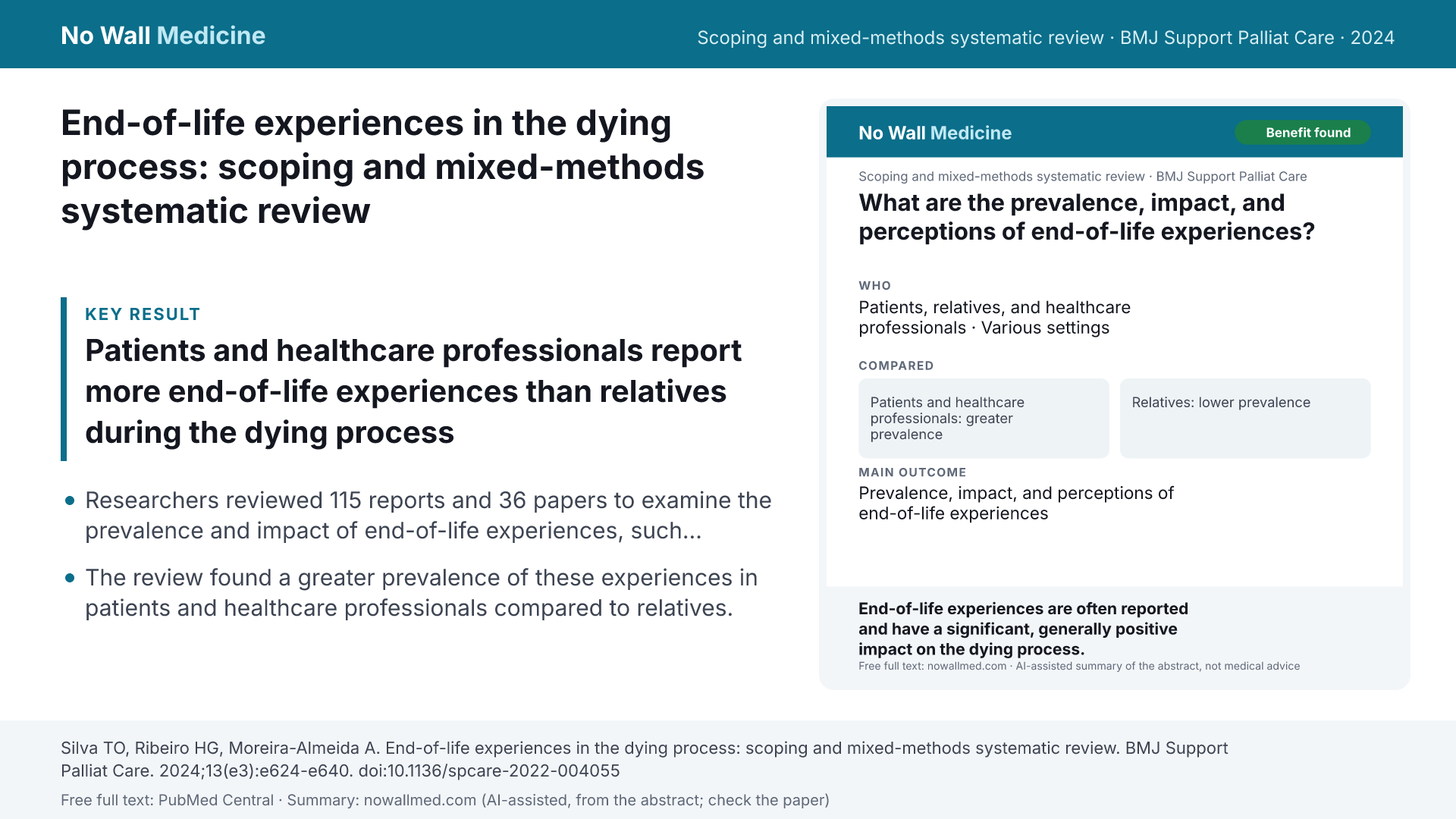
Patients and healthcare professionals report more end-of-life experiences than relatives during the dying process
End-of-life experiences in the dying process: scoping and mixed-methods systematic review
Scoping and mixed-methods systematic reviewBenefit found
What are the prevalence, impact, and perceptions of end-of-life experiences?
Who
Patients, relatives, and healthcare professionals · Various settings
Compared
Patients and healthcare professionals: greater prevalence
Relatives: lower prevalence
Main outcome
Prevalence, impact, and perceptions of end-of-life experiences
Bottom line: End-of-life experiences are often reported and have a significant, generally positive impact on the dying process.
BMJ Support Palliat Care · 2024-01-08Download image
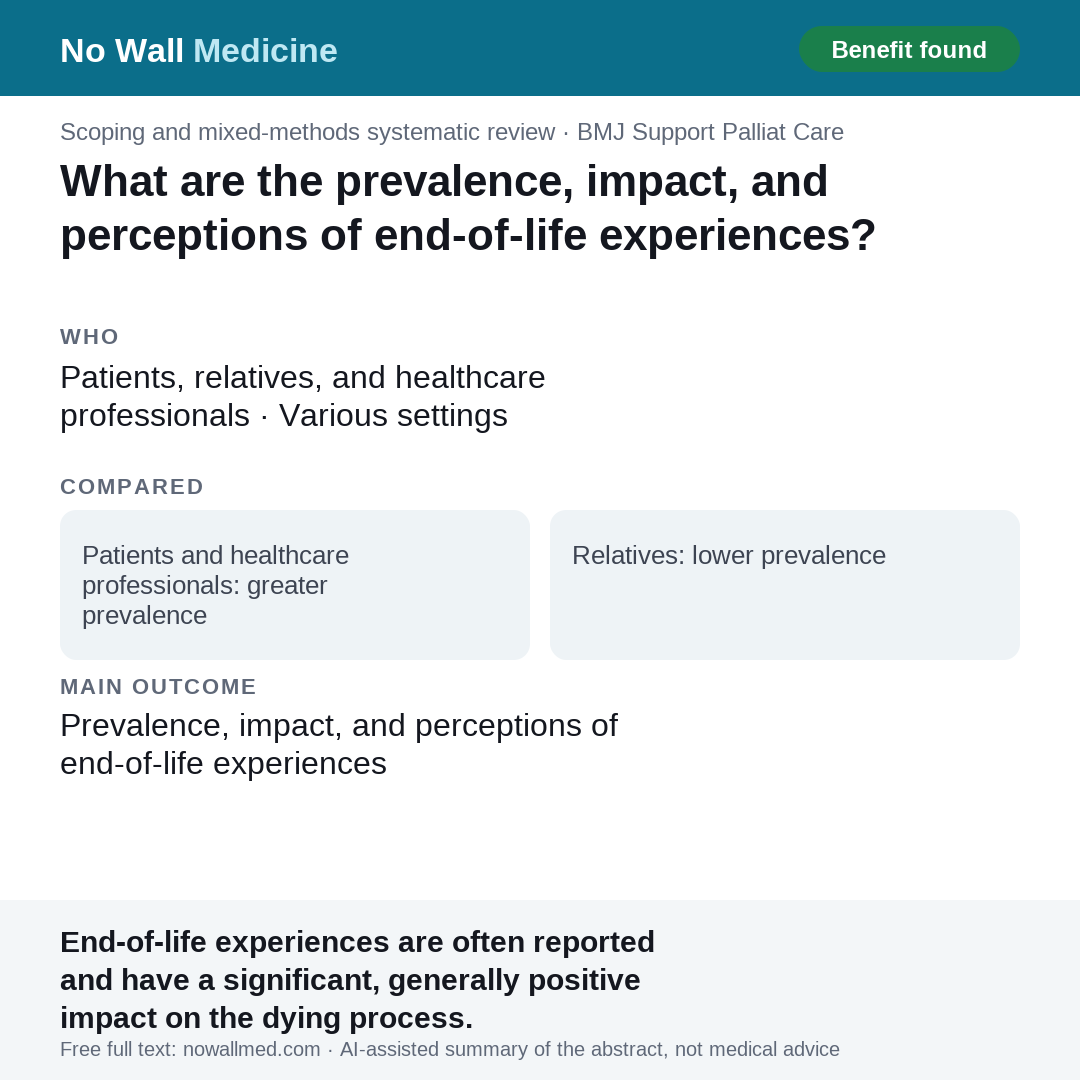
Clinical question: What are the prevalence, impact, and perceptions of end-of-life experiences?
Key points
- Researchers reviewed 115 reports and 36 papers to examine the prevalence and impact of end-of-life experiences, such as visions or dreams.
- The review found a greater prevalence of these experiences in patients and healthcare professionals compared to relatives.
- Most reported experiences involved visions of deceased friends or family and were interpreted as positive spiritual events.
Headline and key points written with AI from the paper’s abstract, with every number checked against it. Read the paper before relying on them.
Was this summary helpful?
Abstract
Objectives
To identify the current state of understanding about end-of-life experiences (ELEs) and examine evidence concerning prevalence, the impact on the process of dying and the perceptions/explanations of patients, relatives and healthcare professionals (HCPs) with regard to ELEs. Methods
Scoping review and mixed-methods systematic review (ScR and MMSR). Nine academic databases were searched for a screening of the available scientific literature (ScR). Articles reporting qualitative, quantitative or mixed-methods studies were selected (MMSR), the quality of which was assessed using the Joanna Briggs Institute (JBI) standardised critical appraisal tools. The quantitative data were synthesised in narrative form while a meta-aggregation approach was adopted for the qualitative results. Results
The ScR identified 115 reports, with 70.4% published after 2010, 55.6% from the USA and the most common terminology for ELE was deathbed visions (29%). The MMSR included 36 papers, describing 35 studies in various settings. The combination of quantitative and qualitative evidence indicated a greater prevalence of ELEs in samples of patients and HCPs compared with relatives. The most common ELEs were visions and dreams of the presence of deceased relatives/friends with references to making ready for a journey. The impact of ELEs was mainly positive, and there was a tendency to interpret them as spiritual experiences inherent to the process of dying. Conclusions
ELEs are often reported by patients, relatives and HCPs and have a significant, generally positive impact on the process of dying. Guidelines for the furtherance of studies and clinical applications are discussed.
Abstract reproduced under the article’s CC BY NC licence.
Subject terms
Headline, design, result, key points, caveat and citation as plain text.
Cite this article
Silva TO, Ribeiro HG, Moreira-Almeida A. End-of-life experiences in the dying process: scoping and mixed-methods systematic review. BMJ Support Palliat Care. 2024. doi:10.1136/spcare-2022-004055
Spotted a mistake? Suggest a correction