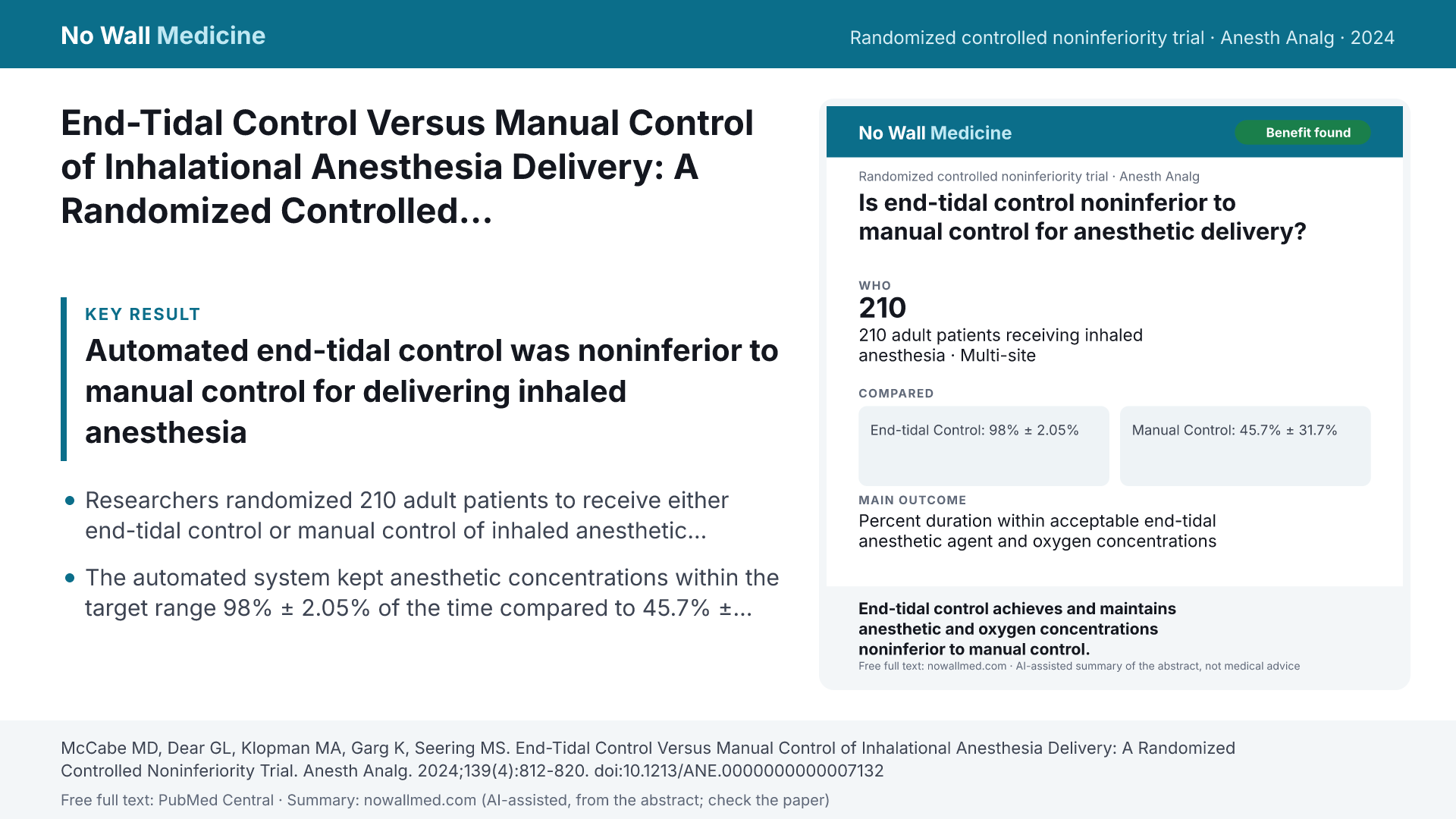
End-Tidal Control Versus Manual Control of Inhalational Anesthesia Delivery: A Randomized Controlled Noninferiority Trial
Key result: Automated end-tidal control was noninferior to manual control for delivering inhaled anesthesia
Randomized controlled noninferiority trialBenefit found
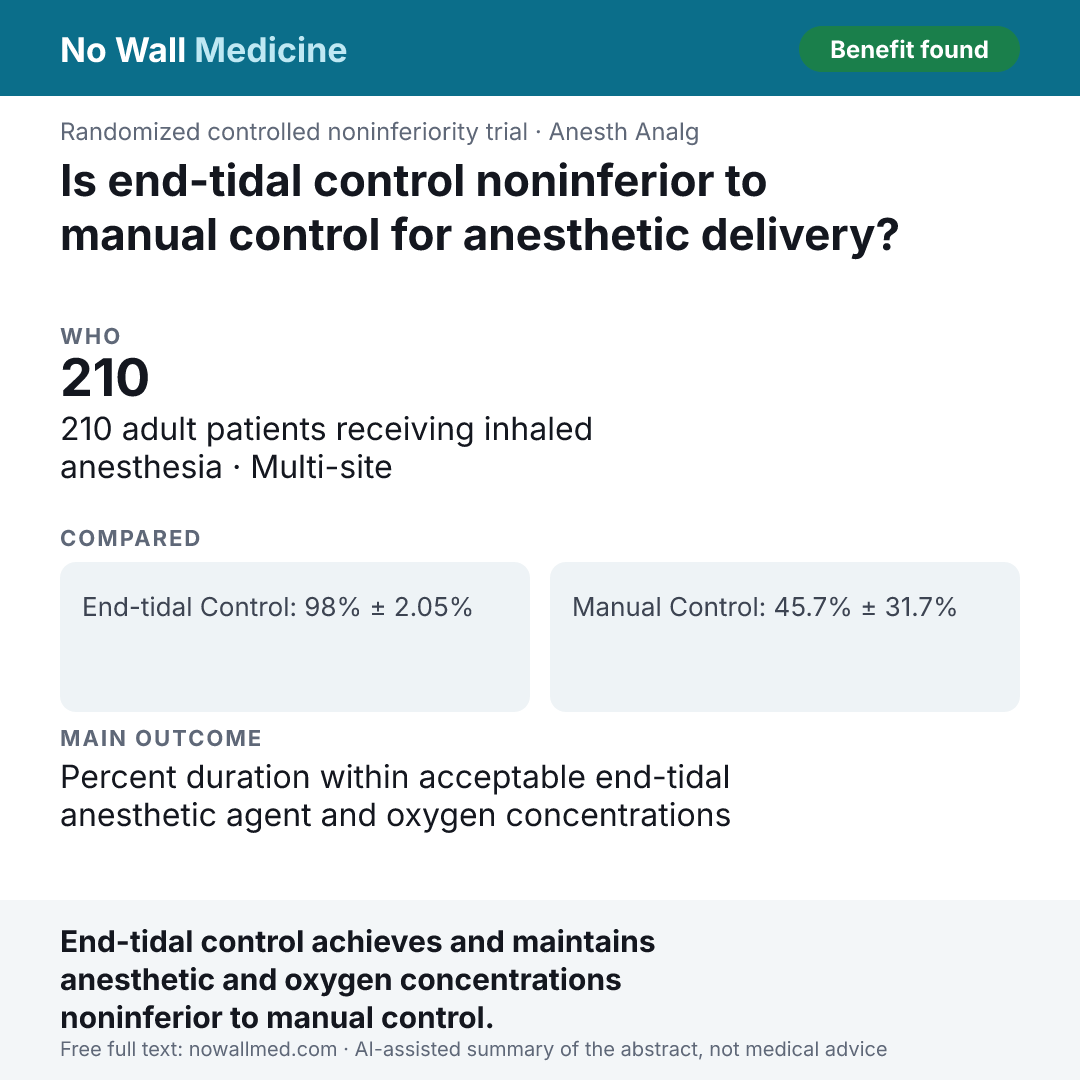
Is end-tidal control noninferior to manual control for anesthetic delivery?
Who
210
210 adult patients receiving inhaled anesthesia · Multi-site
Compared
End-tidal Control: 98% ± 2.05%
Manual Control: 45.7% ± 31.7%
Main outcome
Percent duration within acceptable end-tidal anesthetic agent and oxygen concentrations
Result: difference 52.3% (95% CI, 45.9%-58.6%)
Bottom line: End-tidal control achieves and maintains anesthetic and oxygen concentrations noninferior to manual control.
Anesth Analg · 2024-07-19 · Save PNG
Key points
- Researchers randomized 210 adult patients to receive either end-tidal control or manual control of inhaled anesthetic agent and oxygen concentrations.
- The automated system kept anesthetic concentrations within the target range 98% ± 2.05% of the time compared to 45.7% ± 31.7% for manual control.
- The median time to reach 90% of the desired anesthetic concentration was 75 seconds with automated control and 158 seconds with manual control.
Discussion prompts
- Would these patients look like yours? Who was left out?
- Is the main outcome one that matters to patients?
- Is the difference large enough to change what you do?
Cite: McCabe MD, Dear GL, Klopman MA, Garg K, Seering MS. End-Tidal Control Versus Manual Control of Inhalational Anesthesia Delivery: A Randomized Controlled Noninferiority Trial. Anesth Analg. 2024;139(4):812-820. doi:10.1213/ANE.0000000000007132
Free full text: PubMed Central · Summary and visual abstract: nowallmed.com/a/end-tidal-control-versus-manual-control-of-inhalational-anesthesia-pstxrj/ (AI-assisted from the abstract; check the paper before relying on it).