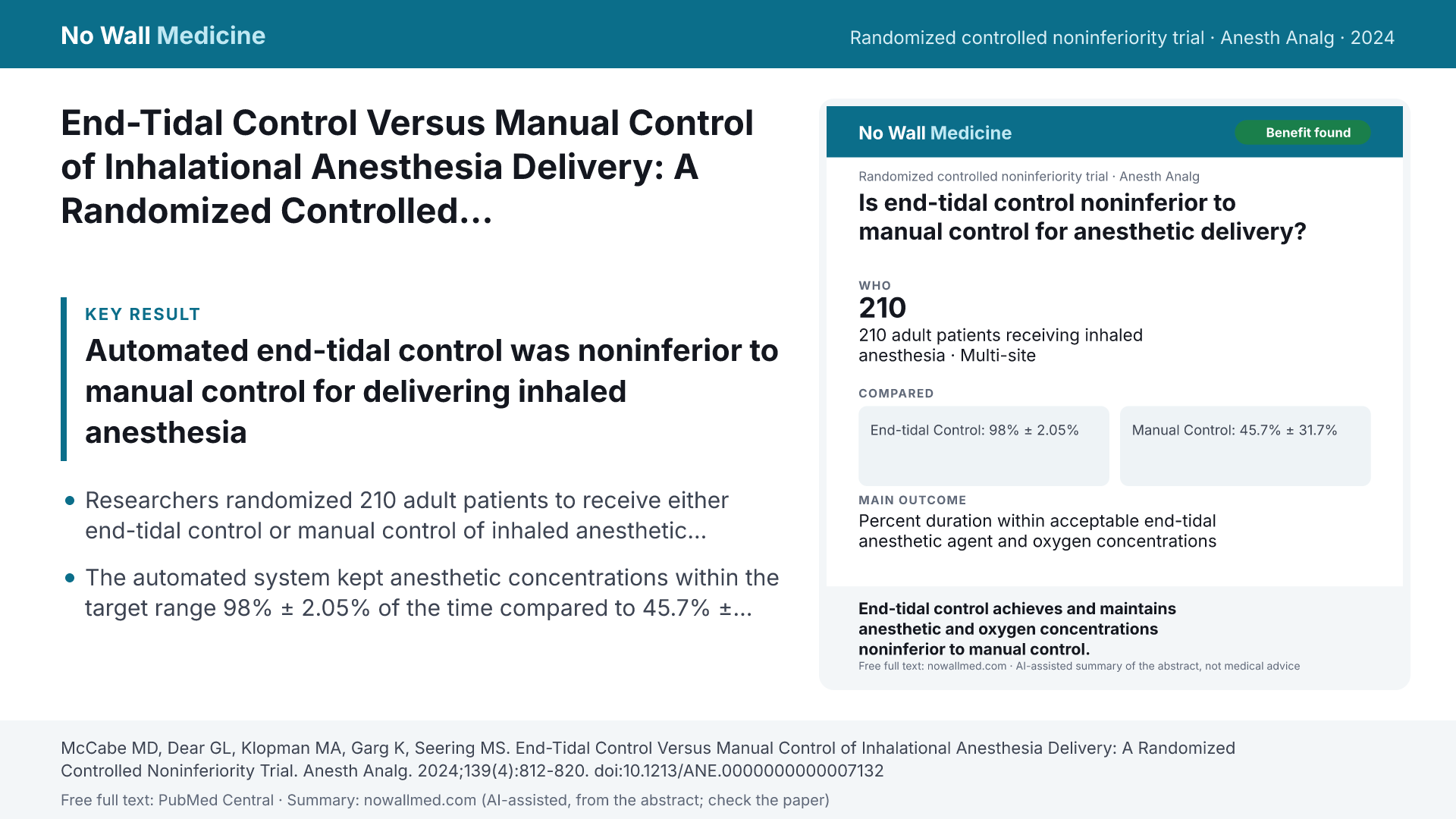
Automated end-tidal control was noninferior to manual control for delivering inhaled anesthesia
End-Tidal Control Versus Manual Control of Inhalational Anesthesia Delivery: A Randomized Controlled Noninferiority Trial
Randomized controlled noninferiority trialBenefit found
Is end-tidal control noninferior to manual control for anesthetic delivery?
Who
210
210 adult patients receiving inhaled anesthesia · Multi-site
Compared
End-tidal Control: 98% ± 2.05%
Manual Control: 45.7% ± 31.7%
Main outcome
Percent duration within acceptable end-tidal anesthetic agent and oxygen concentrations
Result: difference 52.3% (95% CI, 45.9%-58.6%)
Bottom line: End-tidal control achieves and maintains anesthetic and oxygen concentrations noninferior to manual control.
Anesth Analg · 2024-07-19Download image
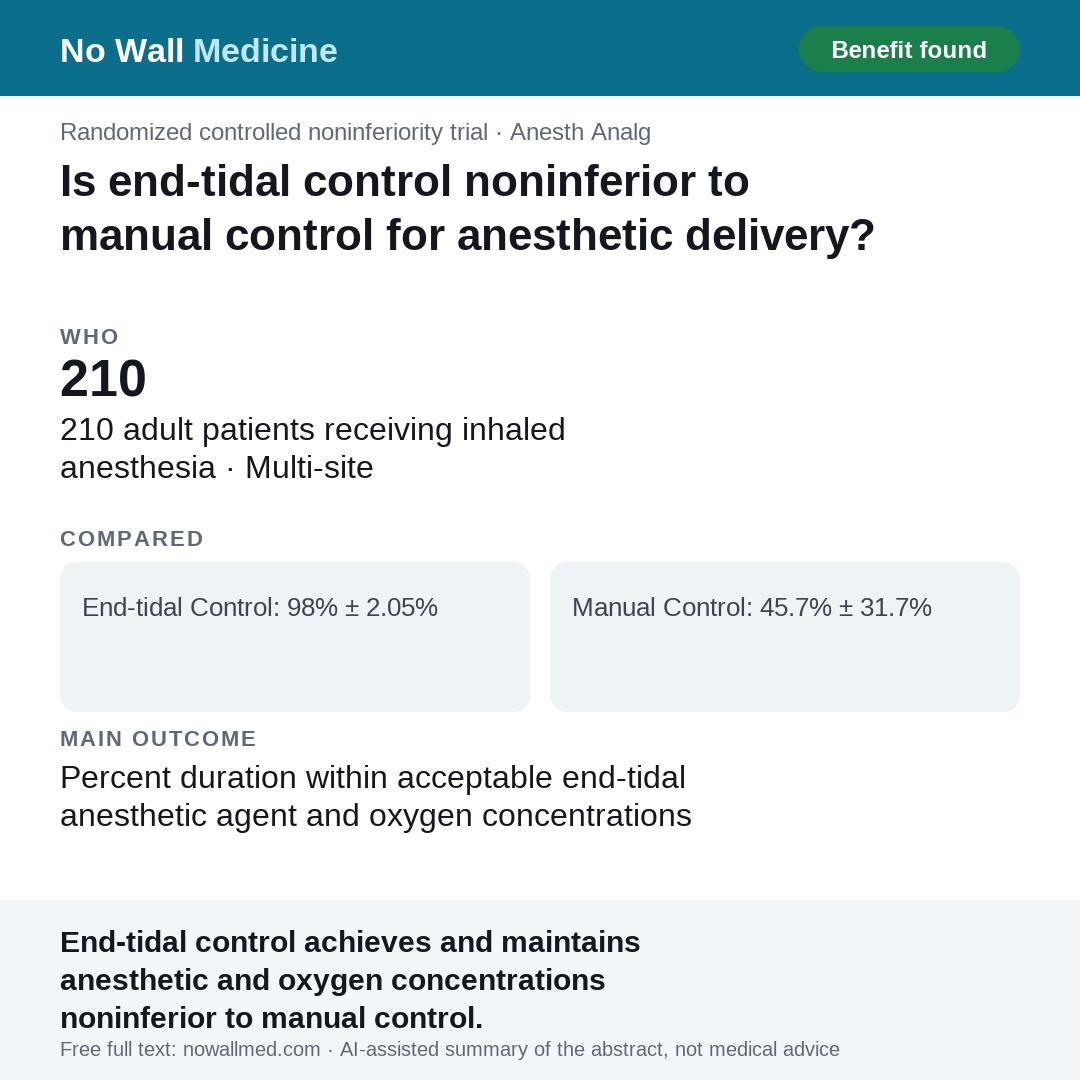
Clinical question: Is end-tidal control noninferior to manual control for anesthetic delivery?
Why it matters: It was unknown if automated closed-loop systems could achieve and maintain clinician-selected anesthetic and oxygen concentrations as effectively as manual adjustments.
Key points
- Researchers randomized 210 adult patients to receive either end-tidal control or manual control of inhaled anesthetic agent and oxygen concentrations.
- The automated system kept anesthetic concentrations within the target range 98% ± 2.05% of the time compared to 45.7% ± 31.7% for manual control.
- The median time to reach 90% of the desired anesthetic concentration was 75 seconds with automated control and 158 seconds with manual control.
Headline and key points written with AI from the paper’s abstract, with every number checked against it. Read the paper before relying on them.
Was this summary helpful?
Subject terms
Cite this article
McCabe MD, Dear GL, Klopman MA, Garg K, Seering MS. End-Tidal Control Versus Manual Control of Inhalational Anesthesia Delivery: A Randomized Controlled Noninferiority Trial. Anesth Analg. 2024. doi:10.1213/ANE.0000000000007132
Spotted a mistake? Suggest a correction