Etrasimod was associated with higher rates of histologic and composite remission in ulcerative colitis
Endoscopic, Histologic, and Composite Endpoints in Patients With Ulcerative Colitis Treated With Etrasimod
Post-hoc analysis of randomized trialBenefit found
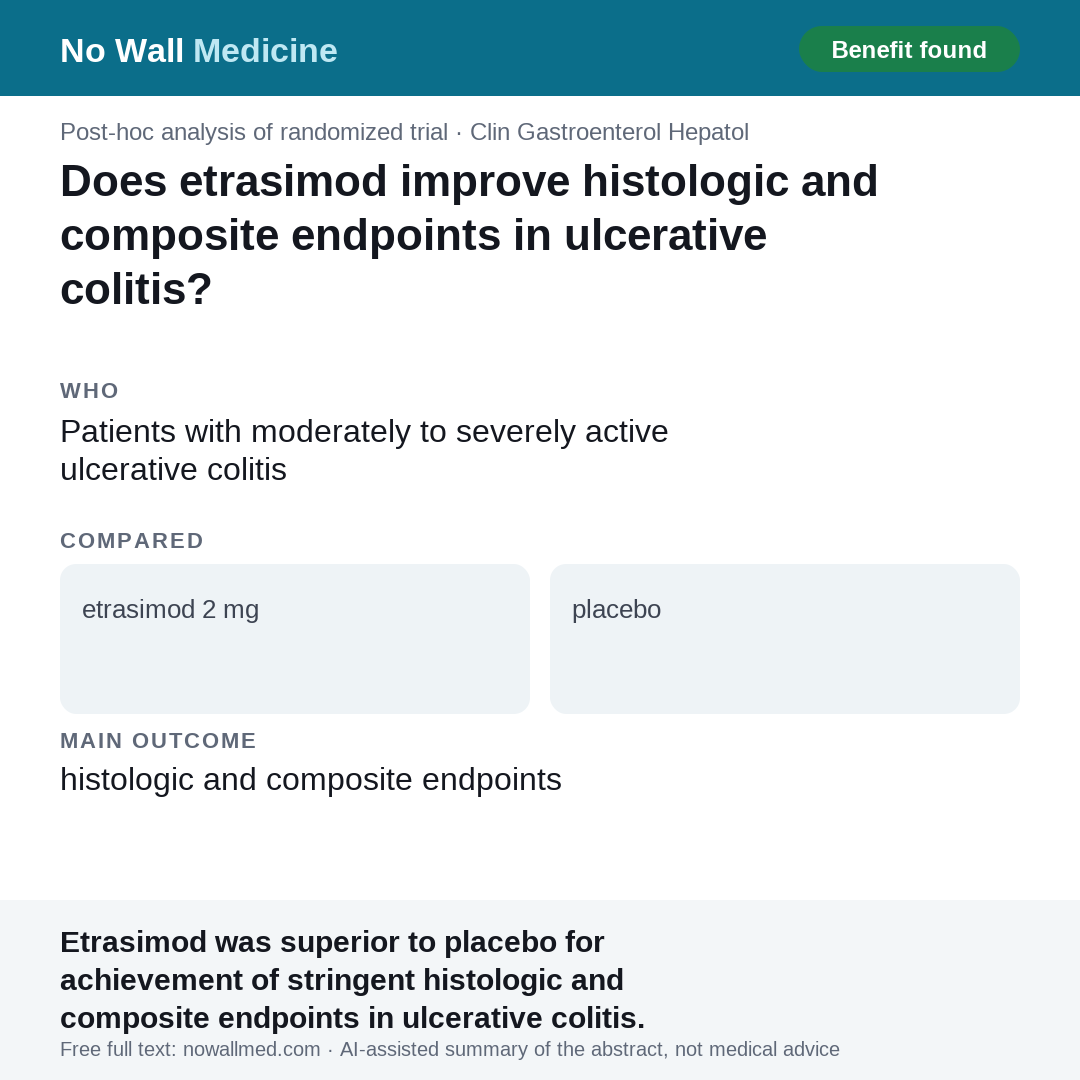
Does etrasimod improve histologic and composite endpoints in ulcerative colitis?
Who
Patients with moderately to severely active ulcerative colitis
Compared
etrasimod 2 mg
placebo
Main outcome
histologic and composite endpoints
Bottom line: Etrasimod was superior to placebo for achievement of stringent histologic and composite endpoints in ulcerative colitis.
Clin Gastroenterol Hepatol · 2024-07-31Download image
Clinical question: Does etrasimod improve histologic and composite endpoints in ulcerative colitis?
Why it matters: It was unknown how histologic remission and composite endpoints, such as disease clearance, function as prognostic markers for long-term outcomes in ulcerative colitis.
Key points
- Patients with moderately to severely active ulcerative colitis were randomized to receive either 2 mg of etrasimod once daily or a placebo.
- At weeks 12 and 52, etrasimod was associated with higher rates of endoscopic improvement combined with histologic remission and disease clearance compared to placebo.
- Among those treated with etrasimod, 73.9% [17/23] achieved clinical remission at week 52 if they had disease clearance at week 12, compared to 28.3% [71/251] without it.
Headline and key points written with AI from the paper’s abstract, with every number checked against it. Read the paper before relying on them.
Topics
Cite this article
Magro F, Peyrin-Biroulet L, Sands BE, Danese S, Jairath V, Goetsch M. Endoscopic, Histologic, and Composite Endpoints in Patients With Ulcerative Colitis Treated With Etrasimod. Clin Gastroenterol Hepatol. 2024. doi:10.1016/j.cgh.2024.07.010
Spotted a mistake? Suggest a correction
Top studies every Monday
The week’s key trials and guidelines in your specialties, by email. Free.
Get the weekly digest