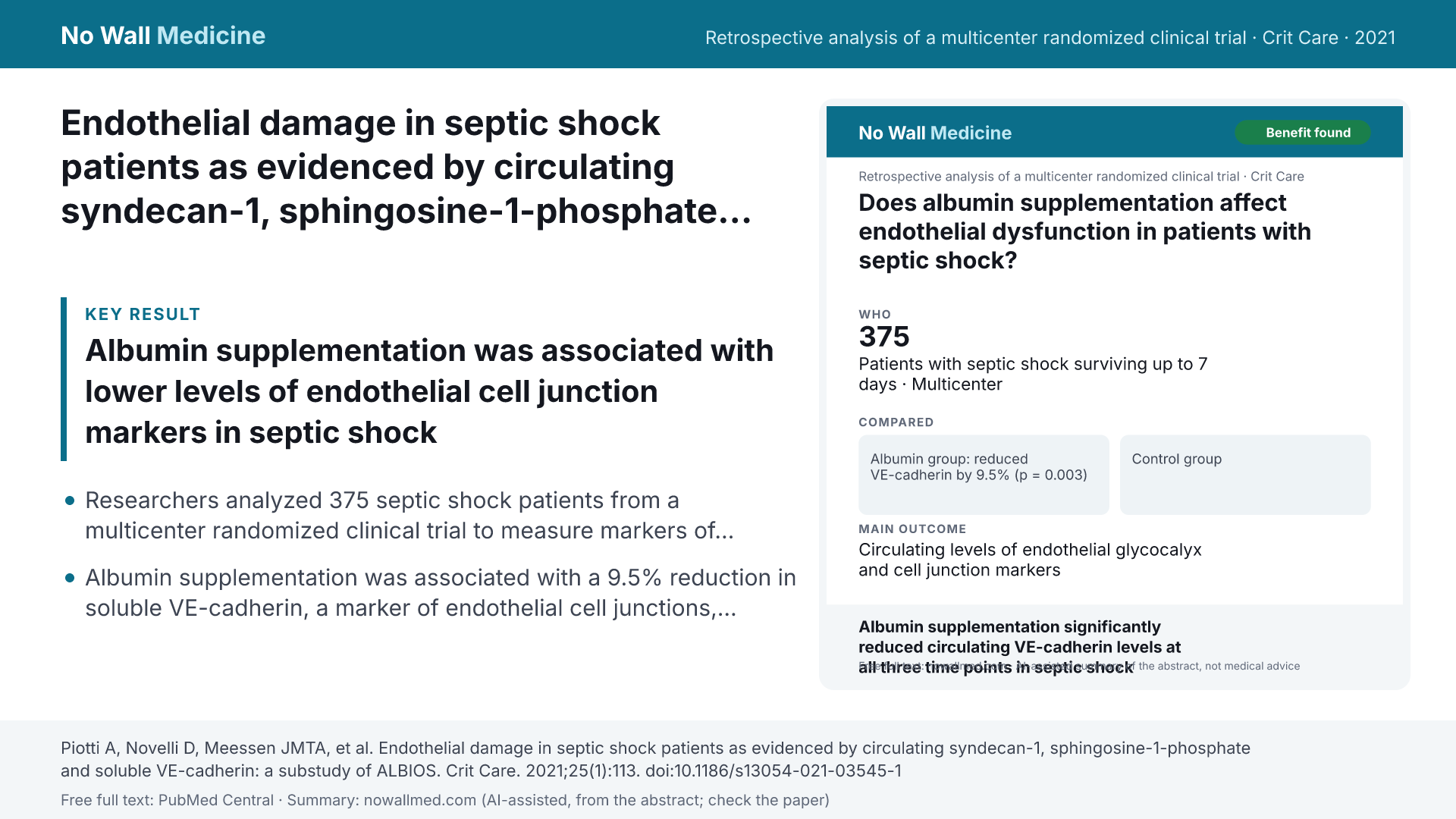
Albumin supplementation was associated with lower levels of endothelial cell junction markers in septic shock
Endothelial damage in septic shock patients as evidenced by circulating syndecan-1, sphingosine-1-phosphate and soluble VE-cadherin: a substudy of ALBIOS
Retrospective analysis of a multicenter randomized clinical trialBenefit found
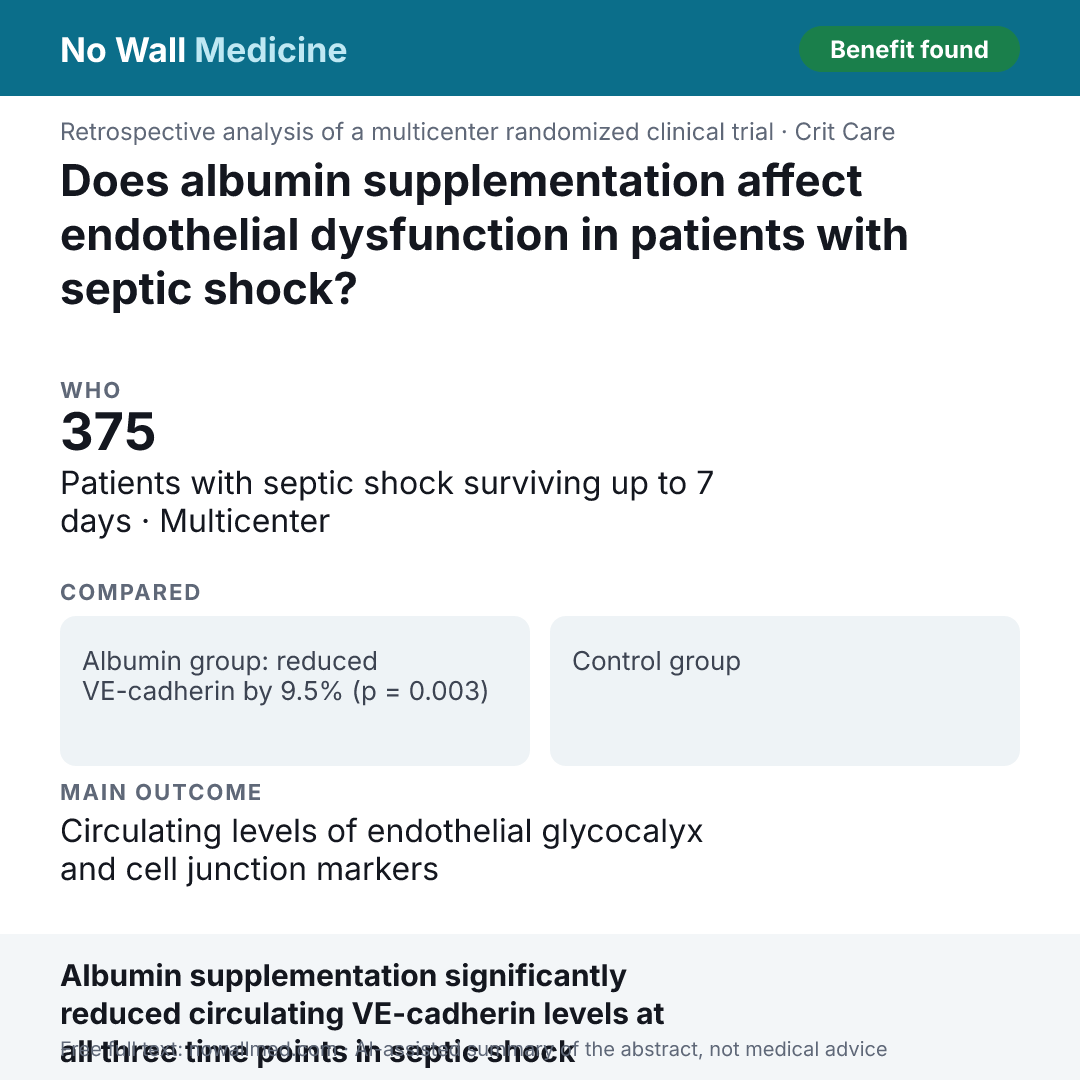
Does albumin supplementation affect endothelial dysfunction in patients with septic shock?
Who
375
Patients with septic shock surviving up to 7 days · Multicenter
Compared
Albumin group: reduced VE-cadherin by 9.5% (p = 0.003)
Control group
Main outcome
Circulating levels of endothelial glycocalyx and cell junction markers
Bottom line: Albumin supplementation significantly reduced circulating VE-cadherin levels at all three time points in septic shock patients.
Crit Care · 2021-03-19 · Save PNG
Clinical question: Does albumin supplementation affect endothelial dysfunction in patients with septic shock?
Key points
- Researchers analyzed 375 septic shock patients from a multicenter randomized clinical trial to measure markers of the endothelial glycocalyx and cell junctions.
- Albumin supplementation was associated with a 9.5% reduction in soluble VE-cadherin, a marker of endothelial cell junctions, at all three measured time points.
- Higher levels of syndecan-1 and soluble VE-cadherin were associated with organ failure, while syndecan-1 was associated with 90-day mortality.
Headline and key points written with AI from the paper’s abstract, with every number checked against it. Read the paper before relying on them.
Was this summary helpful?
Abstract
Background
Septic shock is characterized by breakdown of the endothelial glycocalyx and endothelial damage, contributing to fluid extravasation, organ failure and death. Albumin has shown benefit in septic shock patients. Our aims were: (1) to identify the relations between circulating levels of syndecan-1 (SYN-1), sphingosine-1-phosphate (S1P) (endothelial glycocalyx), and VE-cadherin (endothelial cell junctions), severity of the disease, and survival; (2) to evaluate the effects of albumin supplementation on endothelial dysfunction in patients with septic shock. Methods
This was a retrospective analysis of a multicenter randomized clinical trial on albumin replacement in severe sepsis or septic shock (the Albumin Italian Outcome Sepsis Trial, ALBIOS). Concentrations of SYN-1, S1P, soluble VE-cadherin and other biomarkers were measured on days 1, 2 and 7 in 375 patients with septic shock surviving up to 7 days after randomization. Results
Plasma concentrations of SYN-1 and VE-cadherin rose significantly over 7 days. SYN-1 and VE-cadherin were elevated in patients with organ failure, and S1P levels were lower. SYN-1 and VE-cadherin were independently associated with renal replacement therapy requirement during ICU stay, but only SYN-1 predicted its new occurrence. Both SYN-1 and S1P, but not VE-cadherin, predicted incident coagulation failure. Only SYN-1 independently predicted 90-day mortality. Albumin significantly reduced VE-cadherin, by 9.5% (p = 0.003) at all three time points. Conclusion
Circulating components of the endothelial glycocalyx and of the endothelial cell junctions provide insights into severity and progression of septic shock, with special focus on incident coagulation and renal failure. Albumin supplementation lowered circulating VE-cadherin consistently over time. Clinical trial registration
ALBIOS ClinicalTrials.gov number NCT00707122.
Abstract reproduced under the article’s CC BY licence.
Subject terms
Headline, design, result, key points, caveat and citation as plain text.
Cite this article
Piotti A, Novelli D, Meessen JMTA, et al. Endothelial damage in septic shock patients as evidenced by circulating syndecan-1, sphingosine-1-phosphate and soluble VE-cadherin: a substudy of ALBIOS. Crit Care. 2021. doi:10.1186/s13054-021-03545-1
Spotted a mistake? Suggest a correction