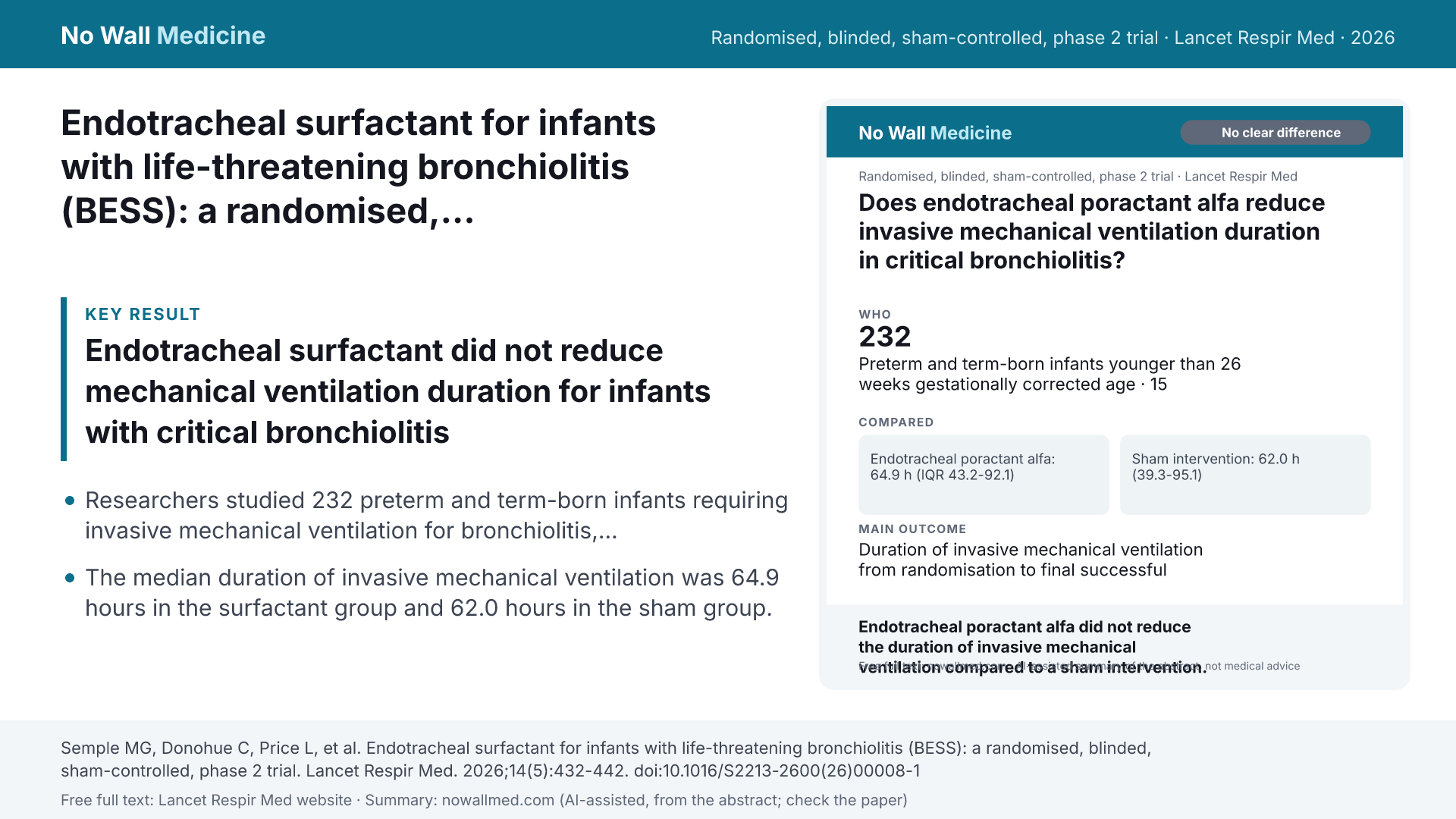
Endotracheal surfactant did not reduce mechanical ventilation duration for infants with critical bronchiolitis
Endotracheal surfactant for infants with life-threatening bronchiolitis (BESS): a randomised, blinded, sham-controlled, phase 2 trial
Randomised, blinded, sham-controlled, phase 2 trialNo clear difference
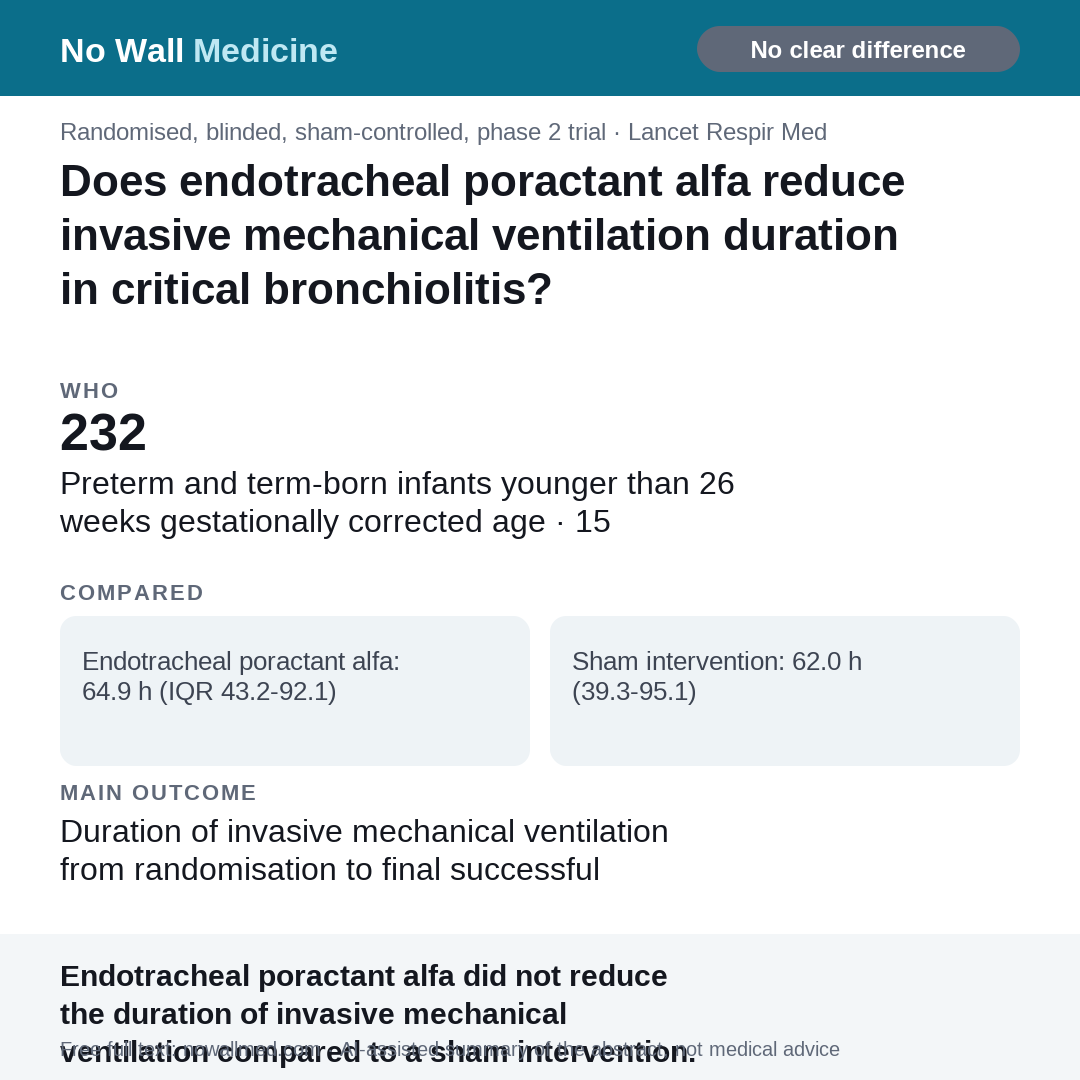
Does endotracheal poractant alfa reduce invasive mechanical ventilation duration in critical bronchiolitis?
Who
232
Preterm and term-born infants younger than 26 weeks gestationally corrected age · 15 paediatric intensive care units in the United Kingdom
Compared
Endotracheal poractant alfa: 64.9 h (IQR 43.2-92.1)
Sham intervention: 62.0 h (39.3-95.1)
Main outcome
Duration of invasive mechanical ventilation from randomisation to final successful extubation
Result: geometric mean ratio 1.02 (95% CI 0.84-1.24)
Bottom line: Endotracheal poractant alfa did not reduce the duration of invasive mechanical ventilation compared to a sham intervention.
Funded by: UK NIHR, UKRI Medical Research Council, Scotland, Northern Ireland, and Chiesi
Lancet Respir Med · 2026-03-21Download image
Clinical question: Does endotracheal poractant alfa reduce invasive mechanical ventilation duration in critical bronchiolitis?
Why it matters: Small studies previously suggested that giving surfactant through a breathing tube might improve gas exchange in infants with severe bronchiolitis.
Key points
- Researchers studied 232 preterm and term-born infants requiring invasive mechanical ventilation for bronchiolitis, comparing poractant alfa to a sham procedure.
- The median duration of invasive mechanical ventilation was 64.9 hours in the surfactant group and 62.0 hours in the sham group.
- No deaths occurred and no clinically significant safety issues were associated with the administration of poractant alfa.
Headline and key points written with AI from the paper’s abstract, with every number checked against it. Read the paper before relying on them.
Was this summary helpful?
Abstract
Background
Bronchiolitis is a common viral respiratory disease of infants, with severity ranging from mild symptoms, such as coryza and feeding difficulties, to fulminant respiratory failure. Endotracheal administration of exogenous surfactant has been shown in small studies to improve gas exchange in critically ill infants with bronchiolitis. We aimed to investigate the safety and efficacy of endotracheal poractant alfa for treating critical bronchiolitis compared with a sham procedure. Methods
BESS was a multicentre, blinded, randomised, sham-controlled, parallel-group, phase 2, superiority trial with exploratory mechanism evaluation studies. The trial was done in 15 paediatric intensive care units in the devolved National Health Service (NHS) of England, Scotland, and Northern Ireland. Preterm and term-born infants younger than 26 weeks of gestationally corrected age admitted to hospitals with bronchiolitis requiring invasive mechanical ventilation (IMV) were randomly assigned (1:1) to receive up to three doses of endotracheal poractant alfa (Curosurf) or sham intervention, allocated through web-based randomisation. Randomisation was stratified by duration of IMV before randomisation (<24 h and ≥24 h) and by site. The infants and their families, clinical care staff, Liverpool Clinical Trial Centre staff, and members of the site research teams were masked to treatment allocations. Endotracheal poractant alfa was given initially at 200 mg/kg, followed by 100 mg/kg at 12 h intervals. The primary endpoint was the duration of IMV from randomisation to final successful extubation. All infants who were successfully extubated were included in the intention-to-treat analysis. Safety outcomes were analysed in infants who had received at least one trial intervention. This trial was registered prospectively with ISRCTN (ISRCTN11746266) and EudraCT (2018-001169-18), and is completed. Findings
The trial was completed after six recruitment seasons. Between Dec 18, 2018, to March 31, 2024, 1009 infants were assessed for eligibility, 232 of whom were randomly assigned to receive either endotracheal poractant alfa (n=115) or a sham intervention (n=117). 130 (56%) of 232 infants were male and 102 (44%) were female. Three infants were withdrawn from the study. None were lost to follow-up. The median duration of IMV was 64·9 h (IQR 43·2-92·1) in the endotracheal poractant alfa group and 62·0 h (39·3-95·1) in the sham intervention group. The geometric mean ratio was 1·02 (95% CI 0·84-1·24; t-test p=0·86). No clinically significant safety issues were associated with endotracheal poractant alfa and there were no deaths. Interpretation
Poractant alfa, administered endotracheally to infants with early critical bronchiolitis, although safe, did not reduce the duration of IMV compared with the sham intervention. Therefore, our findings suggest that it should not be used for this indication at this dose and administration method. Funding
UK National Institute for Health and Care Research, UK Research and Innovation Medical Research Council, Chief Scientist Office Scotland, Health and Social Care Research and Development Division Northern Ireland, and Chiesi Farmaceutici, Italy.
Abstract reproduced under the article’s CC BY licence.
Subject terms
Cite this article
Semple MG, Donohue C, Price L, et al. Endotracheal surfactant for infants with life-threatening bronchiolitis (BESS): a randomised, blinded, sham-controlled, phase 2 trial. Lancet Respir Med. 2026. doi:10.1016/S2213-2600(26)00008-1
Spotted a mistake? Suggest a correction