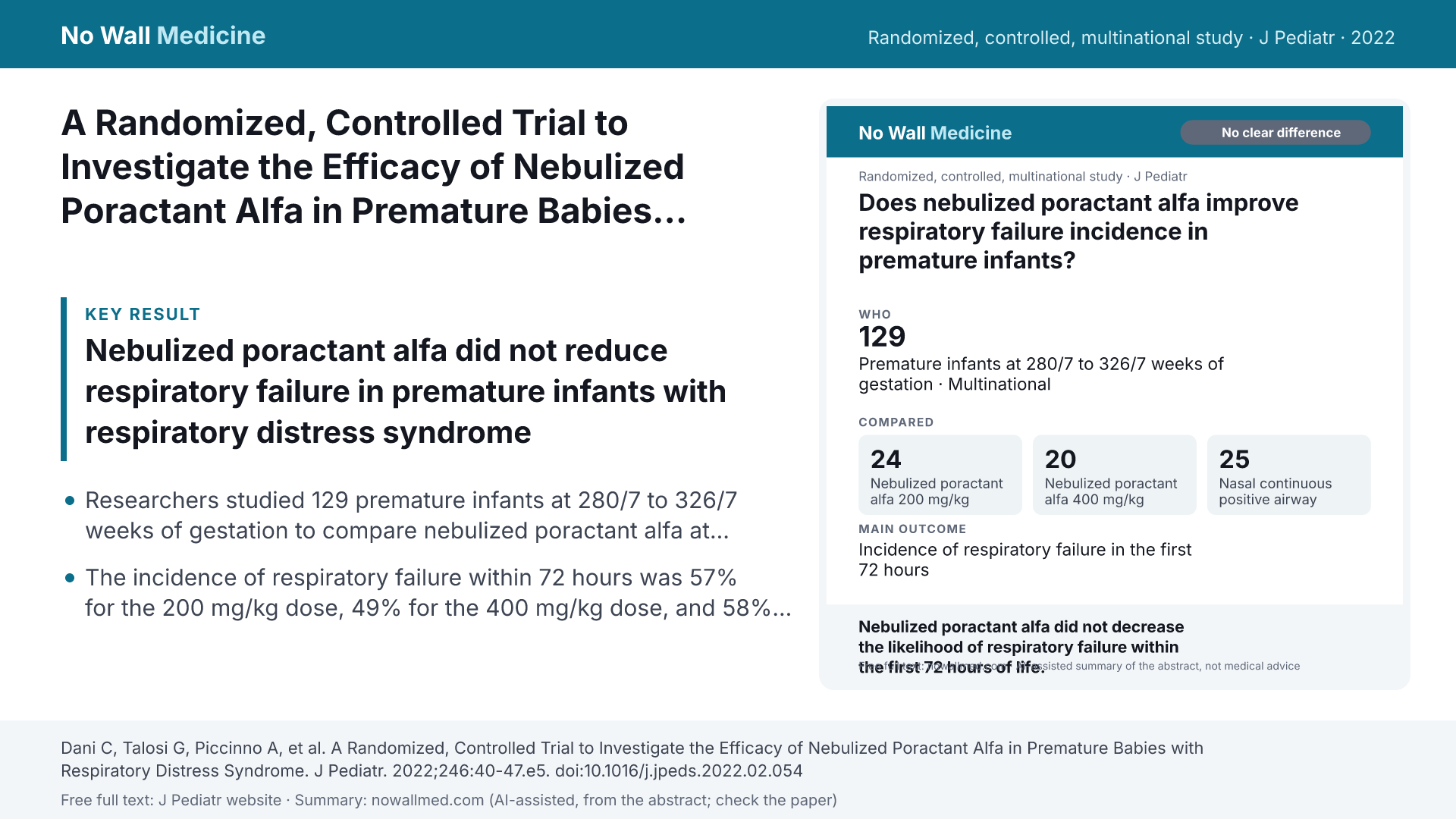
Nebulized poractant alfa did not reduce respiratory failure in premature infants with respiratory distress syndrome
A Randomized, Controlled Trial to Investigate the Efficacy of Nebulized Poractant Alfa in Premature Babies with Respiratory Distress Syndrome
Randomized, controlled, multinational studyNo clear difference
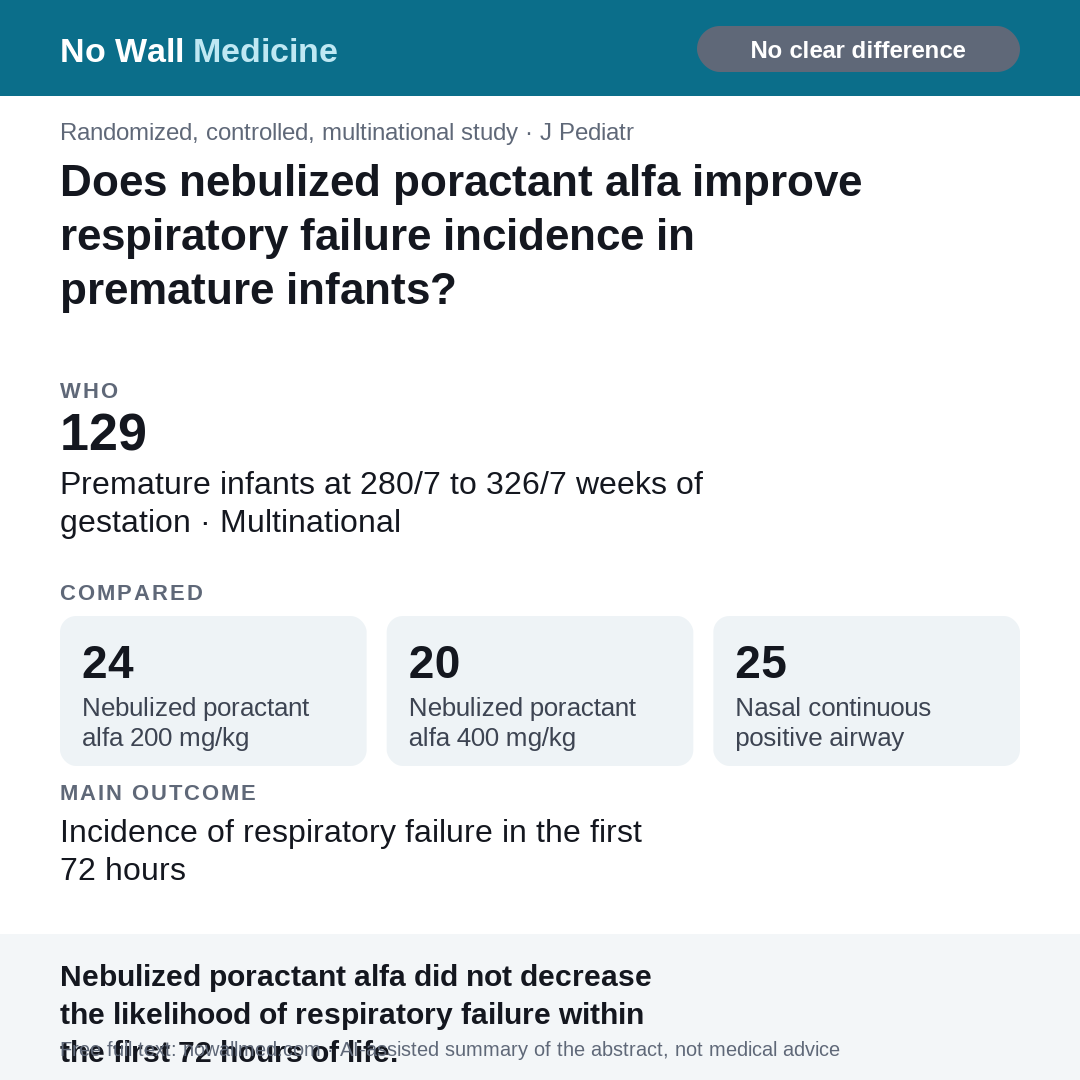
Does nebulized poractant alfa improve respiratory failure incidence in premature infants?
Who
129
Premature infants at 280/7 to 326/7 weeks of gestation · Multinational
Compared
24Nebulized poractant alfa 200 mg/kg (57%)
20Nebulized poractant alfa 400 mg/kg (49%)
25Nasal continuous positive airway pressure alone (58%)
Main outcome
Incidence of respiratory failure in the first 72 hours
Bottom line: Nebulized poractant alfa did not decrease the likelihood of respiratory failure within the first 72 hours of life.
J Pediatr · 2022-03-05Download image
Clinical question: Does nebulized poractant alfa improve respiratory failure incidence in premature infants?
Why it matters: It was unknown if delivering poractant alfa, a surfactant used to help lungs stay open, via a nebulizer alongside nasal continuous positive airway pressure would improve outcomes for premature infants.
Key points
- Researchers studied 129 premature infants at 280/7 to 326/7 weeks of gestation to compare nebulized poractant alfa at 200 mg/kg and 400 mg/kg doses against nasal continuous positive airway pressure alone.
- The incidence of respiratory failure within 72 hours was 57% for the 200 mg/kg dose, 49% for the 400 mg/kg dose, and 58% for the nasal continuous positive airway pressure group.
- The treatment was well-tolerated and no serious adverse events were related to the study treatment.
Headline and key points written with AI from the paper’s abstract, with every number checked against it. Read the paper before relying on them.
Was this summary helpful?
Subject terms
Cite this article
Dani C, Talosi G, Piccinno A, et al. A Randomized, Controlled Trial to Investigate the Efficacy of Nebulized Poractant Alfa in Premature Babies with Respiratory Distress Syndrome. J Pediatr. 2022. doi:10.1016/j.jpeds.2022.02.054
Spotted a mistake? Suggest a correction