Nasal intermittent positive pressure ventilation reduced intubation rates compared to continuous pressure in preterm infants
Nasal Continuous Positive Airway Pressure vs Nasal Intermittent Positive Pressure Ventilation in Preterm Infants With Respiratory Distress Syndrome: A Randomized Clinical Trial
Multicenter, noninferiority randomized clinical trialHarm found
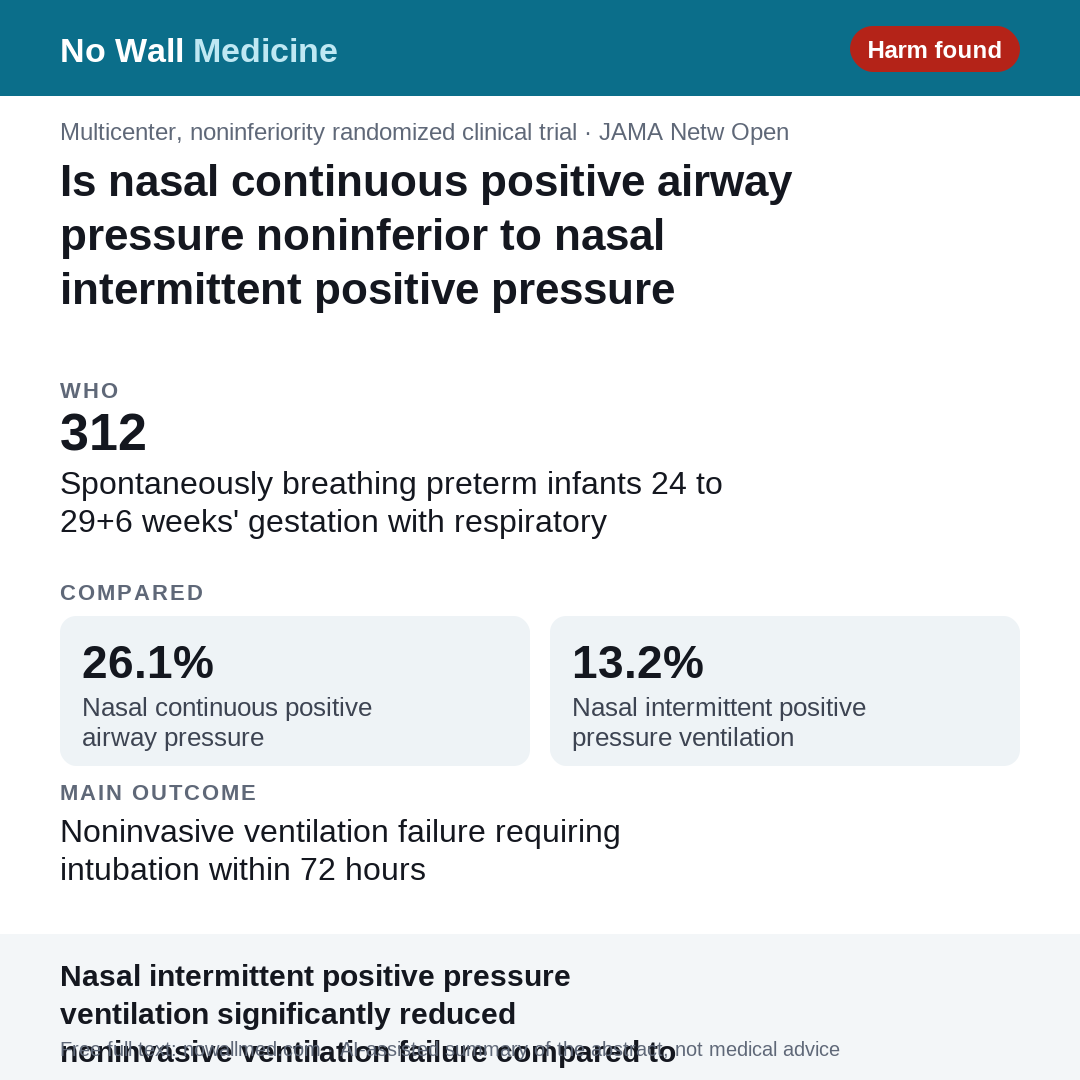
Is nasal continuous positive airway pressure noninferior to nasal intermittent positive pressure ventilation for reducing intubation?
Who
312
Spontaneously breathing preterm infants 24 to 29+6 weeks' gestation with respiratory distress syndrome · 11 tertiary neonatal intensive care units in China
Compared
26.1%Nasal continuous positive airway pressure
13.2%Nasal intermittent positive pressure ventilation
Main outcome
Noninvasive ventilation failure requiring intubation within 72 hours
Result: adjusted risk difference, 12.8%; 95% CI, 4.2%-21.6%
Bottom line: Nasal intermittent positive pressure ventilation significantly reduced noninvasive ventilation failure compared to nasal continuous positive airway pressure in preterm infants.
JAMA Netw Open · 2026-06-01Download image
Clinical question: Is nasal continuous positive airway pressure noninferior to nasal intermittent positive pressure ventilation for reducing intubation?
Why it matters: Evidence is inconsistent regarding the best initial noninvasive ventilation mode for extremely preterm infants with respiratory distress syndrome.
Key points
- Researchers studied 312 preterm infants born between 24 and 29+6 weeks' gestation who required noninvasive respiratory support for respiratory distress syndrome.
- Nasal intermittent positive pressure ventilation resulted in 13.2% failure within 72 hours compared to 26.1% for nasal continuous positive airway pressure.
- The risk difference of 12.8% exceeded the 10% noninferiority margin, demonstrating that continuous pressure was inferior to intermittent pressure.
Headline and key points written with AI from the paper’s abstract, with every number checked against it. Read the paper before relying on them.
Topics
Cite this article
Zhang H, Zhang Y, Zeng L, Tong X, Piao M, He H. Nasal Continuous Positive Airway Pressure vs Nasal Intermittent Positive Pressure Ventilation in Preterm Infants With Respiratory Distress Syndrome: A Randomized Clinical Trial. JAMA Netw Open. 2026. doi:10.1001/jamanetworkopen.2026.19785
Spotted a mistake? Suggest a correction