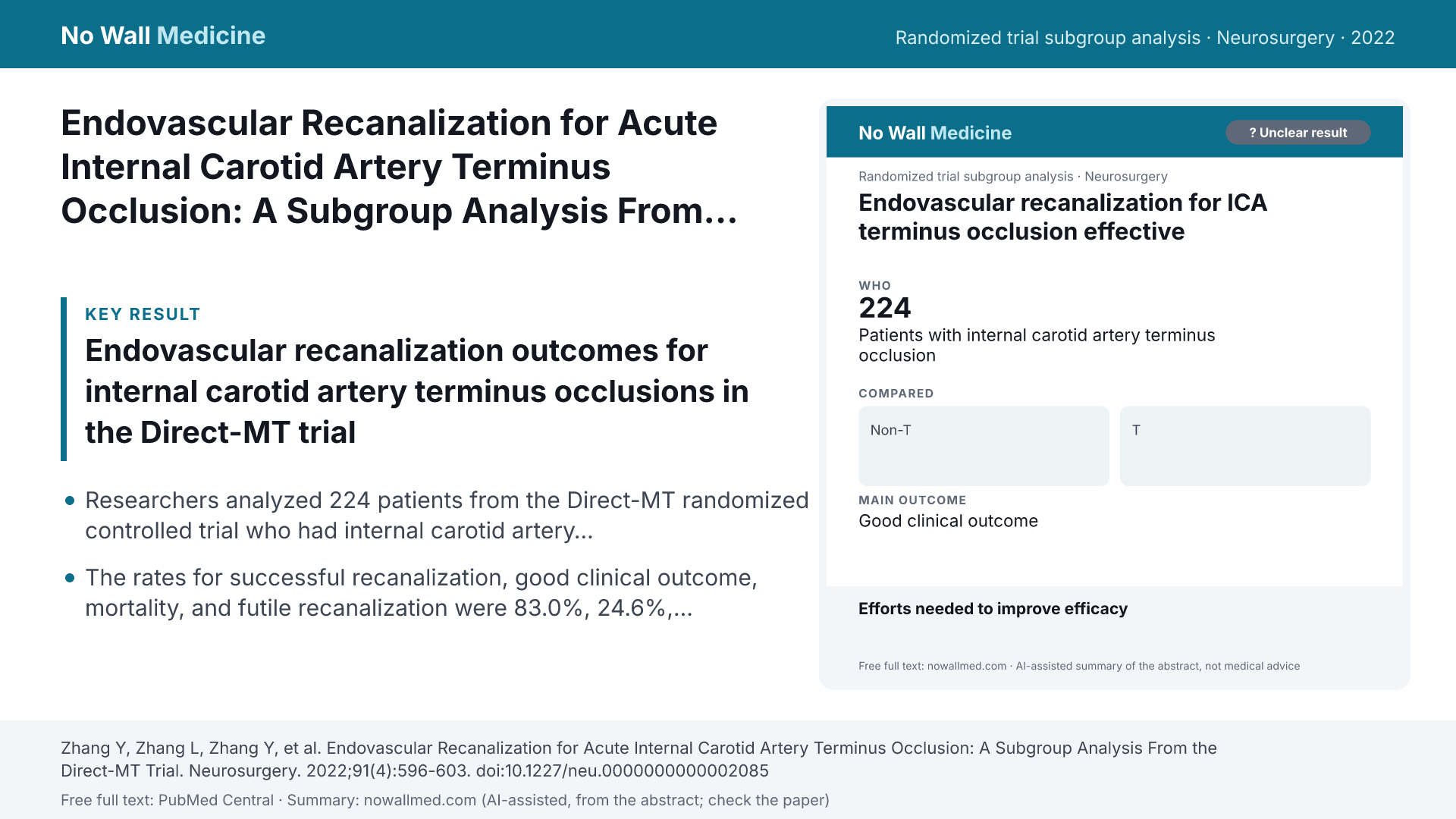
Endovascular recanalization outcomes for internal carotid artery terminus occlusions in the Direct-MT trial
Endovascular Recanalization for Acute Internal Carotid Artery Terminus Occlusion: A Subgroup Analysis From the Direct-MT Trial
Randomized trial subgroup analysisUnclear result
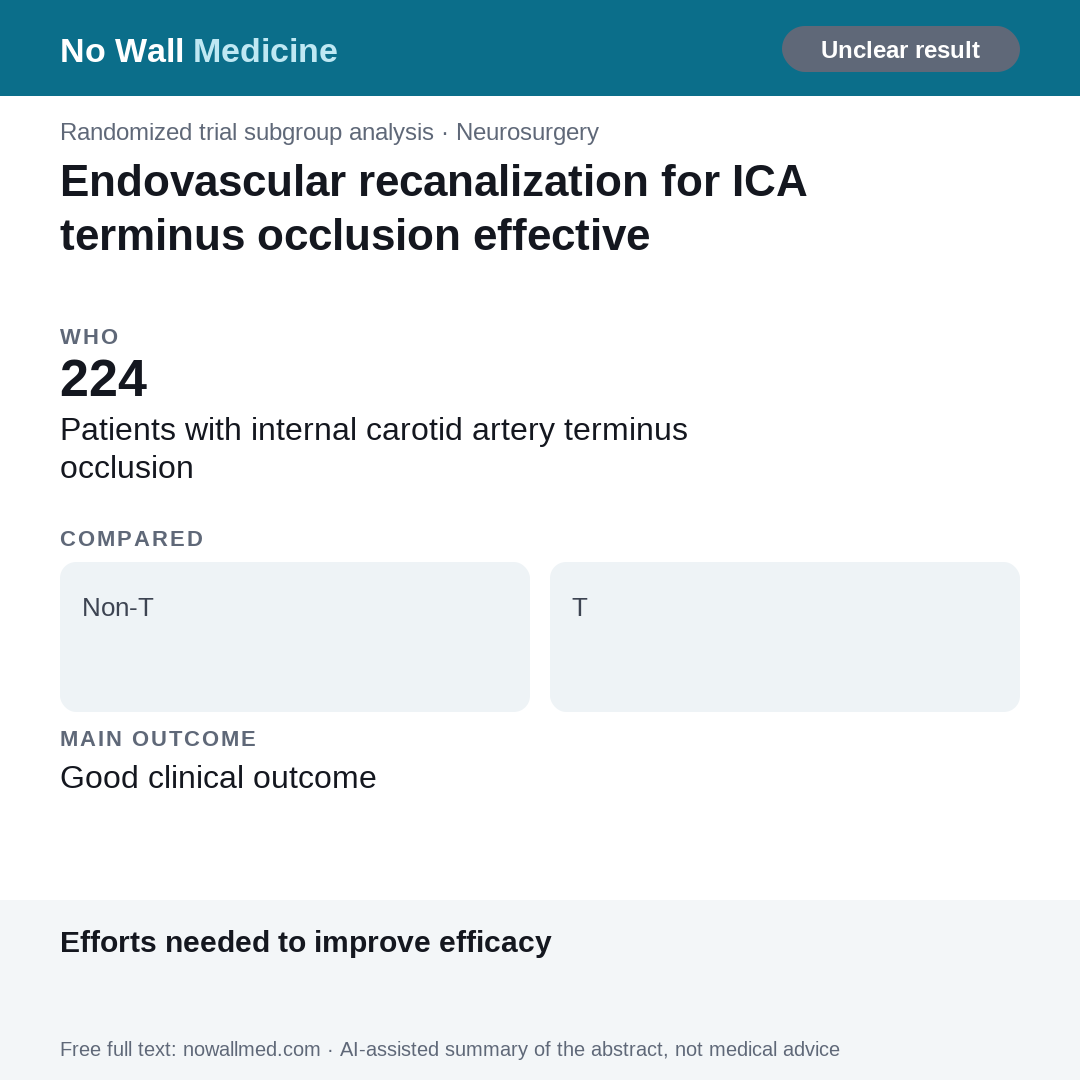
Endovascular recanalization for ICA terminus occlusion effective
Who
224
Patients with internal carotid artery terminus occlusion
Compared
Non-T
T
Main outcome
Good clinical outcome
Bottom line: Efforts needed to improve efficacy
Neurosurgery · 2022-07-22Download image
Why it matters: The efficacy of endovascular recanalization, a procedure to reopen blocked arteries using catheters, for internal carotid artery terminus occlusions has not been completely evaluated.
Key points
- Researchers analyzed 224 patients from the Direct-MT randomized controlled trial who had internal carotid artery terminus occlusions.
- The rates for successful recanalization, good clinical outcome, mortality, and futile recanalization were 83.0%, 24.6%, 26.7%, and 69.6%, respectively.
- First-pass effect, where the clot is removed on the first attempt, was associated with both good clinical outcomes and lower rates of futile recanalization.
Headline and key points written with AI from the paper’s abstract, with every number checked against it. Read the paper before relying on them.
Was this summary helpful?
Subject terms
Headline, design, result, key points, caveat and citation as plain text.
Cite this article
Zhang Y, Zhang L, Zhang Y, et al. Endovascular Recanalization for Acute Internal Carotid Artery Terminus Occlusion: A Subgroup Analysis From the Direct-MT Trial. Neurosurgery. 2022. doi:10.1227/neu.0000000000002085
Spotted a mistake? Suggest a correction