Flow diverters for unruptured carotid artery aneurysms linked to symptom recovery and risks
Flow diversion for compressive unruptured internal carotid artery aneurysms with neuro-ophthalmological symptoms: a systematic review and meta-analysis
Systematic review and meta-analysisMixed results
What are the safety and efficacy of flow diverters for compressive unruptured internal carotid artery aneurysms?
Who
594
Patients with unruptured internal carotid artery aneurysms and neuro-ophthalmological symptoms
Compared
47.4%Neuro-ophthalmological symptom recovery (95% CI 35.0% to 60.1%)
74.5%Neuro-ophthalmological symptom improvement (95% CI 67.9% to 80.2%)
7.1%Transient symptom worsening (95% CI 3.3% to 14.7%)
4.9%Permanent symptom worsening (95% CI 3.2% to 7.4%)
Main outcome
Neuro-ophthalmological symptom recovery, improvement, and worsening
Bottom line: Flow diversion promotes symptom recovery or improvement but carries significant morbidity and mortality risks and potential symptom worsening.
J Neurointerv Surg · 2022-08-02Download image
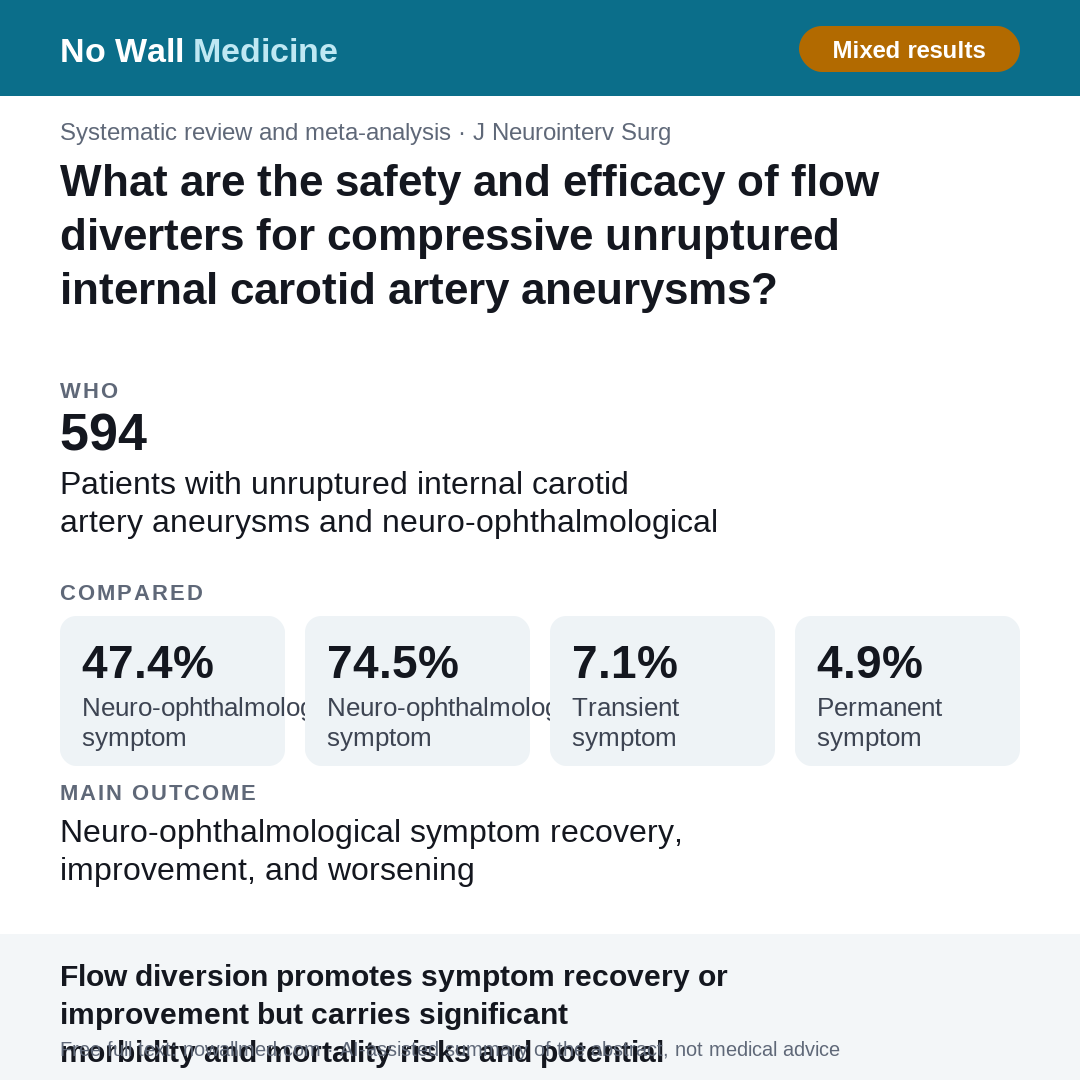
Clinical question: What are the safety and efficacy of flow diverters for compressive unruptured internal carotid artery aneurysms?
Why it matters: Data regarding the safety and effectiveness of flow diverters for unruptured internal carotid artery aneurysms causing neuro-ophthalmological symptoms are scarce.
Key points
- Researchers analyzed 22 studies involving 594 patients treated with flow diverters, which are devices used to redirect blood flow away from an aneurysm.
- The analysis found symptom recovery in 47.4% of patients, symptom improvement in 74.5%, transient worsening in 7.1%, and permanent worsening in 4.9%.
- Morbidity occurred in 5% of patients and mortality was 3.9%.
Headline and key points written with AI from the paper’s abstract, with every number checked against it. Read the paper before relying on them.
Was this summary helpful?
Abstract
Background
Data on the safety and efficacy of flow diverters (FD) for the treatment of unruptured internal carotid artery (ICA) aneurysms with compressive neuro-ophthalmological symptoms (NOS) are scarce and comprise mainly small case series. Methods
We performed a search of three databases and included series with ≥10 patients, with unruptured aneurysms of the ICA and NOS, treated with FD. Random-effects analysis of treatment results and safety was performed. Results
A total of 22 studies reporting on 594 patients were included. Pooled proportions of NOS recovery, improvement, transient and permanent worsening were: 47.4% (95% CI 35.0% to 60.1%); 74.5% (95% CI 67.9% to 80.2%); 7.1% (95% CI 3.3% to 14.7%); and 4.9% (95% CI 3.2% to 7.4%), respectively. Rates of complete recovery and improvement in patients with isolated visual symptoms were 30.6% (95% CI 12.5% to 57.7%) and 56.6% (95% CI 42.3% to 69.9%). Isolated oculomotor symptoms recovered completely in 47.8% (95% CI 29.9% to 66.3%) and improved in 78% (95% CI 69.2% to 84.9%). Morbidity occurred in 5% (95% CI 2.8% to 9%) and mortality in 3.9% (95% CI 2% to 7.5%) of patients. An increased likelihood of symptom improvement was observed when treatment was performed early (<1 month) after symptom onset (OR=11.22, 95% CI 3.9% to 32.5%). Conclusion
Flow diversion promotes recovery or improvement of compressive symptoms in a large proportion of patients but is associated with significant rates of morbidity and mortality. Transient and permanent NOS worsening is not uncommon. Early treatment is of utmost importance, as it increases the likelihood of symptom improvement more than 10-fold.
Abstract reproduced under the article’s CC BY licence.
Subject terms
Cite this article
Kaiser DPO, Cuberi A, Linn J, Gawlitza M. Flow diversion for compressive unruptured internal carotid artery aneurysms with neuro-ophthalmological symptoms: a systematic review and meta-analysis. J Neurointerv Surg. 2022. doi:10.1136/jnis-2022-019249
Spotted a mistake? Suggest a correction
Top studies every Monday
The week’s key trials and guidelines in your specialties, plus any topics you follow. By email, free.
Get the weekly digest