Trial compares coated flow diverters with single antiplatelet therapy against bare devices with dual therapy
Coating (Coating to Optimize Aneurysm Treatment in the New Flow Diverter Generation) study. The first randomized controlled trial evaluating a coated flow diverter (p64 MW HPC): study design
Prospective, randomized, multicenter trialUnclear result
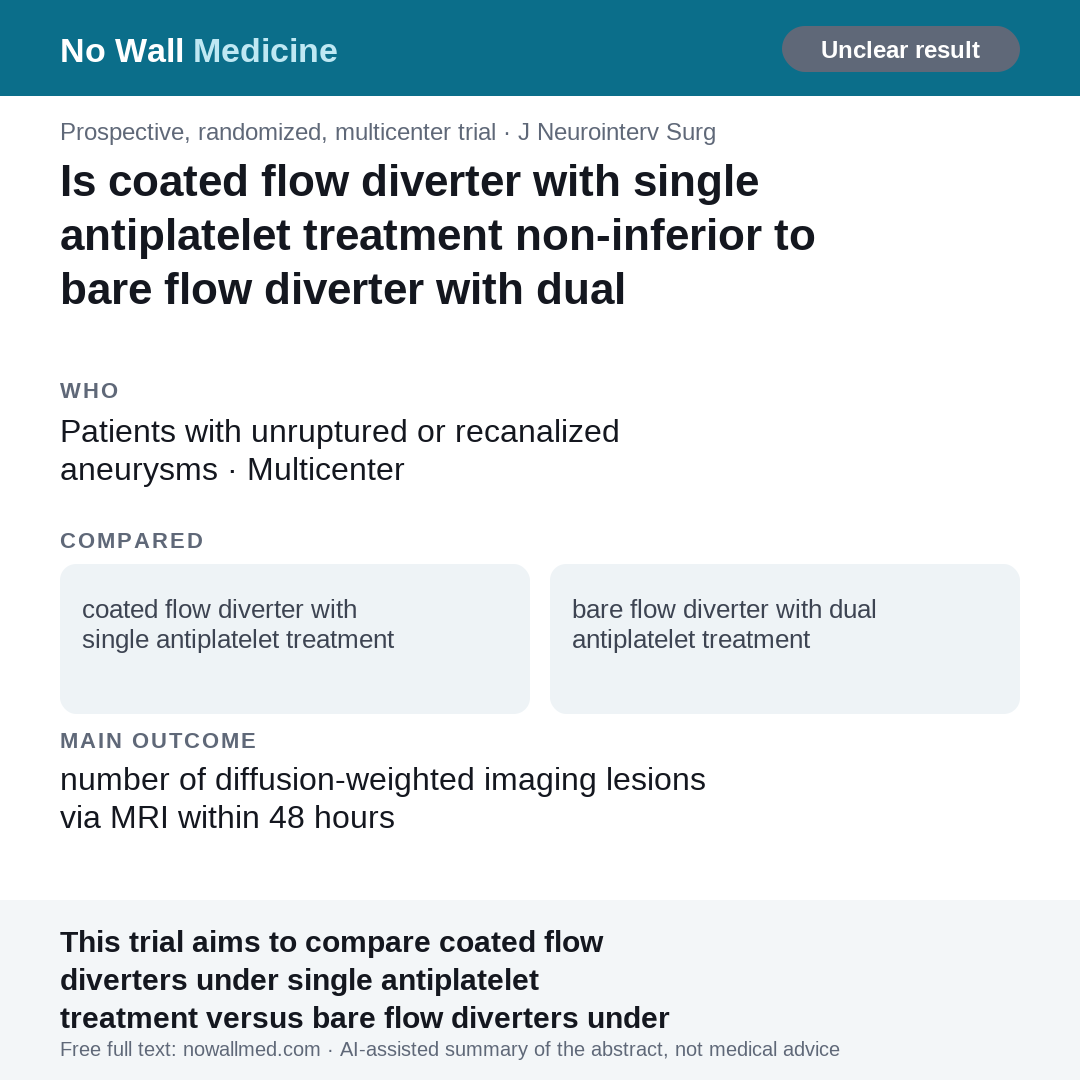
Is coated flow diverter with single antiplatelet treatment non-inferior to bare flow diverter with dual antiplatelet treatment?
Who
Patients with unruptured or recanalized aneurysms · Multicenter
Compared
coated flow diverter with single antiplatelet treatment
bare flow diverter with dual antiplatelet treatment
Main outcome
number of diffusion-weighted imaging lesions via MRI within 48 hours
Bottom line: This trial aims to compare coated flow diverters under single antiplatelet treatment versus bare flow diverters under dual antiplatelet treatment.
J Neurointerv Surg · 2022-05-24Download image
Clinical question: Is coated flow diverter with single antiplatelet treatment non-inferior to bare flow diverter with dual antiplatelet treatment?
Why it matters: Flow diversion is currently not indicated for ruptured aneurysms because it requires dual antiplatelet treatment to prevent complications.
Key points
- The COATING trial is a prospective, randomized, multicenter study enrolling patients with unruptured or recanalized aneurysms for flow diverter treatment.
- Patients are randomly assigned to receive either a coated flow diverter (p64 MW HPC) with single antiplatelet treatment or a bare flow diverter (p64 MW) with dual antiplatelet treatment.
- The primary endpoint is the number of lesions seen on magnetic resonance imaging (MRI) within 48 hours (±24 hours) after the procedure.
Headline and key points written with AI from the paper’s abstract, with every number checked against it. Read the paper before relying on them.
Was this summary helpful?
Abstract
Background
Due to its high efficacy, flow diversion is increasingly used in the management of unruptured and recanalized aneurysms. Because of the need for perioperative dual antiplatelet treatment (DAPT), flow diversion is not indicated for the treatment of ruptured aneurysms. To overcome this major limitation, surface modification-'coating'-of flow diverters has been developed to reduce platelet aggregation on the implanted device, reduce thromboembolic complications, and facilitate the use of coated flow diverter treatment in patients with single antiplatelet treatment (SAPT). COATING (Coating to Optimize Aneurysm Treatment in the New Flow Diverter Generation) is a prospective, randomized, multicenter trial that aims to determine whether the use of the coated flow diverter p64 MW HPC under SAPT is non-inferior (or even superior) to the use of the bare flow diverter p64 MW under DAPT in relation to thromboembolic and hemorrhagic complications. Methods
Patients with unruptured or recanalized aneurysms for which endovascular treatment with a flow diverter is indicated will be enrolled and randomly assigned on a 1:1 ratio to one of two treatment groups: p64 MW HPC with SAPT or p64 MW with DAPT. Results
The primary endpoint is the number of diffusion-weighted imaging lesions visualized via MRI assessed within 48 hours (±24 hours) of the index procedure. Secondary primary endpoints are comparing safety and efficacy in both arms. Conclusions
This randomized controlled trial is the first to directly compare safety and efficacy of coated flow diverters under SAPT with bare flow diverters under DAPT. Trial registration number
http://clinicaltrials.gov/ - NCT04870047.
Abstract reproduced under the article’s CC BY NC licence.
Subject terms
Cite this article
Pierot L, Lamin S, Barreau X, Berlis A, Ciceri E, Cohen JE. Coating (Coating to Optimize Aneurysm Treatment in the New Flow Diverter Generation) study. The first randomized controlled trial evaluating a coated flow diverter (p64 MW HPC): study design. J Neurointerv Surg. 2022. doi:10.1136/neurintsurg-2022-018969
Spotted a mistake? Suggest a correction
Top studies every Monday
The week’s key trials and guidelines in your specialties, plus any topics you follow. By email, free.
Get the weekly digest