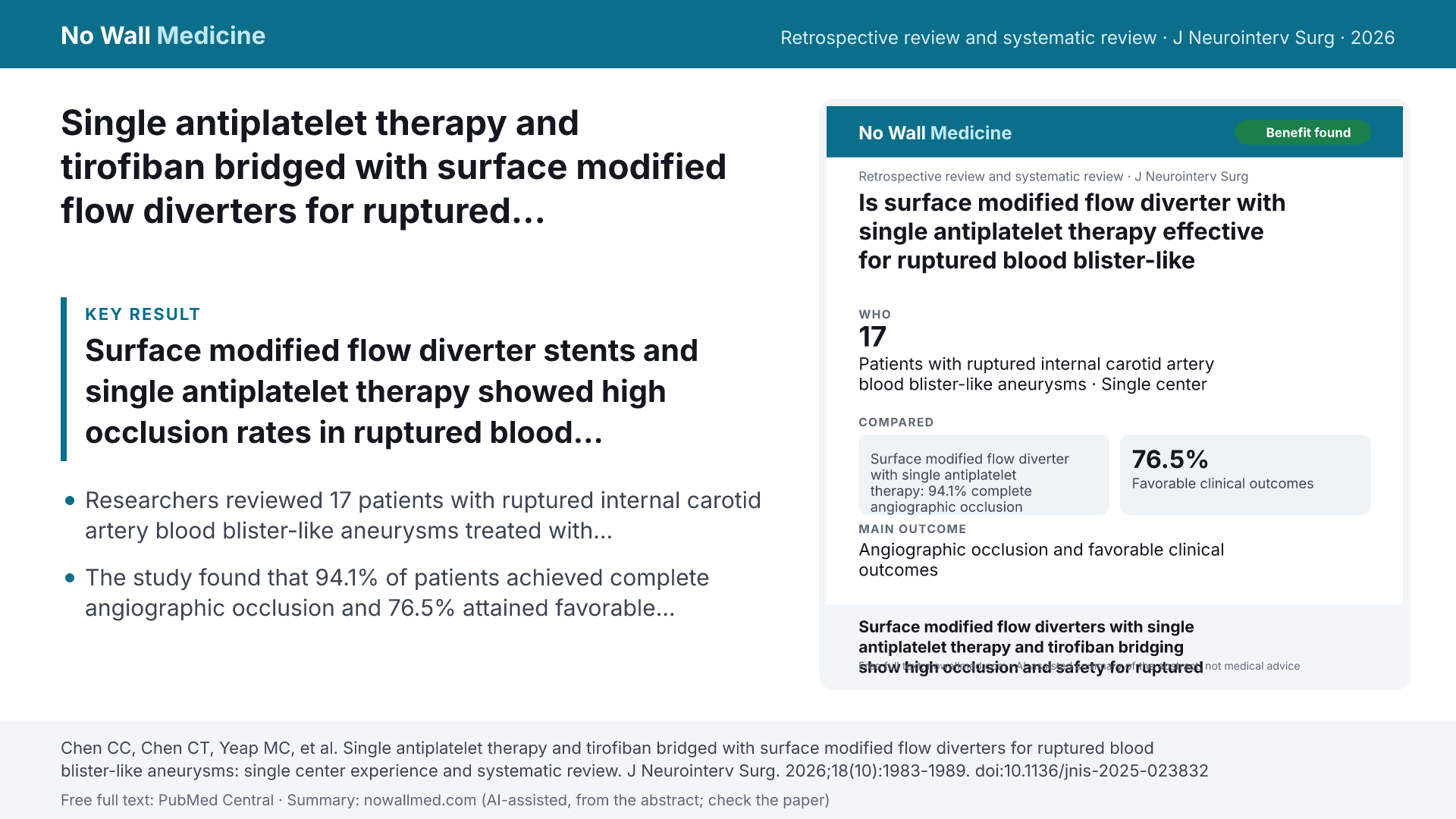
Surface modified flow diverter stents and single antiplatelet therapy showed high occlusion rates in ruptured blood blister-like aneurysms
Single antiplatelet therapy and tirofiban bridged with surface modified flow diverters for ruptured blood blister-like aneurysms: single center experience and systematic review
Retrospective review and systematic reviewBenefit found
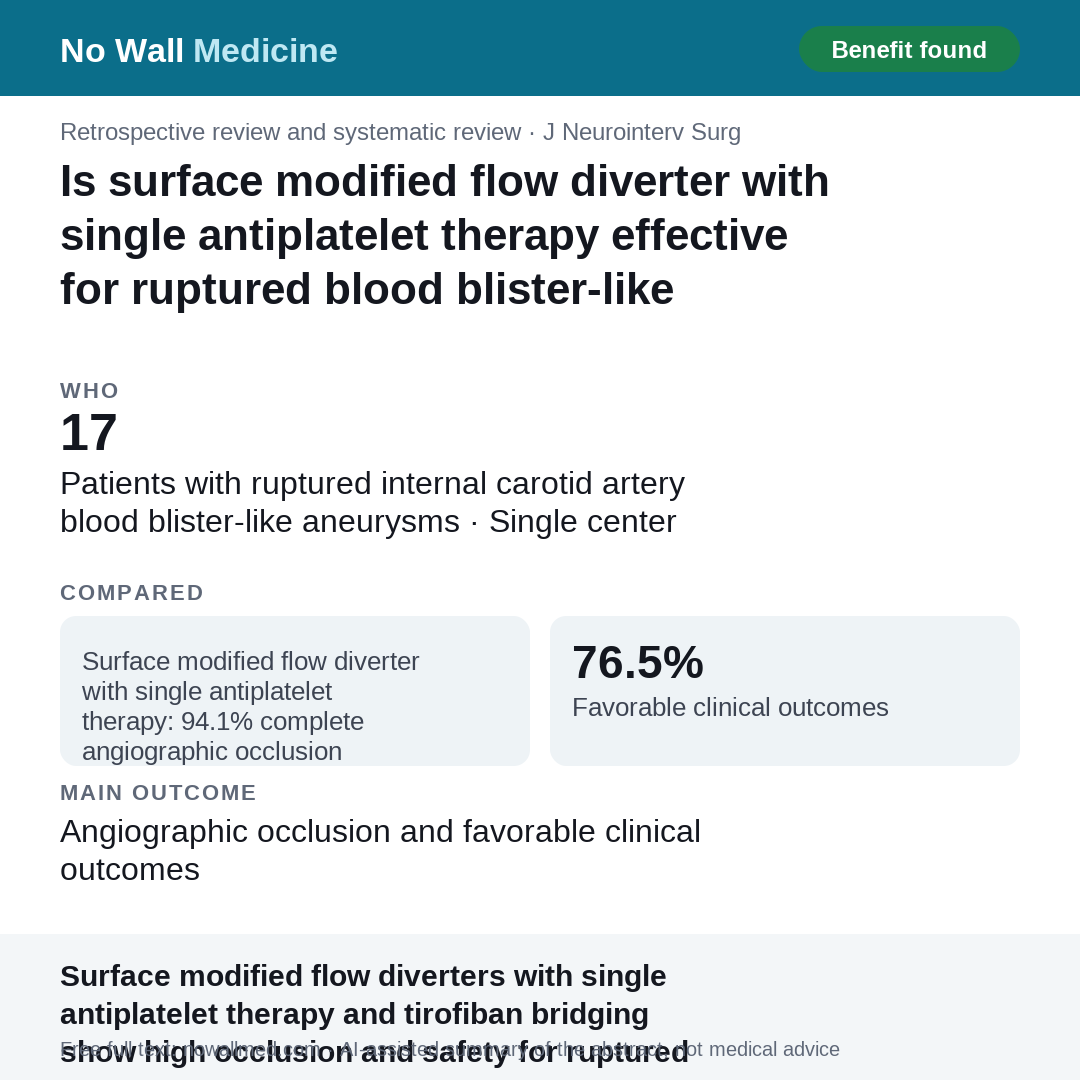
Is surface modified flow diverter with single antiplatelet therapy effective for ruptured blood blister-like aneurysms?
Who
17
Patients with ruptured internal carotid artery blood blister-like aneurysms · Single center
Compared
Surface modified flow diverter with single antiplatelet therapy: 94.1% complete angiographic occlusion
76.5%Favorable clinical outcomes
Main outcome
Angiographic occlusion and favorable clinical outcomes
Bottom line: Surface modified flow diverters with single antiplatelet therapy and tirofiban bridging show high occlusion and safety for ruptured blood blister-like aneurysms.
J Neurointerv Surg · 2026-09-14Download image
Clinical question: Is surface modified flow diverter with single antiplatelet therapy effective for ruptured blood blister-like aneurysms?
Why it matters: Treating ruptured blood blister-like aneurysms is difficult because the fragile structure of these lesions carries high risks when using dual antiplatelet therapy.
Key points
- Researchers reviewed 17 patients with ruptured internal carotid artery blood blister-like aneurysms treated with surface modified flow diverter stents and single antiplatelet therapy bridged with intravenous tirofiban.
- The study found that 94.1% of patients achieved complete angiographic occlusion and 76.5% attained favorable clinical outcomes, defined as a modified Rankin Scale score of 2 or less.
- No aneurysm rebleeding or device related ischemic events, which are strokes caused by blood clots, were observed in the 17 patients.
Limitation the authors note: The authors state that larger prospective studies are needed to validate these findings.
Headline and key points written with AI from the paper’s abstract, with every number checked against it. Read the paper before relying on them.
Was this summary helpful?
Abstract
Background
Blood blister-like aneurysms (BBAs) of the internal carotid artery are rare but high risk lesions that frequently re-rupture due to their fragile structure and dissecting pathology. Treatment is particularly challenging in ruptured cases, given the risks associated with dual antiplatelet therapy. Recent advancements in flow diverter stents (FDSs) with surface modifications, and the use of single antiplatelet therapy (SAPT), offer a potential alternative strategy. Methods
We conducted a retrospective review of 17 patients with ruptured internal carotid artery BBAs treated with surface modified FDS under SAPT (ticagrelor or prasugrel) bridged periprocedurally with intravenous tirofiban. All procedures were performed within the acute phase of subarachnoid hemorrhage. Clinical, radiographic outcomes, and procedure related complications were evaluated. Results
Among 17 patients, 94.1% achieved complete angiographic occlusion, and 76.5% attained favorable clinical outcomes (modified Rankin Scale score ≤2). No aneurysm rebleeding or device related ischemic events occurred. A total of 11 patients underwent external ventricular drainage or ventriculoperitoneal shunting without discontinuing SAPT, and no hemorrhagic complications were observed. A literature review incorporating seven additional series identified a total of 42 FDS plus SAPT treated BBA cases, with similar safety and efficacy profiles. Conclusions
Surface modified FDS with SAPT and tirofiban bridging appears to be a promising treatment option for ruptured BBAs, offering high occlusion rates with minimal thromboembolic and hemorrhagic complications. Larger prospective studies are needed to validate these findings.
Abstract reproduced under the article’s CC BY NC licence.
Subject terms
Cite this article
Chen CC, Chen CT, Yeap MC, et al. Single antiplatelet therapy and tirofiban bridged with surface modified flow diverters for ruptured blood blister-like aneurysms: single center experience and systematic review. J Neurointerv Surg. 2026. doi:10.1136/jnis-2025-023832
Spotted a mistake? Suggest a correction