Poor blood flow restoration after stroke procedure was associated with worse functional outcomes
Endovascular therapy in acute ischemic stroke with poor reperfusion is associated with worse outcomes compared with best medical management: a HERMES substudy
Patient-level meta-analysis of seven randomized trialsHarm found
Are outcomes worse for endovascular therapy with poor reperfusion compared to medical management?
Who
1764
Patients with acute ischemic stroke and large vessel occlusion
Compared
Endovascular therapy with poor reperfusion: median 4 (IQR 3-6)
Control arm: median 4 (IQR 2-5)
Main outcome
modified Rankin Scale score at 90 days
Result: adjusted common OR 0.59 (95% CI 0.38 to 0.91)
Bottom line: Poor reperfusion after endovascular therapy was associated with worse functional outcomes than best medical management.
J Neurointerv Surg · 2024-08-14Download image
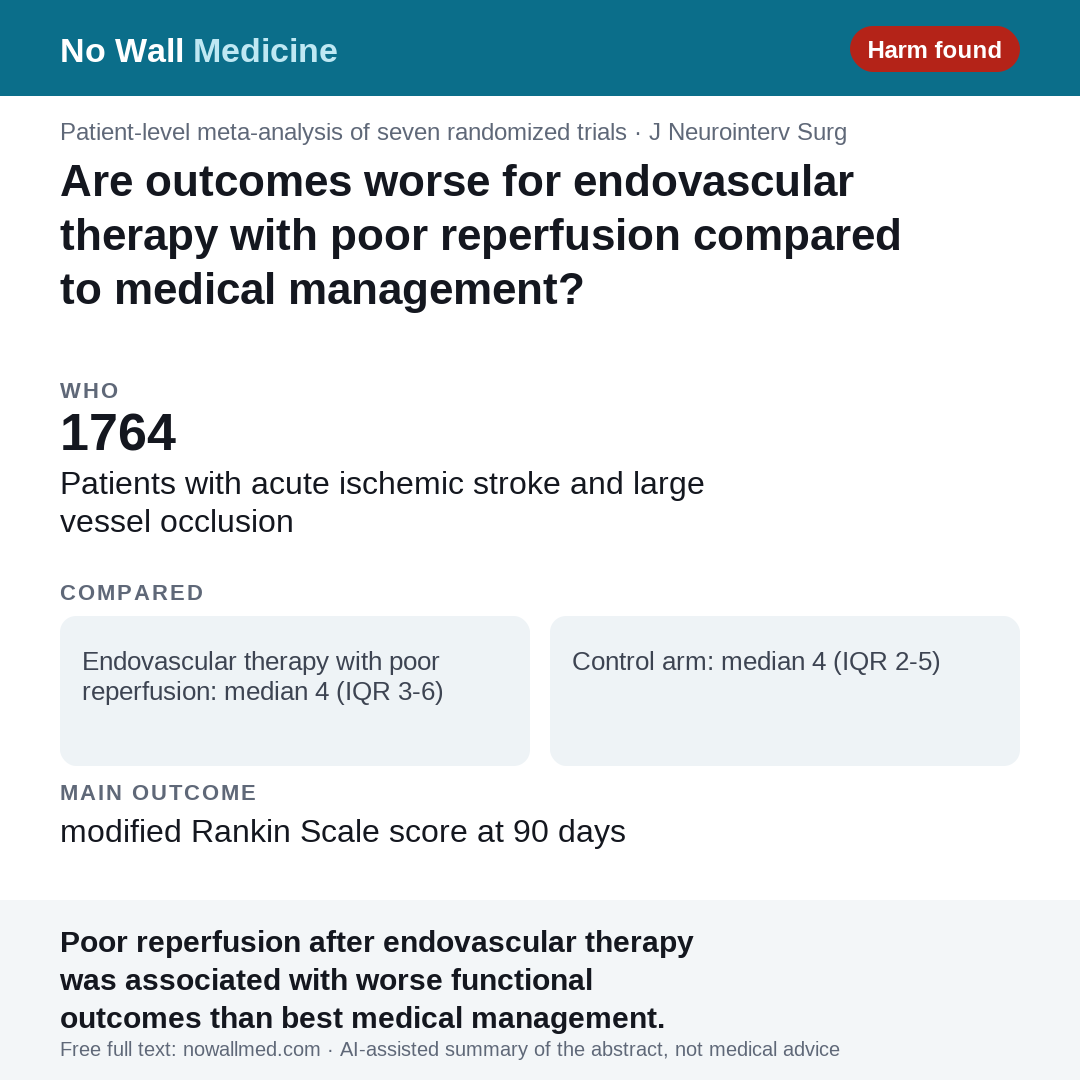
Clinical question: Are outcomes worse for endovascular therapy with poor reperfusion compared to medical management?
Why it matters: It was unknown how functional outcomes compared for patients with large vessel occlusion who achieved poor blood flow restoration after endovascular treatment versus those receiving medical management.
Key points
- Researchers analyzed 972 patients from seven randomized trials, comparing those with poor blood flow restoration after endovascular treatment to those receiving only medical management.
- Patients with poor reperfusion had a median modified Rankin Scale score of 4 at 90 days compared to a median score of 4 in the control group.
- Symptomatic intracranial hemorrhage, or bleeding in the brain, was 3.9% in the poor reperfusion group and 3.5% in the control group.
Headline and key points written with AI from the paper’s abstract, with every number checked against it. Read the paper before relying on them.
Topics
Cite this article
Rex N, Ospel JM, Brown SB, McDonough RV, Kashani N, Hill MD. Endovascular therapy in acute ischemic stroke with poor reperfusion is associated with worse outcomes compared with best medical management: a HERMES substudy. J Neurointerv Surg. 2024. doi:10.1136/jnis-2023-020411
Spotted a mistake? Suggest a correction
Top studies every Monday
The week’s key trials and guidelines in your specialties, plus any topics you follow. By email, free.
Get the weekly digest