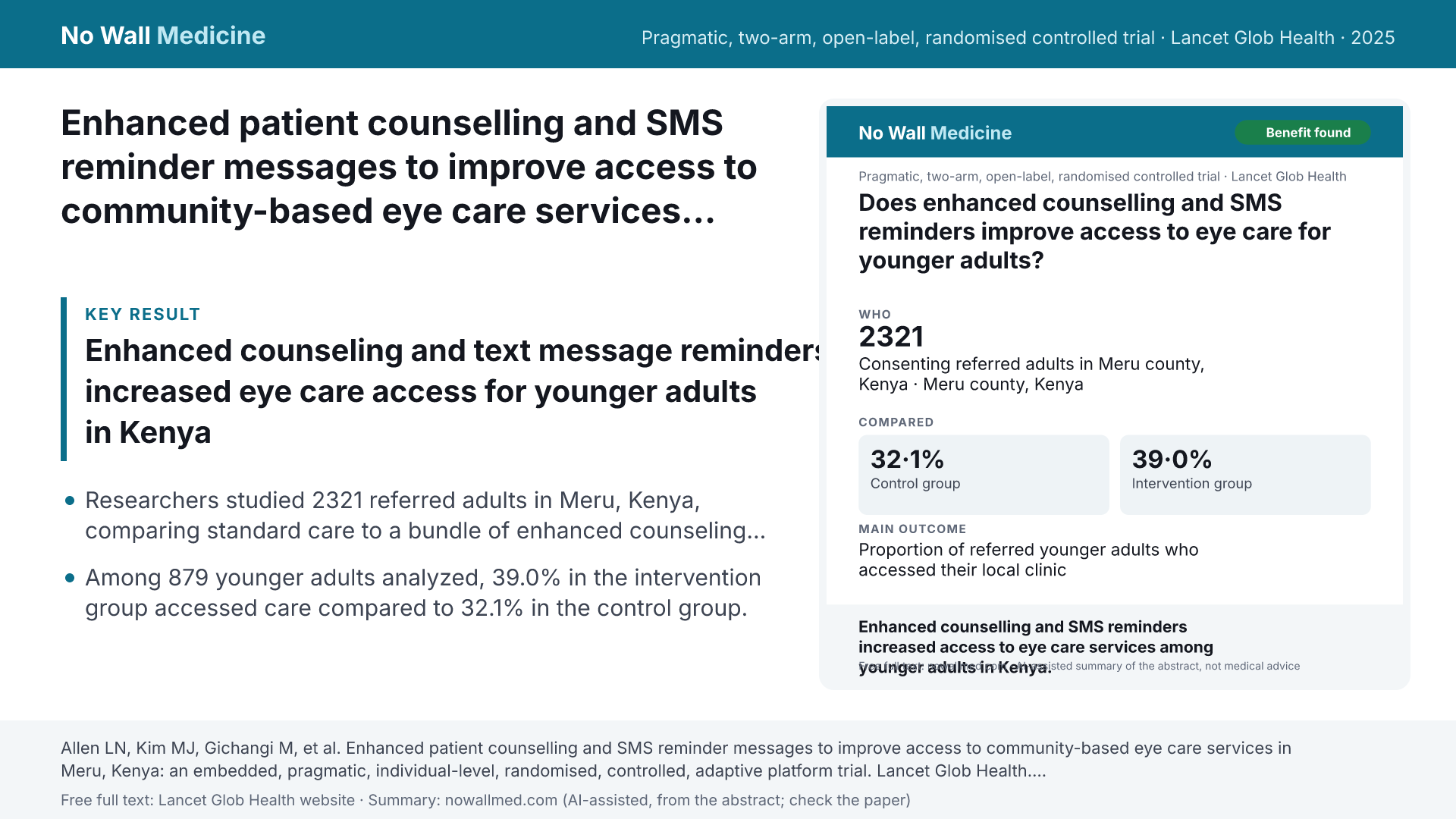
Enhanced counseling and text message reminders increased eye care access for younger adults in Kenya
Enhanced patient counselling and SMS reminder messages to improve access to community-based eye care services in Meru, Kenya: an embedded, pragmatic, individual-level, randomised, controlled, adaptive platform trial
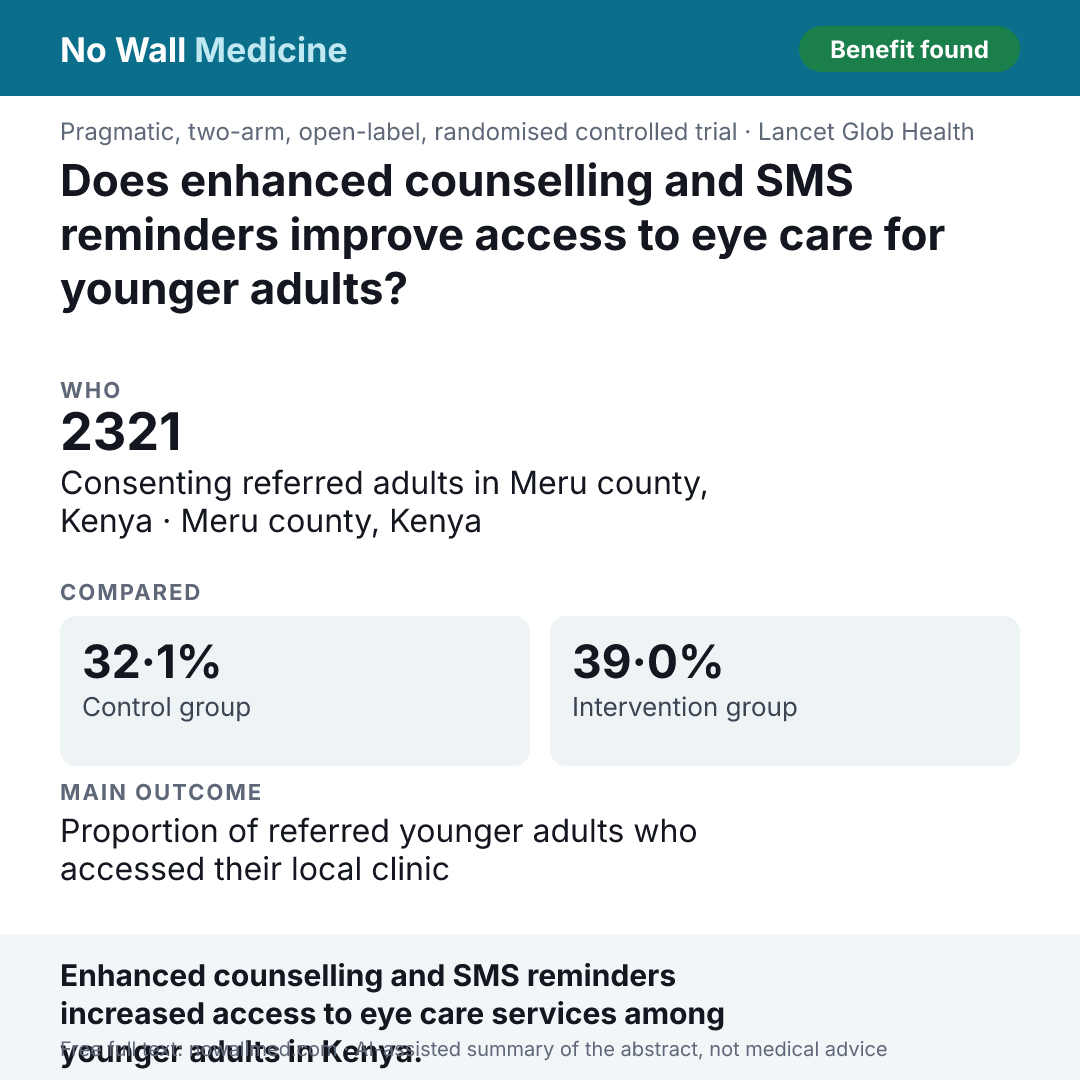
Pragmatic, two-arm, open-label, randomised controlled trialBenefit found
Does enhanced counselling and SMS reminders improve access to eye care for younger adults?
Who
2321
Consenting referred adults in Meru county, Kenya · Meru county, Kenya
Compared
32·1%Control group (147/458)
39·0%Intervention group (164/421)
Main outcome
Proportion of referred younger adults who accessed their local clinic
Result: 98·6% posterior probability that the intervention group was superior
Bottom line: Enhanced counselling and SMS reminders increased access to eye care services among younger adults in Kenya.
Funded by: National Institute for Health Research and NIHR-Wellcome Partnership
Lancet Glob Health · 2025-12-13 · Save PNG
Clinical question: Does enhanced counselling and SMS reminders improve access to eye care for younger adults?
Why it matters: In Meru, Kenya, only 46% of people identified with eye problems during screening go on to access local eye care services.
Key points
- Researchers studied 2321 referred adults in Meru, Kenya, comparing standard care to a bundle of enhanced counseling and SMS text message reminders.
- Among 879 younger adults analyzed, 39.0% in the intervention group accessed care compared to 32.1% in the control group.
- The study found a 98.6% posterior probability that the intervention was superior for increasing care access among younger adults.
Headline and key points written with AI from the paper’s abstract, with every number checked against it. Read the paper before relying on them.
Was this summary helpful?
Abstract
Background
In Meru county, Kenya, only 46% of people identified with an eye problem during screening go on to access eye care services at local clinics, with younger adults (aged 18-44 years) being the least likely to receive eye care. This study aimed to test whether provision of additional information was associated with better access to eye services, compared with standard care. Methods
We developed enhanced counselling and SMS reminders with lay input and tested this bundled intervention against standard care using a pragmatic, two-arm, open-label, randomised controlled trial, embedded within Meru's ongoing eye screening programme. All consenting referred adults were enrolled. The primary outcome was the proportion of referred younger adults who accessed their local clinic following referral. We used Bayesian methods and Monte Carlo simulations to generate the posterior probability distribution of the effect difference between the groups every 7 days. Participants were continually recruited until one of two stopping rules were met: there was a greater than 95% probability that either one group was more effective (stopping for superiority), or that the difference between the groups was less than 1% (stopping for equivalence). This completed trial was registered with ISRCTN (11329596). Findings
The trial ran from May 21 to June 20, 2024. A total of 7356 individuals had been screened and referred. Of these, 2321 consented to participate and were randomly assigned to a group (1140 in the control group and 1181 in the intervention group). All 2321 participants had complete follow-up data (ie, 14 days had elapsed since their appointment date). Our testing algorithm stopped the trial after 30 days based on analysis of outcome data from 879 younger adults. 147 (32·1%) of 458 younger adults in the control group had accessed care versus 164 (39·0%) of 421 younger adults in the intervention group, resulting in a 98·6% posterior probability that the intervention group was superior among younger adults. Interpretation
This trial found evidence that an intervention bundle with enhanced counselling and SMS reminders, as suggested by an underserved population, increased access to care. This embedded, adaptive, equity-focused approach has broad applications, aligned with the principle of proportionate universalism. Funding
National Institute for Health Research (NIHR; using the UK's Official Development Assistance funding) and NIHR-Wellcome Partnership for Global Health Research. Translation
For the Swahili translation of the abstract see Supplementary Materials section.
Abstract reproduced under the article’s CC BY licence.
Subject terms
Headline, design, result, key points, caveat and citation as plain text.
Cite this article
Allen LN, Kim MJ, Gichangi M, et al. Enhanced patient counselling and SMS reminder messages to improve access to community-based eye care services in Meru, Kenya: an embedded, pragmatic, individual-level, randomised, controlled, adaptive platform trial. Lancet Glob Health. 2026;14(1):e112-e120. doi:10.1016/S2214-109X(25)00401-2
Spotted a mistake? Suggest a correction