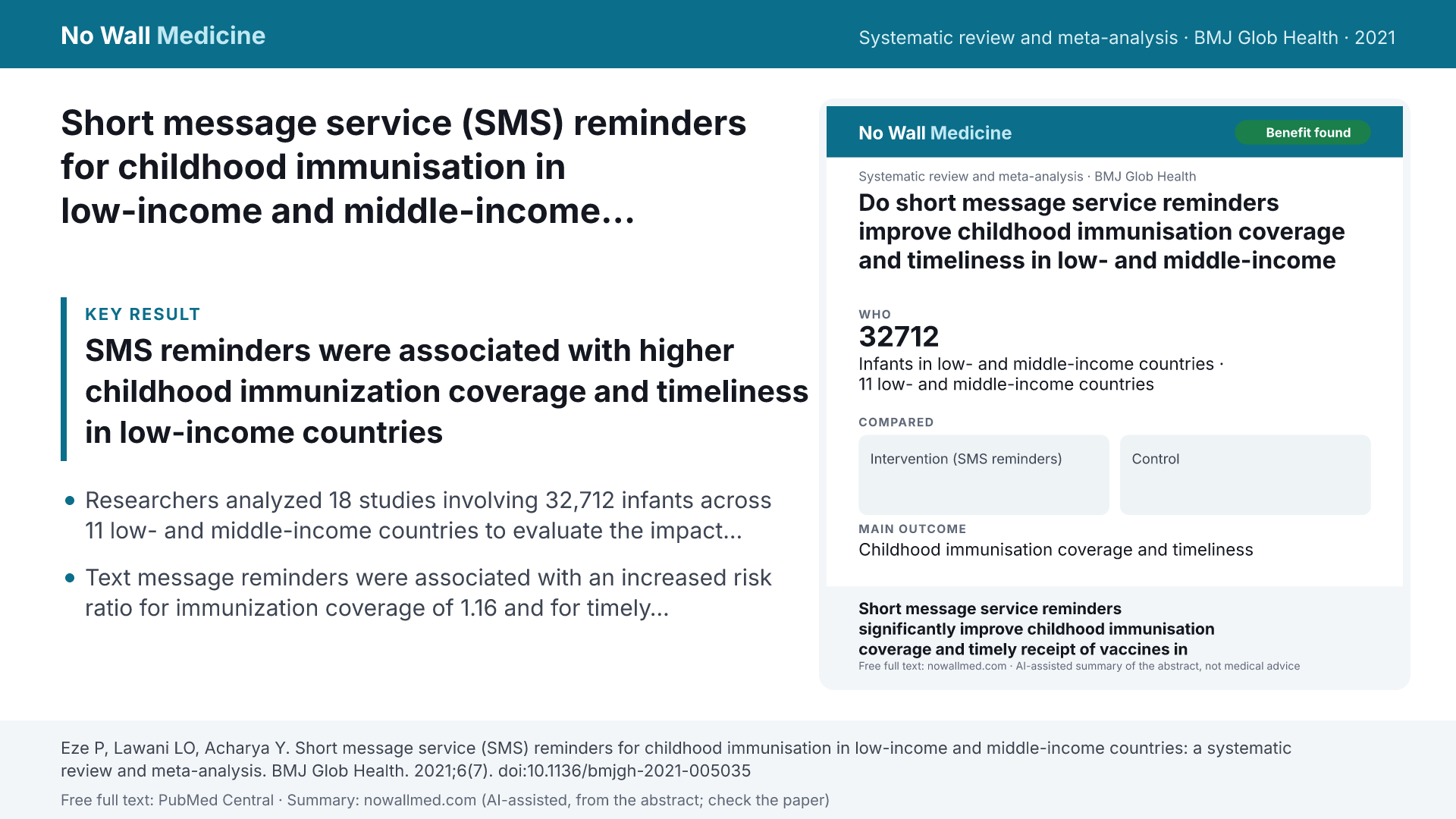
SMS reminders were associated with higher childhood immunization coverage and timeliness in low-income countries
Short message service (SMS) reminders for childhood immunisation in low-income and middle-income countries: a systematic review and meta-analysis
Systematic review and meta-analysisBenefit found
Do short message service reminders improve childhood immunisation coverage and timeliness in low- and middle-income countries?
Who
32712
Infants in low- and middle-income countries · 11 low- and middle-income countries
Compared
Intervention (SMS reminders)
Control
Main outcome
Childhood immunisation coverage and timeliness
Result: risk ratio 1.16 (95% CI: 1.10 to 1.21) for coverage; risk ratio 1.21 (95% CI: 1.12 to 1.30) for timeliness
Bottom line: Short message service reminders significantly improve childhood immunisation coverage and timely receipt of vaccines in low- and middle-income countries.
Limitation: significant heterogeneity
BMJ Glob Health · 2021-07-22Download image
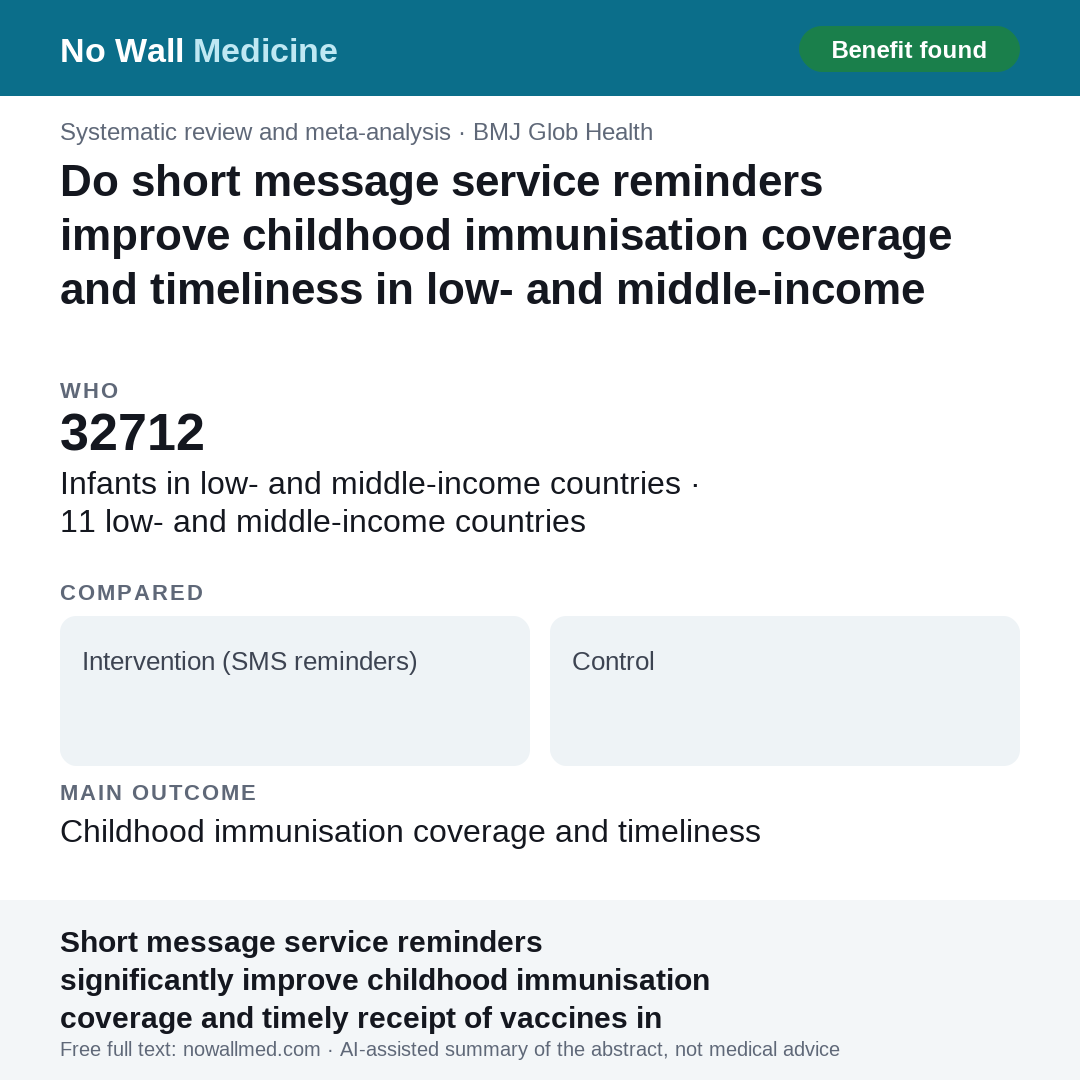
Clinical question: Do short message service reminders improve childhood immunisation coverage and timeliness in low- and middle-income countries?
Why it matters: It was unknown if text message reminders could effectively improve the coverage and timing of childhood vaccinations in low- and middle-income countries.
Key points
- Researchers analyzed 18 studies involving 32,712 infants across 11 low- and middle-income countries to evaluate the impact of text message reminders.
- Text message reminders were associated with an increased risk ratio for immunization coverage of 1.16 and for timely vaccine receipt of 1.21.
- The effectiveness of reminders for timely vaccination was higher when more than two messages were sent compared to one or two messages.
Limitation the authors note: The meta-analysis showed significant heterogeneity, which refers to the variation in results across the included studies.
Headline and key points written with AI from the paper’s abstract, with every number checked against it. Read the paper before relying on them.
Was this summary helpful?
Abstract
Introduction
Childhood vaccine delivery services in the low- and middle-income countries (LMIC) are struggling to reach every child with lifesaving vaccines. Short message service (SMS) reminders have demonstrated positive impact on a number of attrition-prone healthcare delivery services. We aimed to evaluate the effectiveness of SMS reminders in improving immunisation coverage and timeliness in LMICs. Methods
PubMed, Embase, Scopus, Cochrane CENTRAL, CINAHL, CNKI, PsycINFO and Web of Science including grey literatures and Google Scholar were systematically searched for randomised controlled trials (RCTs) and non-RCTs that evaluated the effect of SMS reminders on childhood immunisation and timeliness in LMICs. Risk of bias was assessed using the Cochrane Risk of Bias 2.0 assessment tool for RCTs and Cochrane Risk of Bias in Non-randomised Studies of Interventions tool for non-RCTs. Meta-analysis was conducted using random-effects models to generate pooled estimates of risk ratio (RR). Results
18 studies, 13 RCTs and 5 non-RCTs involving 32 712 infants (17 135 in intervention groups and 15 577 in control groups) from 11 LMICs met inclusion criteria. Pooled estimates showed that SMS reminders significantly improved childhood immunisation coverage (RR=1.16; 95% CI: 1.10 to 1.21; I2=90.4%). Meta-analysis of 12 included studies involving 25 257 infants showed that SMS reminders significantly improved timely receipt of childhood vaccines (RR=1.21; 95% CI: 1.12 to 1.30; I2=87.3%). Subgroup analysis showed that SMS reminders are significantly more effective in raising childhood immunisation coverage in lower middle-income and low-income countries than in upper middle-income countries (p<0.001) and sending more than two SMS reminders significantly improves timely receipt of childhood vaccines than one or two SMS reminders (p=0.040). Conclusion
Current evidence from LMICs, although with significant heterogeneity, suggests that SMS reminders can contribute to achieving high and timely childhood immunisation coverage. Prospero registration number
CRD42021225843.
Abstract reproduced under the article’s CC BY NC licence.
Subject terms
Cite this article
Eze P, Lawani LO, Acharya Y. Short message service (SMS) reminders for childhood immunisation in low-income and middle-income countries: a systematic review and meta-analysis. BMJ Glob Health. 2021. doi:10.1136/bmjgh-2021-005035
Spotted a mistake? Suggest a correction