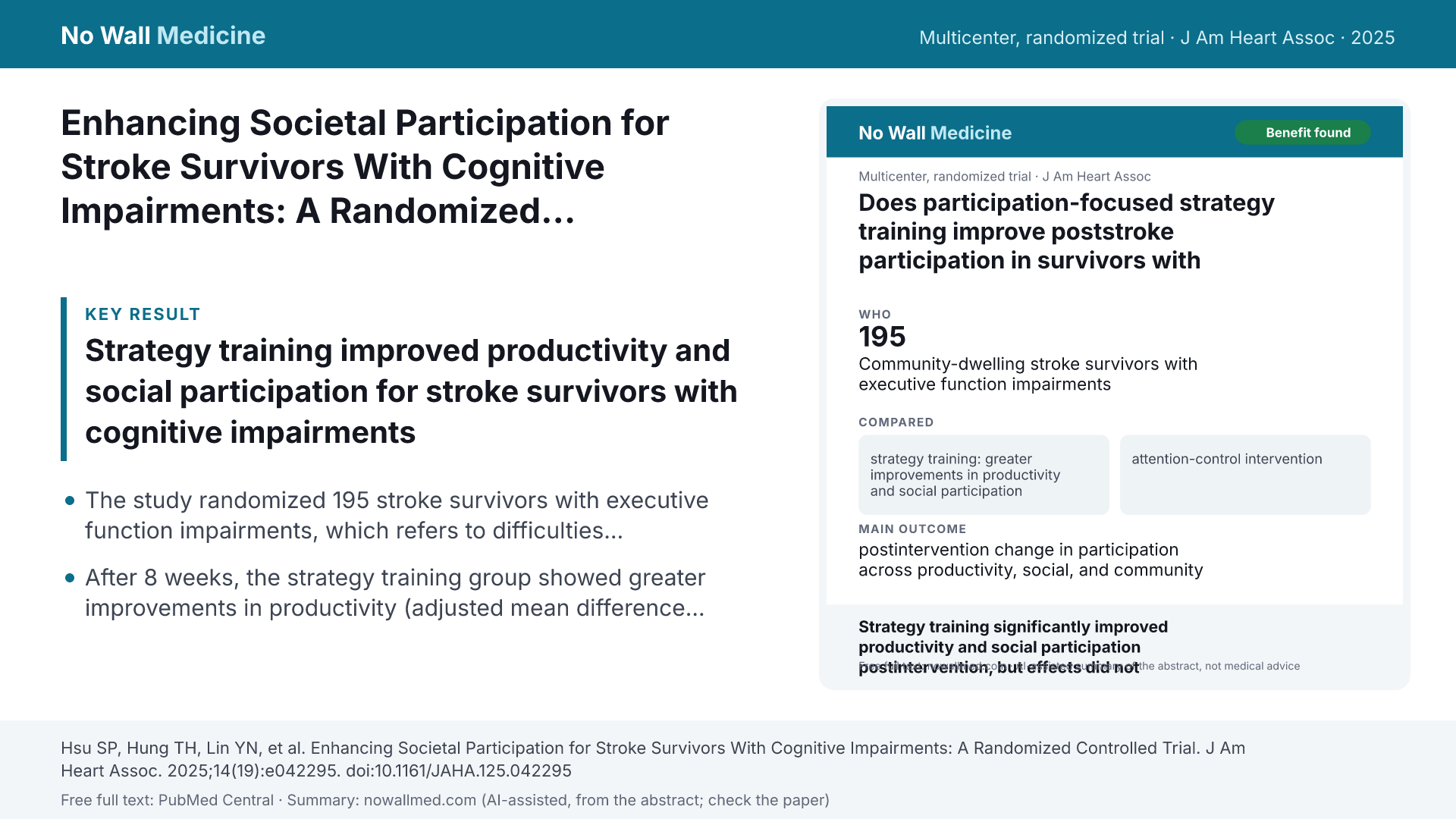
Strategy training improved productivity and social participation for stroke survivors with cognitive impairments
Enhancing Societal Participation for Stroke Survivors With Cognitive Impairments: A Randomized Controlled Trial
Multicenter, randomized trialBenefit found
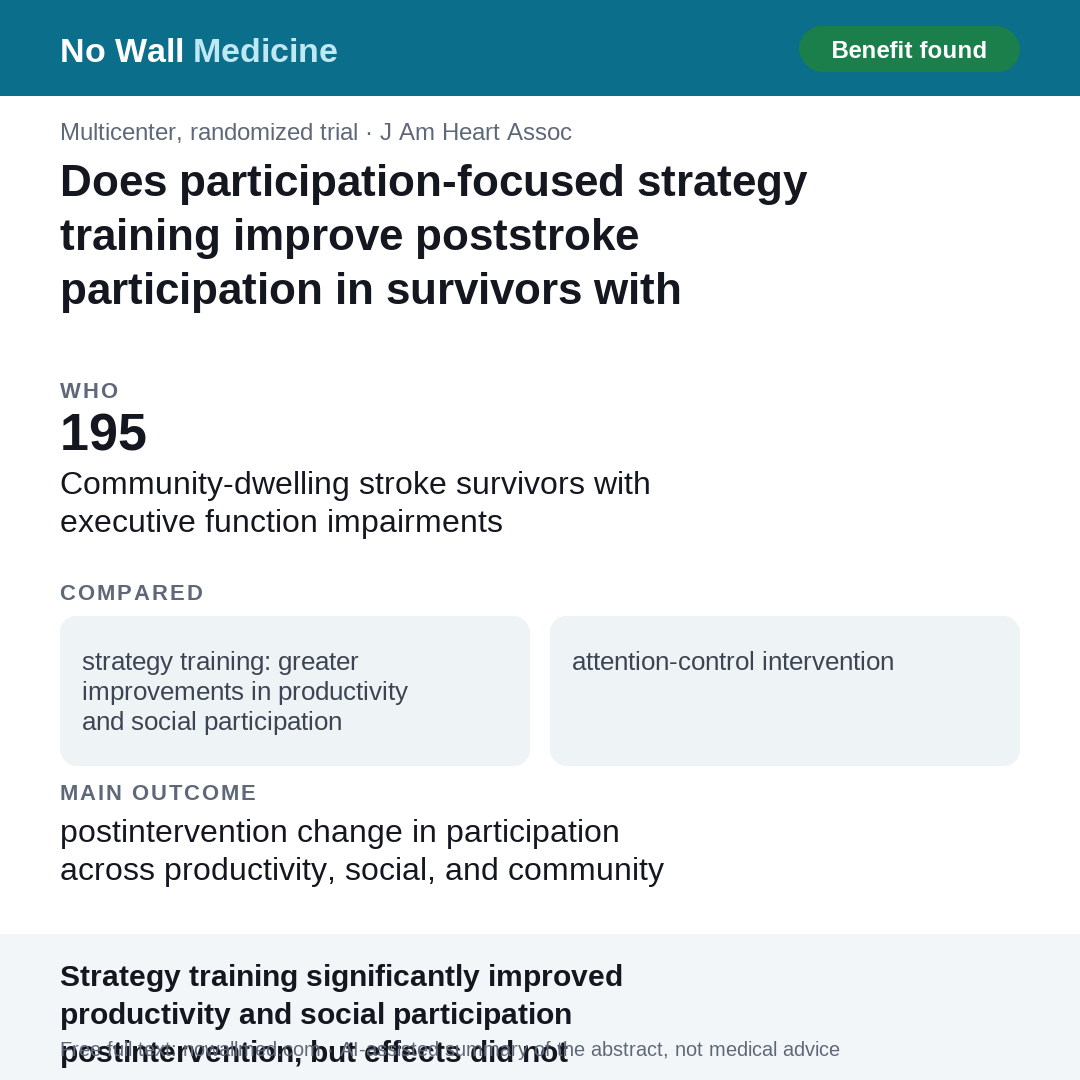
Does participation-focused strategy training improve poststroke participation in survivors with cognitive impairments?
Who
195
Community-dwelling stroke survivors with executive function impairments
Compared
strategy training: greater improvements in productivity and social participation
attention-control intervention
Main outcome
postintervention change in participation across productivity, social, and community domains
Result: adjusted mean difference 7.89 (95% CI 2.61 to 13.16) for productivity and 0.29 (95% CI 0.08 to 0.51) for social participation
Bottom line: Strategy training significantly improved productivity and social participation postintervention, but effects did not persist at 3-month follow-up.
J Am Heart Assoc · 2025-09-19Download image
Clinical question: Does participation-focused strategy training improve poststroke participation in survivors with cognitive impairments?
Why it matters: Evidence remains inconclusive regarding which rehabilitation methods effectively help stroke survivors with cognitive impairments return to societal participation.
Key points
- The study randomized 195 stroke survivors with executive function impairments, which refers to difficulties with planning and organizing, to either strategy training or an attention-control intervention.
- After 8 weeks, the strategy training group showed greater improvements in productivity (adjusted mean difference 7.89 [2.61-13.16], P=0.004) and social participation (adjusted mean difference 0.29 [0.08-0.51], P=0.009) than the control group.
- No significant differences were observed between groups for activity performance, self-efficacy, or global cognition, and the participation benefits did not persist at a 3-month follow-up.
Headline and key points written with AI from the paper’s abstract, with every number checked against it. Read the paper before relying on them.
Was this summary helpful?
Subject terms
Cite this article
Hsu SP, Hung TH, Lin YN, et al. Enhancing Societal Participation for Stroke Survivors With Cognitive Impairments: A Randomized Controlled Trial. J Am Heart Assoc. 2025. doi:10.1161/JAHA.125.042295
Spotted a mistake? Suggest a correction