Virtual multidisciplinary stroke care clinic improved self-efficacy, social participation, and depression levels
Virtual Multidisciplinary Stroke Care Clinic for Community-Dwelling Stroke Survivors: A Randomized Controlled Trial
Randomized controlled trialBenefit found
Does a virtual multidisciplinary stroke care clinic improve health and self-management outcomes?
Who
335
Community-dwelling stroke survivors · 10 hospitals
Compared
Virtual Multidisciplinary Stroke Care Clinic: B=4.60 [95% CI, 0.16 to 9.05] for self-efficacy
Usual care
Main outcome
Self-efficacy, self-management behaviors, social participation, and depression
Result: Hedges' g effect sizes 0.19 to 0.36
Bottom line: The virtual clinic showed small to medium improvements in self-efficacy, social participation, and depression.
Limitation: Baseline levels favored the control group, so intervention effects might be overestimated.
Stroke · 2023-08-08Download image
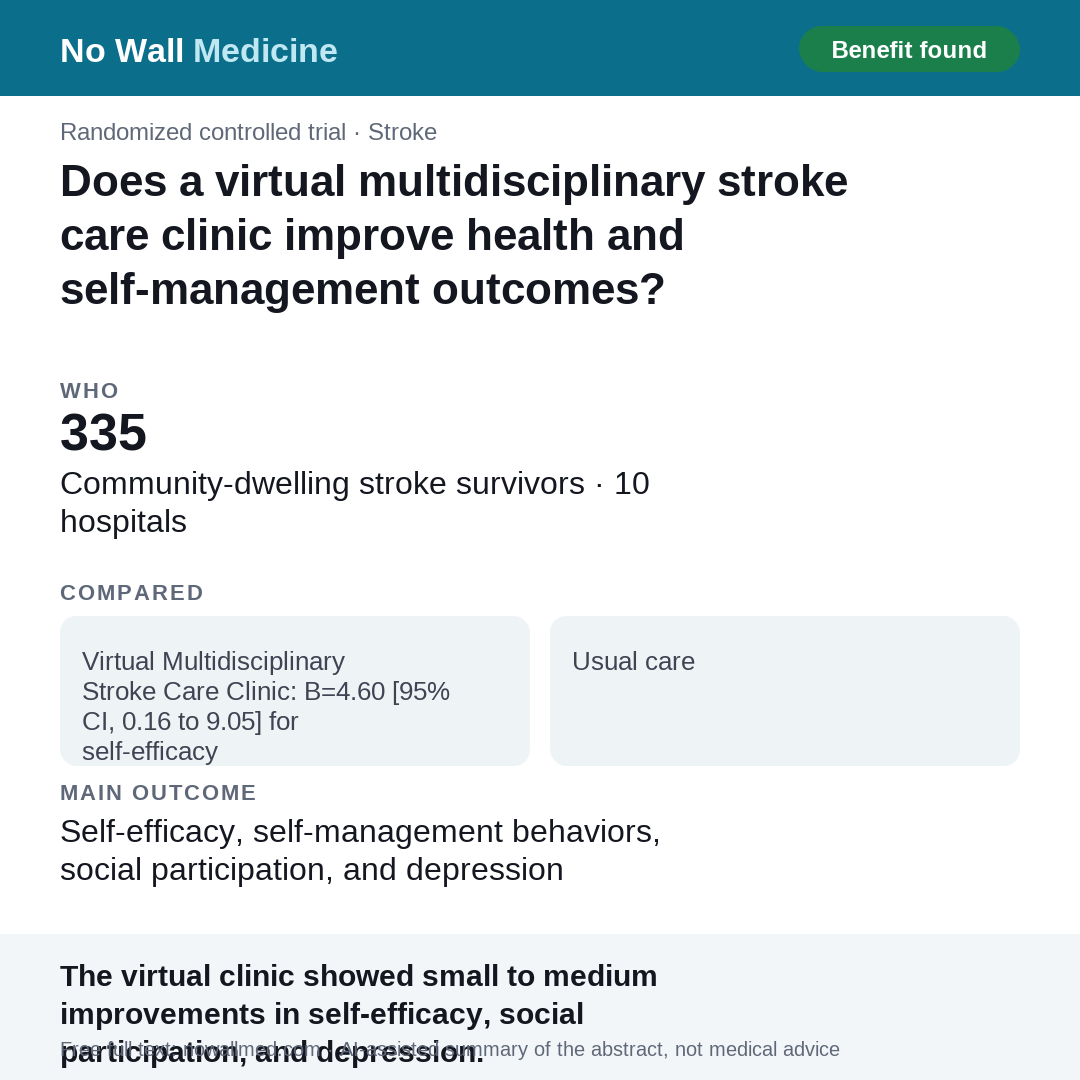
Clinical question: Does a virtual multidisciplinary stroke care clinic improve health and self-management outcomes?
Why it matters: Stroke survivors often feel helpless and unprepared after hospital discharge, and more flexible support is needed for their recovery.
Key points
- Researchers conducted a randomized controlled trial with 335 stroke survivors who received either monthly online nurse consultations and an online platform or usual care.
- At 6 months, the intervention group showed significantly greater improvements in self-efficacy (B=4.60), social participation (B=5.07), and depression (B=-2.33) compared to the control group.
- The virtual clinic did not show a significant improvement in the performance of self-management behaviors (B=3.45).
Limitation the authors note: The authors state that baseline levels were in favor of the control group, which might mean the intervention effects were overestimated.
Headline and key points written with AI from the paper’s abstract, with every number checked against it. Read the paper before relying on them.
Topics
Cite this article
Lo SHS, Chau JPC, Lau AYL, Choi KC, Shum EWC, Lee VWY. Virtual Multidisciplinary Stroke Care Clinic for Community-Dwelling Stroke Survivors: A Randomized Controlled Trial. Stroke. 2023. doi:10.1161/STROKEAHA.123.043605
Spotted a mistake? Suggest a correction
Top studies every Monday
The week’s key trials and guidelines in your specialties, plus any topics you follow. By email, free.
Get the weekly digest