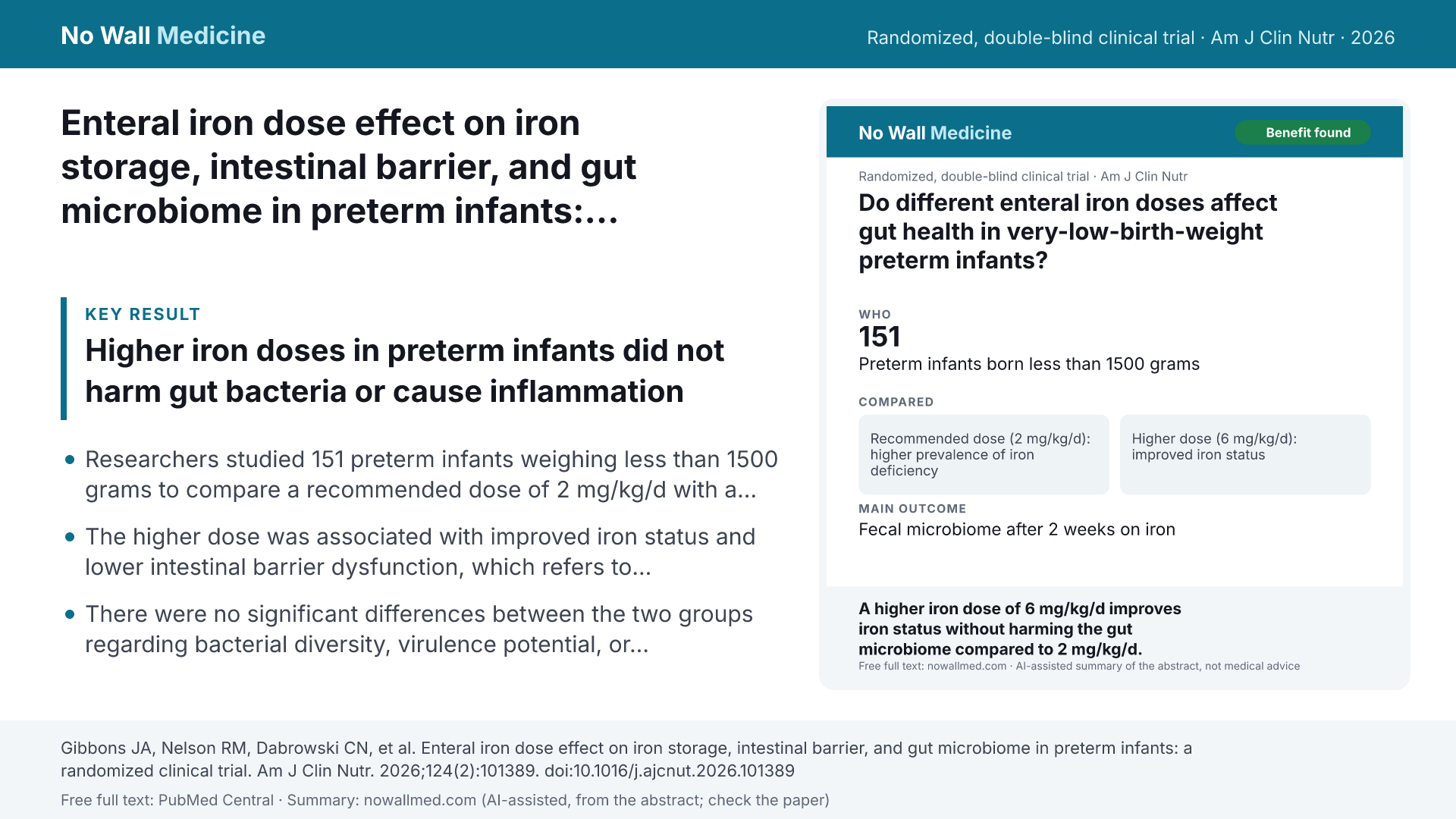
Higher iron doses in preterm infants did not harm gut bacteria or cause inflammation
Enteral iron dose effect on iron storage, intestinal barrier, and gut microbiome in preterm infants: a randomized clinical trial
Randomized, double-blind clinical trialBenefit found
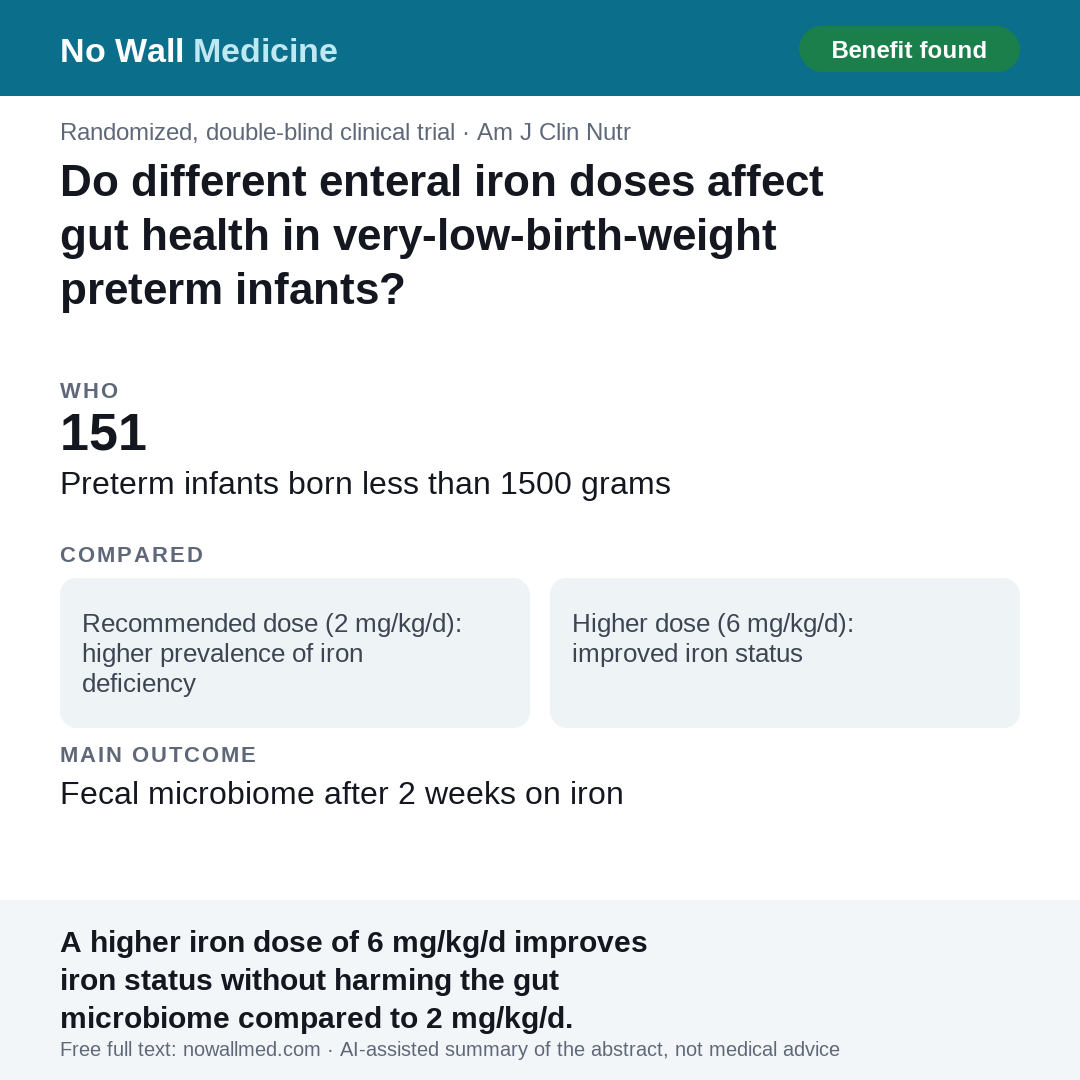
Do different enteral iron doses affect gut health in very-low-birth-weight preterm infants?
Who
151
Preterm infants born less than 1500 grams
Compared
Recommended dose (2 mg/kg/d): higher prevalence of iron deficiency
Higher dose (6 mg/kg/d): improved iron status
Main outcome
Fecal microbiome after 2 weeks on iron
Bottom line: A higher iron dose of 6 mg/kg/d improves iron status without harming the gut microbiome compared to 2 mg/kg/d.
Limitation: Subgroup analysis of singletons showed significant differences in temporal shifts in bacterial community structure.
Am J Clin Nutr · 2026-06-09Download image
Clinical question: Do different enteral iron doses affect gut health in very-low-birth-weight preterm infants?
Why it matters: Concerns regarding potential harms of iron supplementation on the gut microbiome have contributed to recommendations for lower dosing in preterm infants.
Key points
- Researchers studied 151 preterm infants weighing less than 1500 grams to compare a recommended dose of 2 mg/kg/d with a higher dose of 6 mg/kg/d.
- The higher dose was associated with improved iron status and lower intestinal barrier dysfunction, which refers to the integrity of the gut lining.
- There were no significant differences between the two groups regarding bacterial diversity, virulence potential, or markers of intestinal inflammation.
Headline and key points written with AI from the paper’s abstract, with every number checked against it. Read the paper before relying on them.
Was this summary helpful?
Subject terms
Headline, design, result, key points, caveat and citation as plain text.
Cite this article
Gibbons JA, Nelson RM, Dabrowski CN, et al. Enteral iron dose effect on iron storage, intestinal barrier, and gut microbiome in preterm infants: a randomized clinical trial. Am J Clin Nutr. 2026;124(2):101389. doi:10.1016/j.ajcnut.2026.101389
Spotted a mistake? Suggest a correction