Hyperimmune bovine colostrum did not significantly reduce travellers' diarrhoea risk
Enterotoxigenic Escherichia coli hyperimmune bovine colostrum for preventing travellers' diarrhoea (TD): a randomised, double-blind, placebo-controlled trial
Randomised, double-blind trialNo clear difference
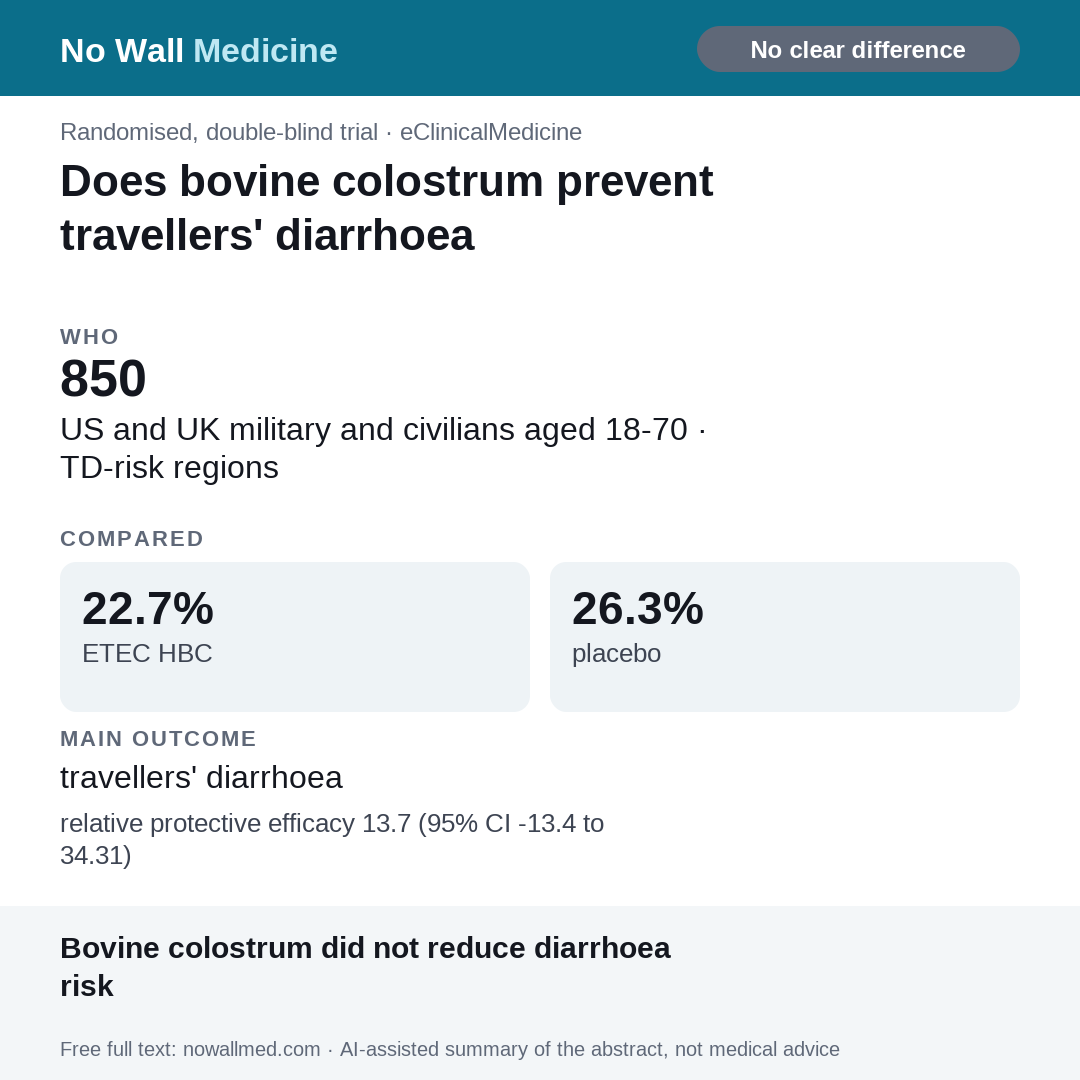
Does bovine colostrum prevent travellers' diarrhoea
Who
850
US and UK military and civilians aged 18-70 · TD-risk regions
Compared
22.7%ETEC HBC
26.3%placebo
Main outcome
travellers' diarrhoea
Result: relative protective efficacy 13.7 (95% CI -13.4 to 34.31)
Bottom line: Bovine colostrum did not reduce diarrhoea risk
Limitation: limited power for ETEC-specific efficacy
Funded by: Defense Health Agency
eClinicalMedicine · 2026-10-06Download image
Key points
- 975 participants were enrolled and 850 randomised to hyperimmune bovine colostrum or placebo.
- Travellers' diarrhoea occurred in 22.7% of hyperimmune bovine colostrum and 26.3% of placebo recipients.
- Adverse events were rare and mild, with 2 events in each group, all resolving spontaneously.
Headline and key points written with AI from the paper’s abstract, with every number checked against it. Read the paper before relying on them.
Cite this article
Lalani T, Copeland NK, Barton JQ, Schofield C, Colombo RE, Troth T. Enterotoxigenic Escherichia coli hyperimmune bovine colostrum for preventing travellers' diarrhoea (TD): a randomised, double-blind, placebo-controlled trial. eClinicalMedicine. 2026. doi:10.1016/j.eclinm.2026.104249
Spotted a mistake? Suggest a correction