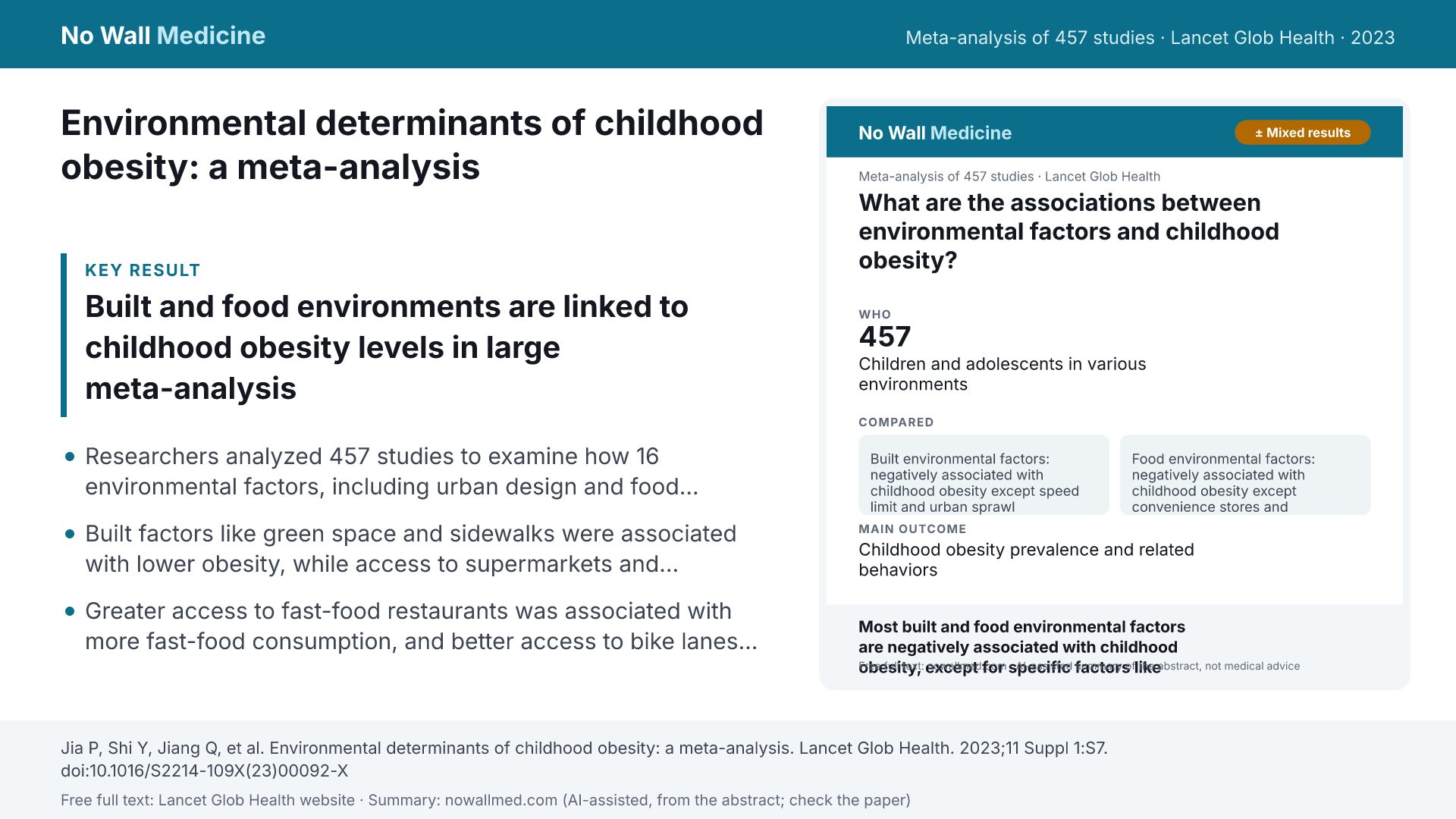
Built and food environments are linked to childhood obesity levels in large meta-analysis
Environmental determinants of childhood obesity: a meta-analysis
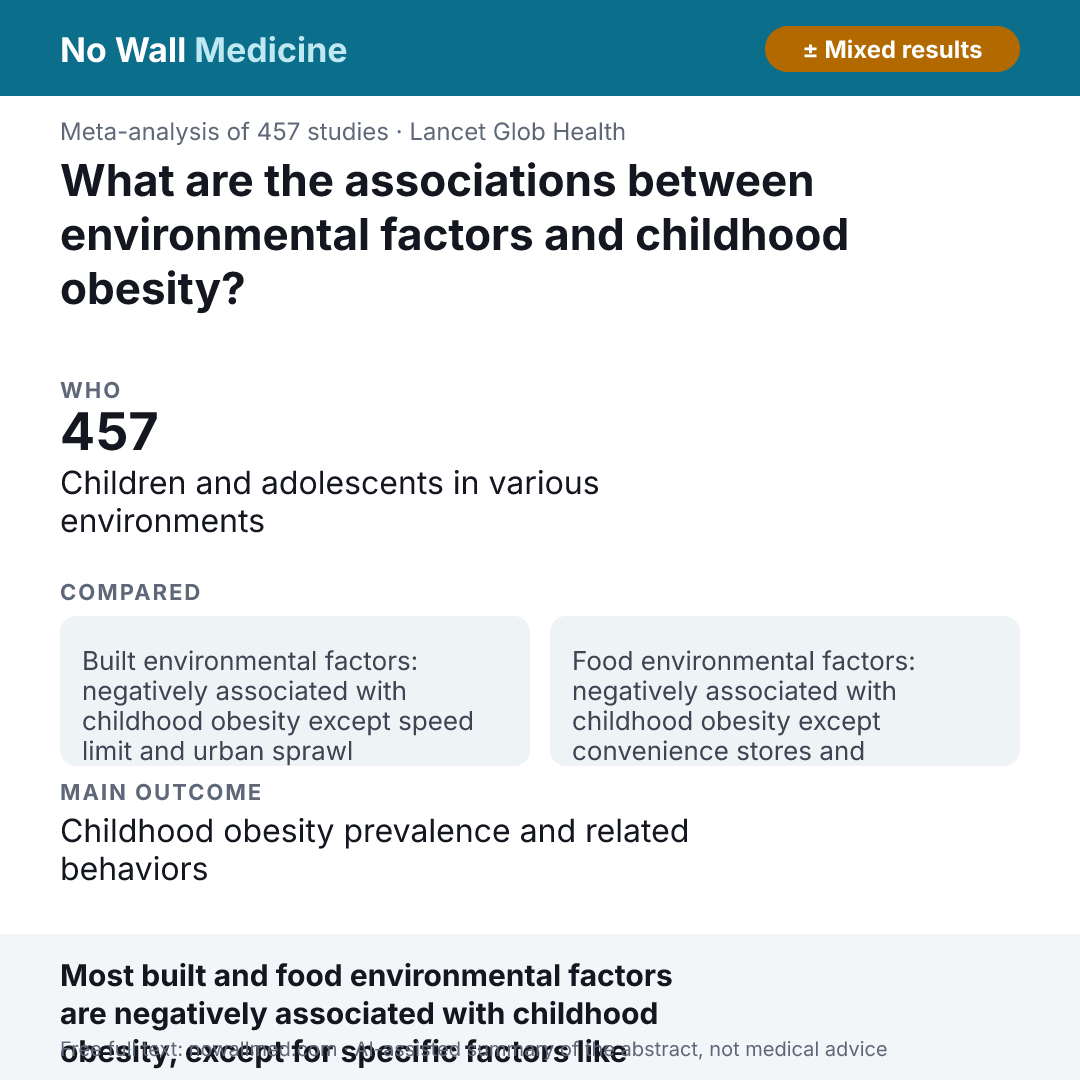
Meta-analysis of 457 studiesMixed results
What are the associations between environmental factors and childhood obesity?
Who
457
Children and adolescents in various environments
Compared
Built environmental factors: negatively associated with childhood obesity except speed limit and urban sprawl
Food environmental factors: negatively associated with childhood obesity except convenience stores and fast-food restaurants
Main outcome
Childhood obesity prevalence and related behaviors
Bottom line: Most built and food environmental factors are negatively associated with childhood obesity, except for specific factors like fast-food access.
Funded by: National Natural Science Foundation of China and others
Lancet Glob Health · 2023-03-03 · Save PNG
Clinical question: What are the associations between environmental factors and childhood obesity?
Key points
- Researchers analyzed 457 studies to examine how 16 environmental factors, including urban design and food access, were associated with childhood obesity.
- Built factors like green space and sidewalks were associated with lower obesity, while access to supermarkets and fruit markets was also associated with lower obesity.
- Greater access to fast-food restaurants was associated with more fast-food consumption, and better access to bike lanes was associated with more physical activity.
Headline and key points written with AI from the paper’s abstract, with every number checked against it. Read the paper before relying on them.
Was this summary helpful?
Abstract
Background
The increasing prevalence of childhood obesity has contributed to the growing global burden of chronic diseases over the life course, which has been largely attributed to obesogenic environments. This giant-scale review was done to translate existing obesogenic environmental studies into evidence-based governance for fighting childhood obesity and promoting life-course health. Methods
Following a standard strategy of literature search and inclusion, all obesogenic environmental studies, published since the inception of the electronic databases, were reviewed to identify the evidence on associations with childhood obesity of 16 obesogenic environmental factors, including 10 built environmental factors or indices (ie, land-use mix, street connectivity, residential density, speed limit, urban sprawl, and access to green space, public transport, bike lanes, sidewalks, and neighbourhood aesthetics) and six food environmental factors (ie, access to convenience stores, supermarkets, grocery stores, full-service restaurants, fast-food restaurants, and fruit and vegetable markets). A meta-analysis was conducted to quantify the influence of each factor with sufficient studies on childhood obesity. Findings
A total of 24 155 search results were found and filtered, with 457 studies included in the analysis. All built environmental factors, except speed limit and urban sprawl, were negatively associated with childhood obesity by encouraging physical activity while discouraging sedentary behaviours; the access to all food venues, except convenience stores and fast-food restaurants, was negatively associated with childhood obesity by encouraging their healthy eating behaviours. There were some globally consistent associations, such as between greater access to fast-food restaurants in the neighbourhood and more fast-food consumption, between better access to bike lanes and more physical activity, between better access to sidewalks and reduced sedentary behaviours, and between greater access to green space and more physical activity and less TV or computer screen time. Interpretation
Findings have formed the unprecedentedly inclusive evidence for policy making and the establishment of the future research agenda regarding the obesogenic environment. Funding
National Natural Science Foundation of China, Chengdu Technological Innovation R&D Project, Sichuan Provincial Key R&D Program, and Wuhan University Specific Fund for Major School-level Internationalization Initiatives.
Abstract reproduced under the article’s CC BY licence.
Subject terms
Headline, design, result, key points, caveat and citation as plain text.
Cite this article
Jia P, Shi Y, Jiang Q, et al. Environmental determinants of childhood obesity: a meta-analysis. Lancet Glob Health. 2023;11 Suppl 1:S7. doi:10.1016/S2214-109X(23)00092-X
Spotted a mistake? Suggest a correction