Review of food environment indicators shows gaps in monitoring childhood overweight and obesity
Food Environment and Childhood Overweight/Obesity: A Systematic Review
Why it matters: Current monitoring systems lack standardized, child-centered indicators to help guide policies for managing childhood overweight and obesity.
Key points
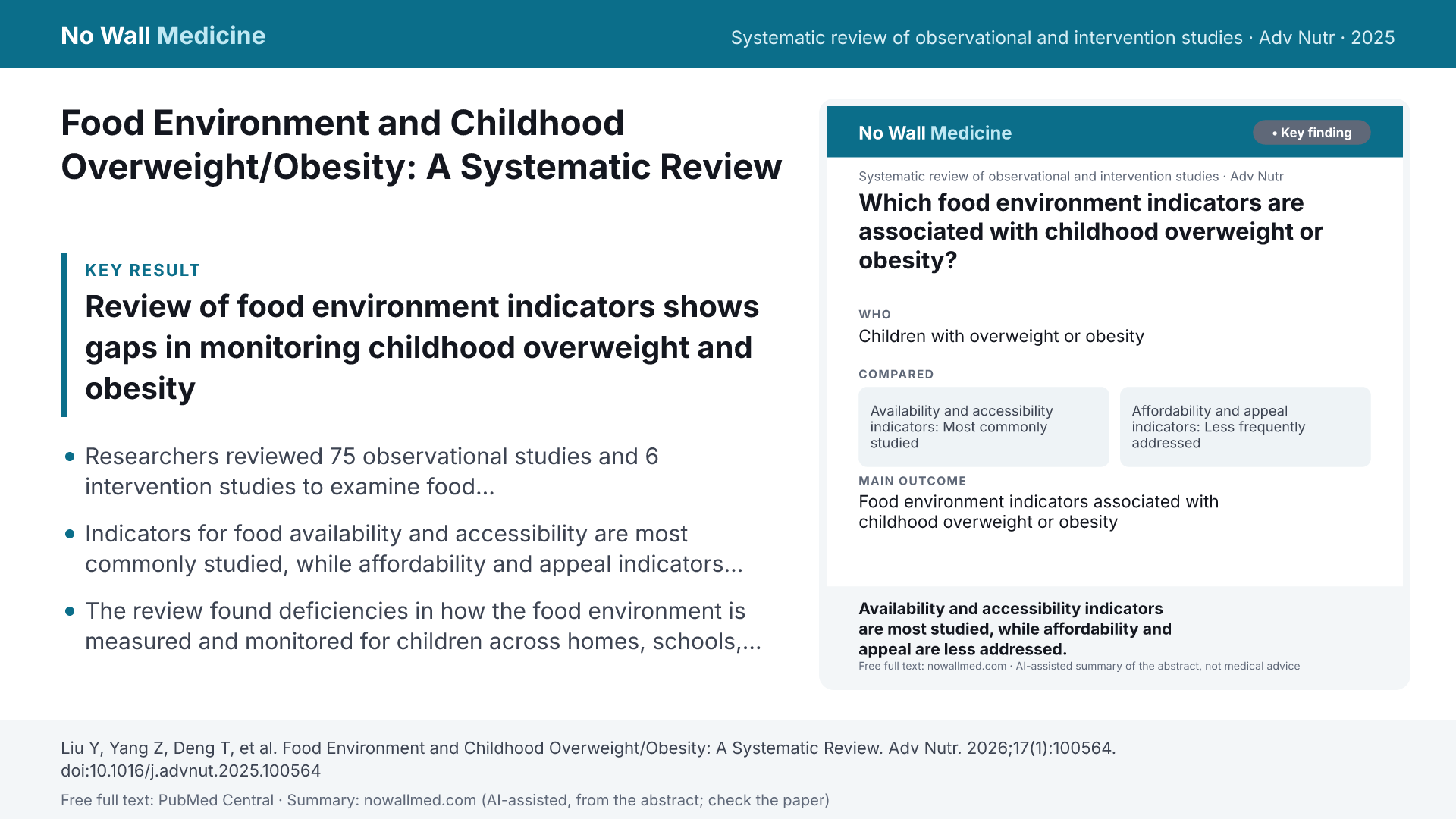
- Researchers reviewed 75 observational studies and 6 intervention studies to examine food availability, accessibility, affordability, and appeal for children.
- Indicators for food availability and accessibility are most commonly studied, while affordability and appeal indicators are less frequently addressed.
- The review found deficiencies in how the food environment is measured and monitored for children across homes, schools, and communities.
Headline and key points written with AI from the paper’s abstract, with every number checked against it. Read the paper before relying on them.
Was this summary helpful?
Subject terms
Headline, design, result, key points, caveat and citation as plain text.
Cite this article
Liu Y, Yang Z, Deng T, et al. Food Environment and Childhood Overweight/Obesity: A Systematic Review. Adv Nutr. 2026;17(1):100564. doi:10.1016/j.advnut.2025.100564
Spotted a mistake? Suggest a correction