Exposure to arsenic, cadmium, and vanadium is associated with increased urologic cancer risk
Environmental Nonessential Element Exposure and Urologic Cancer: A Systematic Review and Meta-Analysis
Systematic review and meta-analysisHarm found
Does environmental exposure to nonessential elements increase urologic cancer risk?
Who
Cohort and case-control studies
Compared
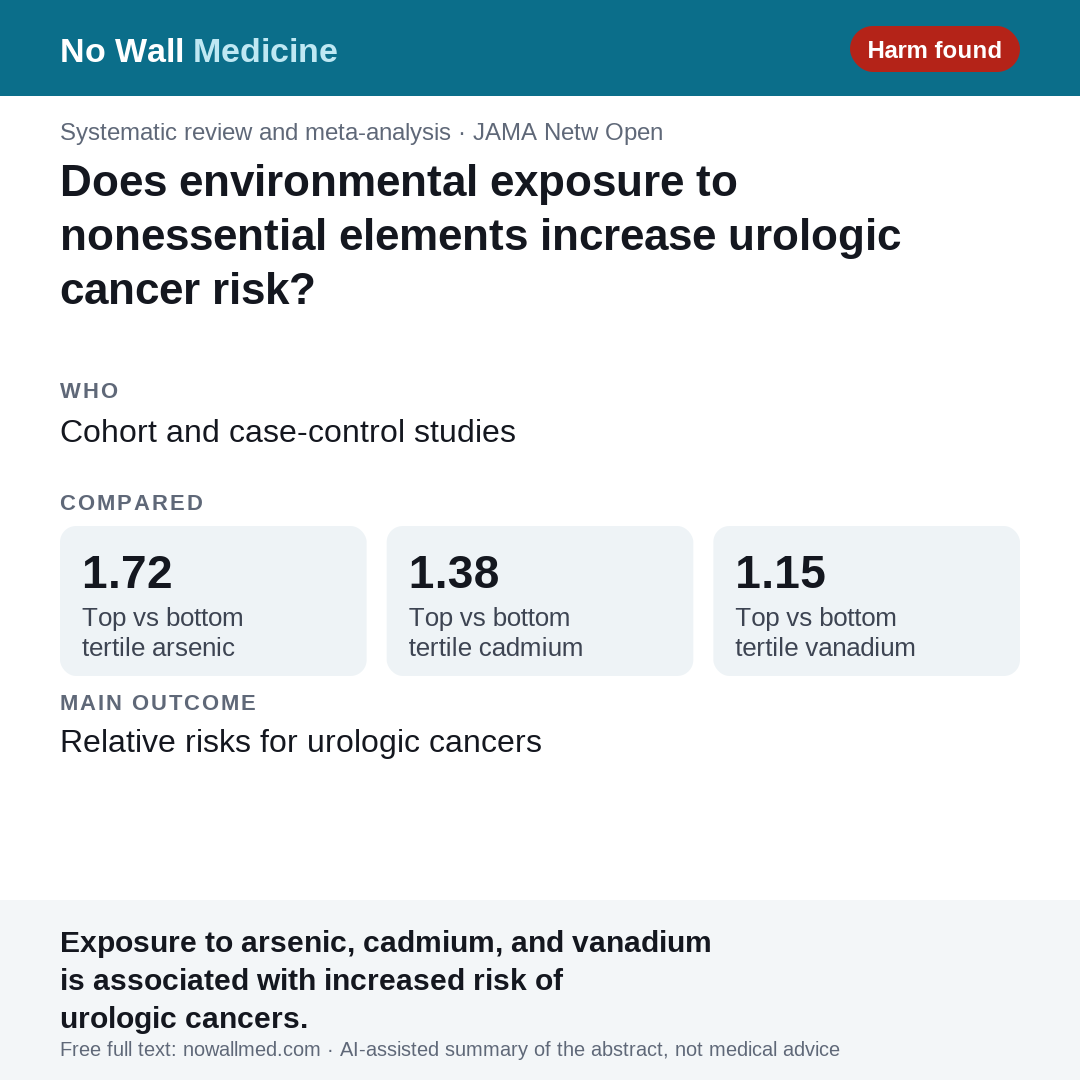
1.72Top vs bottom tertile arsenic exposure (95% CI, 1.33-2.22)
1.38Top vs bottom tertile cadmium exposure (95% CI, 1.04-1.82)
1.15Top vs bottom tertile vanadium exposure (95% CI, 1.05-1.26)
Main outcome
Relative risks for urologic cancers
Bottom line: Exposure to arsenic, cadmium, and vanadium is associated with increased risk of urologic cancers.
Limitation: High heterogeneity across studies limited interpretability.
JAMA Netw Open · 2026-05-01Download image
Clinical question: Does environmental exposure to nonessential elements increase urologic cancer risk?
Why it matters: The associations between low-level environmental exposure to nonessential chemical elements and the risk of urologic cancers are poorly understood.
Key points
- Researchers analyzed 62 studies to examine how exposure to nonessential elements like arsenic, cadmium, and vanadium affects the risk of cancers in the urinary system.
- High arsenic exposure was linked to a 1.72 relative risk for all urologic cancers and a 3.37 relative risk for urothelial carcinoma.
- Cadmium exposure showed a 1.38 relative risk for overall urologic cancer, while vanadium exposure showed a 1.15 relative risk.
Limitation the authors note: High heterogeneity across studies limited interpretability.
Headline and key points written with AI from the paper’s abstract, with every number checked against it. Read the paper before relying on them.
Topics
Spotted a mistake? Suggest a correction