Two cycles of cisplatin with radiation therapy showed non-inferior survival to three cycles
Epstein-Barr virus DNA-guided chemoradiotherapy for patients with low-risk locoregionally advanced nasopharyngeal carcinoma: a secondary 5-year follow-up analysis of an open-label, randomised controlled, phase 2 non-inferiority trial
Open-label, randomised, controlled, phase 2 non-inferiority trialBenefit found
Is two cycles of cisplatin non-inferior to three cycles for low-risk nasopharyngeal carcinoma?
Who
332
Low-risk locoregionally advanced nasopharyngeal carcinoma patients · Sun Yat-sen University Cancer Center
Compared
85.0%Two cycles cisplatin (95% CI, 79.4-90.4)
87.3%Three cycles cisplatin (95% CI, 82.2-92.4)
Main outcome
5-year progression-free survival
Result: difference 2.4%; 95% CI, -5.0%-9.8%
Bottom line: Two cycles of cisplatin with intensity-modulated radiation therapy provide comparable survival with fewer late toxicities than three cycles.
Limitation: The study was conducted at a single center, limiting generalisability to non-endemic regions.
Funded by: National Key Research and Development Program of China and others
eClinicalMedicine · 2025-10-30Download image
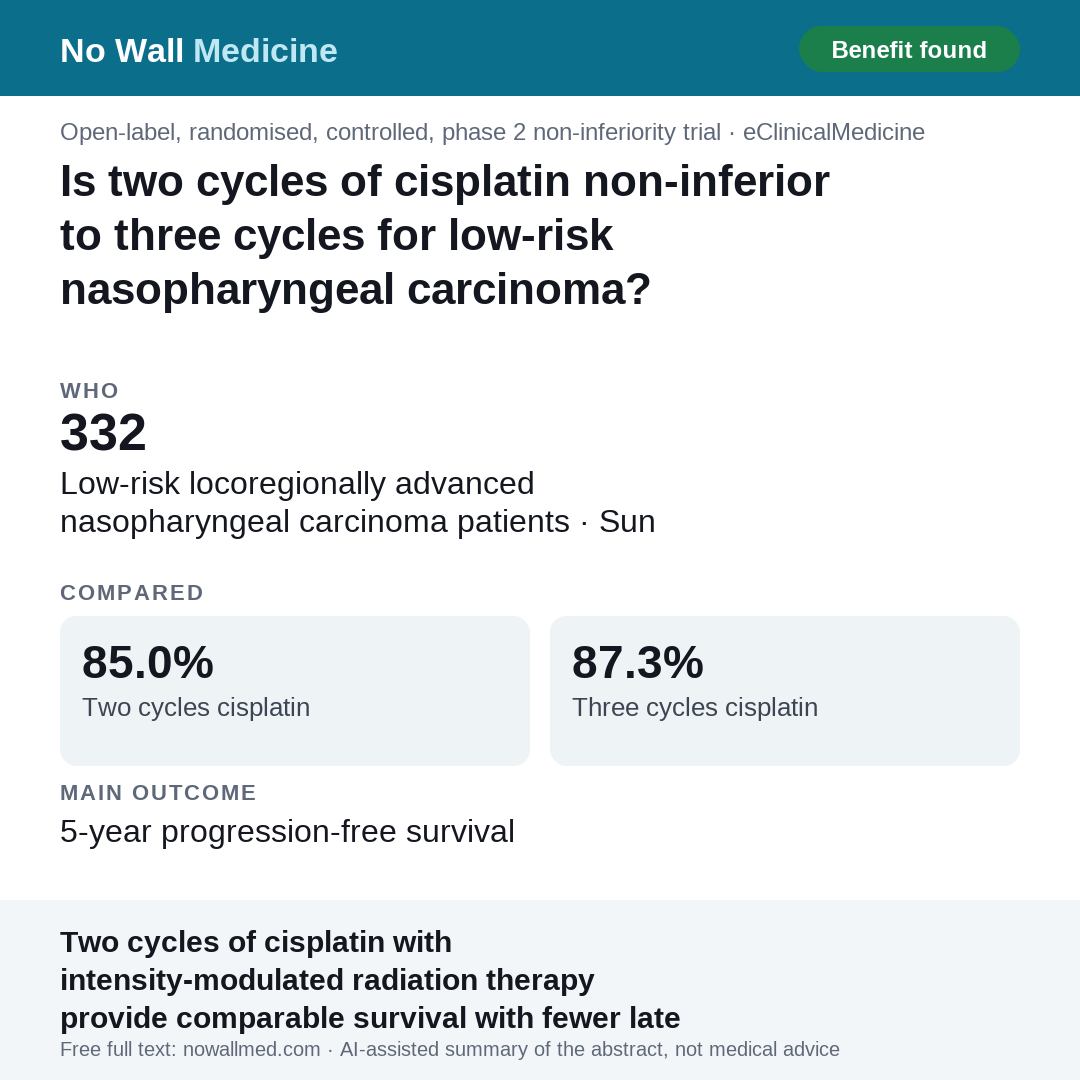
Clinical question: Is two cycles of cisplatin non-inferior to three cycles for low-risk nasopharyngeal carcinoma?
Why it matters: It is unclear if reducing cisplatin from three cycles to two cycles maintains survival outcomes while reducing long-term side effects in low-risk patients.
Key points
- Researchers studied 332 patients with low-risk locoregionally advanced nasopharyngeal carcinoma, comparing two cycles of cisplatin and radiation to three cycles.
- At a median follow-up of 79.7 months, the 5-year progression-free survival rate was 85.0% for the two-cycle group versus 87.3% for the three-cycle group.
- The three-cycle group had higher rates of late toxicities including trismus at 22.4% versus 12.7%, xerostomia at 83.0% versus 72.9%, and hearing impairment at 55.8% versus 44.0%.
Limitation the authors note: The study was conducted at a single center, which may affect how well the findings apply to other regions.
Headline and key points written with AI from the paper’s abstract, with every number checked against it. Read the paper before relying on them.
Was this summary helpful?
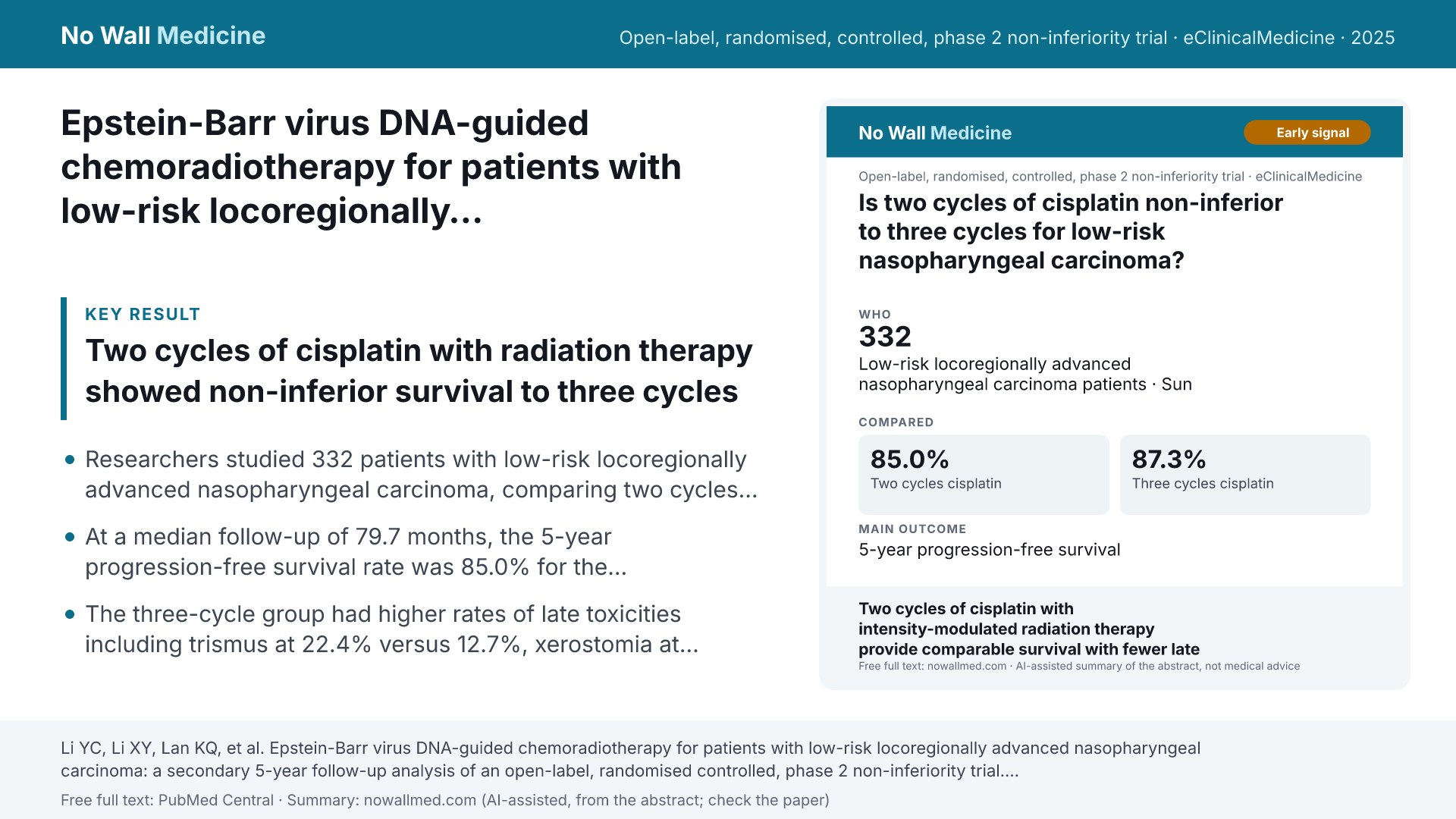
Cite this article
Li YC, Li XY, Lan KQ, Cheng H, Chen J, Liu LT. Epstein-Barr virus DNA-guided chemoradiotherapy for patients with low-risk locoregionally advanced nasopharyngeal carcinoma: a secondary 5-year follow-up analysis of an open-label, randomised controlled, phase 2 non-inferiority trial. eClinicalMedicine. 2025. doi:10.1016/j.eclinm.2025.103615
Spotted a mistake? Suggest a correction