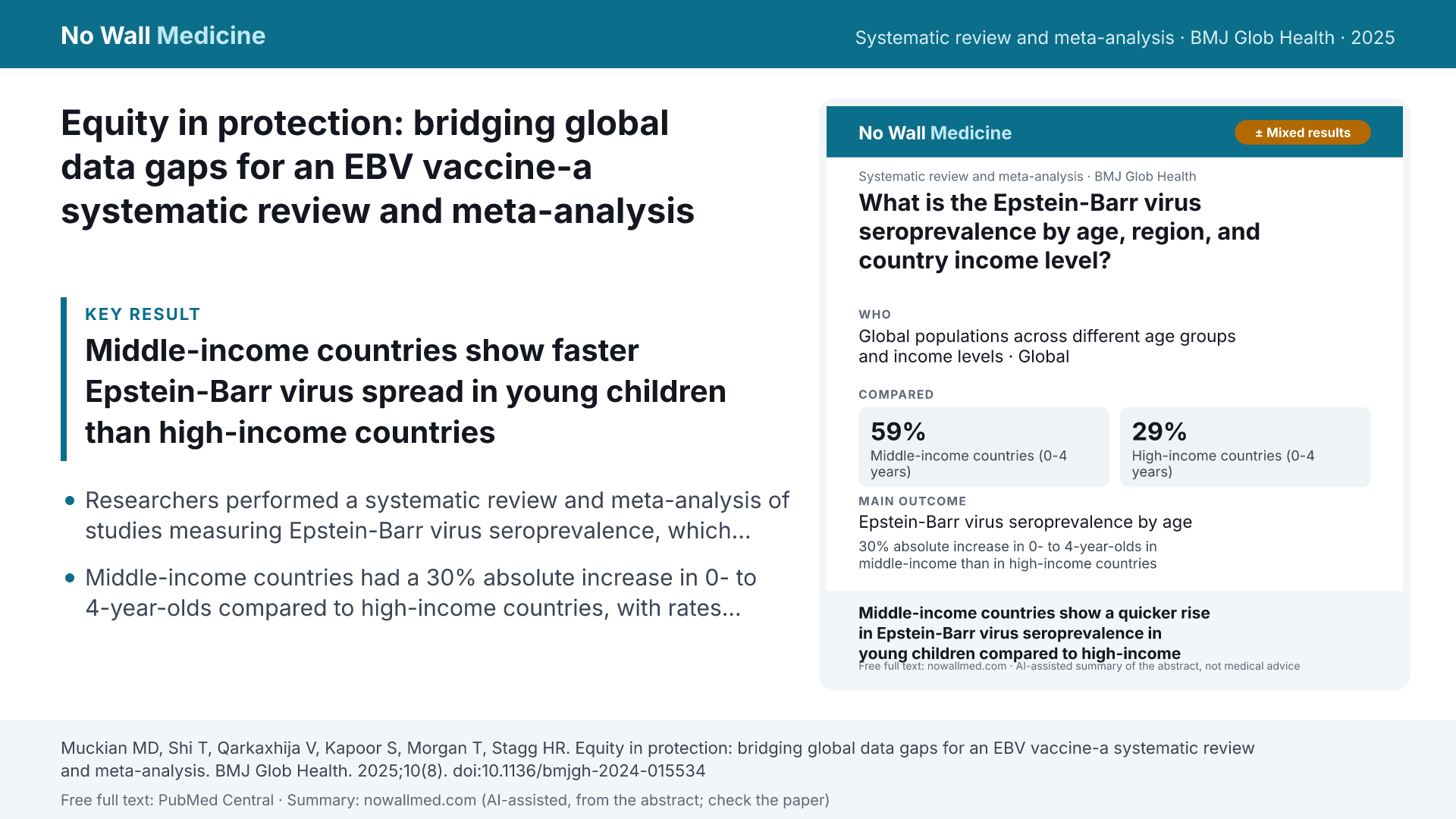
Middle-income countries show faster Epstein-Barr virus spread in young children than high-income countries
Equity in protection: bridging global data gaps for an EBV vaccine-a systematic review and meta-analysis
Systematic review and meta-analysisMixed results
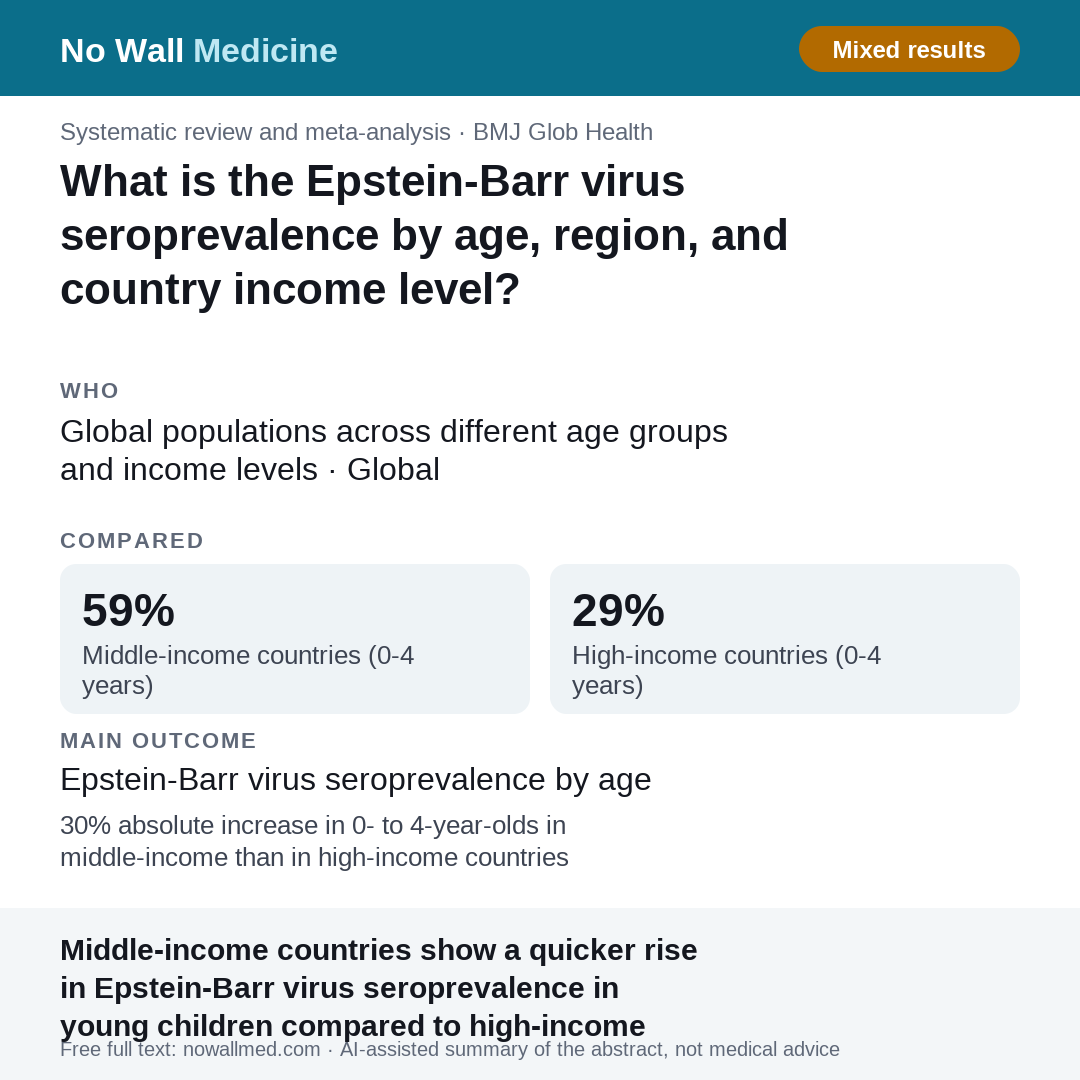
What is the Epstein-Barr virus seroprevalence by age, region, and country income level?
Who
Global populations across different age groups and income levels · Global
Compared
59%Middle-income countries (0-4 years) (95% CI 28 to 91%, I2=99%)
29%High-income countries (0-4 years) (95% CI 16 to 41%, I2=99%)
Main outcome
Epstein-Barr virus seroprevalence by age
Result: 30% absolute increase in 0- to 4-year-olds in middle-income than in high-income countries
Bottom line: Middle-income countries show a quicker rise in Epstein-Barr virus seroprevalence in young children compared to high-income countries.
Limitation: Data variability and limited consistency of methodologies and seroprevalence measurements hindered comprehensive meta-analyses.
BMJ Glob Health · 2025-08-14Download image
Clinical question: What is the Epstein-Barr virus seroprevalence by age, region, and country income level?
Why it matters: Data on the age at which people acquire Epstein-Barr virus is needed to guide vaccine roll-out, especially in resource-limited settings.
Key points
- Researchers performed a systematic review and meta-analysis of studies measuring Epstein-Barr virus seroprevalence, which is the presence of antibodies in the blood, by age and location.
- Middle-income countries had a 30% absolute increase in 0- to 4-year-olds compared to high-income countries, with rates of 59% versus 29%.
- The Western Pacific region was associated with higher seroprevalence in younger age groups than other World Health Organization regions.
Limitation the authors note: Data variability and limited consistency of methodologies and Epstein-Barr virus seroprevalence measurements hindered comprehensive meta-analyses across all regions and countries.
Headline and key points written with AI from the paper’s abstract, with every number checked against it. Read the paper before relying on them.
Was this summary helpful?
Abstract
Introduction
Epstein-Barr virus (EBV) is linked to multiple malignancies and autoimmune conditions, with different disease burdens globally. Pharmaceutical companies and researchers are placing substantial investment in the development of EBV vaccines. To ensure optimal vaccine roll-out, particularly in resource-limited settings, it is essential to have data on the age at acquisition of EBV. This study aimed to systematically review and meta-analyse seroprevalence by age and country, WHO region and country income level, identify knowledge gaps, and determine an approach to bridge these gaps. Methods
MEDLINE, Embase and Web of Science were searched on 22 March 2022 for studies that measured EBV seroprevalence by age. An updated search was conducted on 22 October 2022. There were no language restrictions. Papers were assessed for quality using an adapted version of the Downs and Black checklist. Seroprevalence by age was estimated using a fixed-effect (country) or random-effects (WHO region and income) meta-analysis. This review has been registered on PROSPERO (CRD42022349900). Results
Only one country (USA) had enough data for a country meta-analysis. WHO regional analyses revealed the Western Pacific region to have a higher seroprevalence in younger age groups than other WHO regions. Country income level better explained seroprevalence trends per age. Middle-income countries displayed a quicker rise to balance seroprevalence than high-income countries, with a 30% absolute increase in 0- to 4-year-olds in middle-income than in high-income countries (59% [95% CI 28 to 91%, I2=99%] vs 29% [95% CI 16 to 41%, I2=99%]). Conclusion
This first meta-analysis producing estimates of EBV seroprevalence by age provides crucial information to guide governments when using a vaccine for EBV. However, data variability and limited consistency of methodologies and EBV seroprevalence measurements hindered comprehensive meta-analyses across all WHO regions and countries. This study provides an interim framework for the extrapolation of seroprevalence using country-specific income levels to aid vaccine roll-out decisions. Prospero registration number
CRD42022349900.
Abstract reproduced under the article’s CC BY NC licence.
Subject terms
Cite this article
Muckian MD, Shi T, Qarkaxhija V, Kapoor S, Morgan T, Stagg HR. Equity in protection: bridging global data gaps for an EBV vaccine-a systematic review and meta-analysis. BMJ Glob Health. 2025. doi:10.1136/bmjgh-2024-015534
Spotted a mistake? Suggest a correction