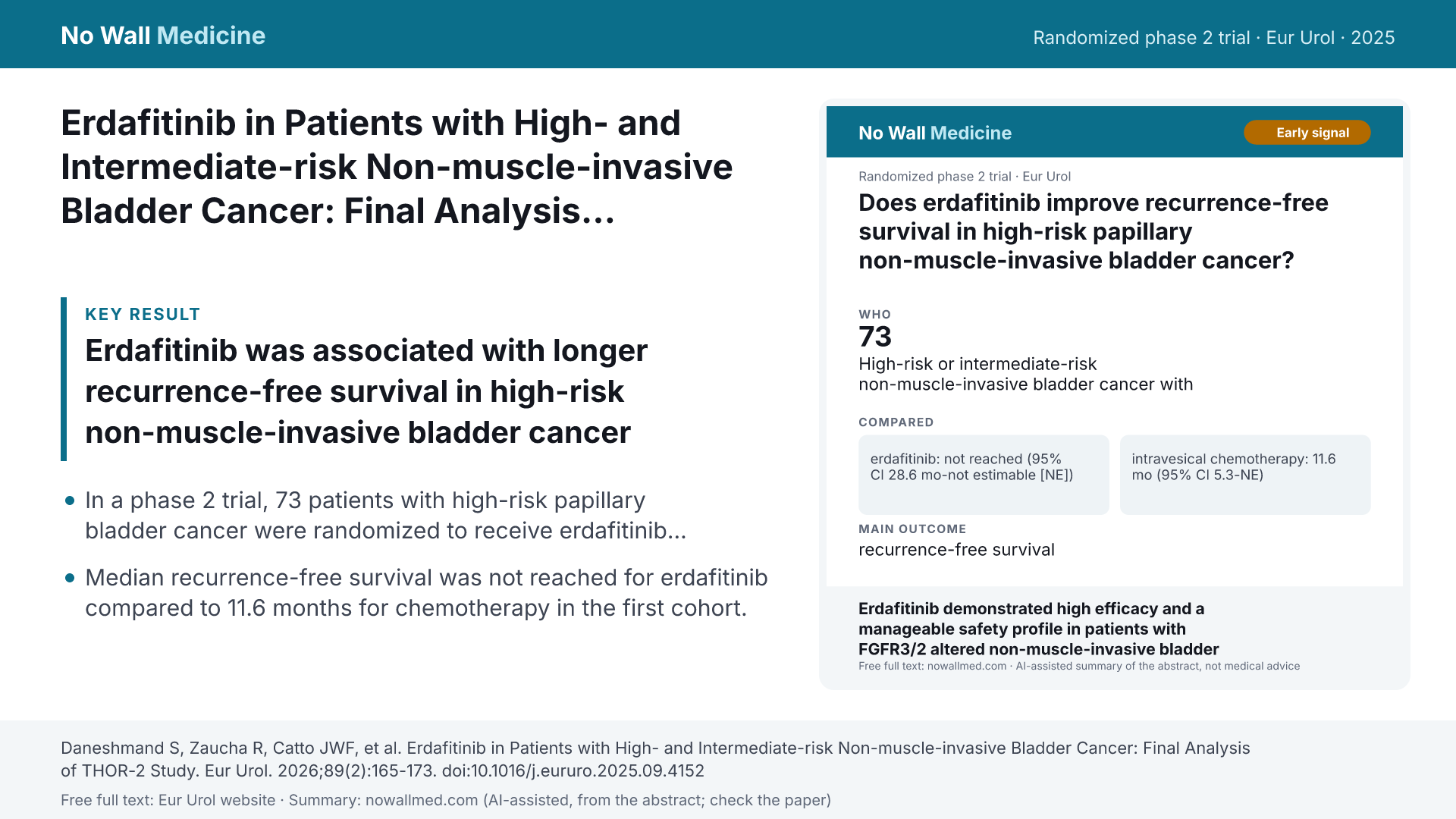
Erdafitinib was associated with longer recurrence-free survival in high-risk non-muscle-invasive bladder cancer
Erdafitinib in Patients with High- and Intermediate-risk Non-muscle-invasive Bladder Cancer: Final Analysis of THOR-2 Study
Randomized phase 2 trialEarly signal
Does erdafitinib improve recurrence-free survival in high-risk papillary non-muscle-invasive bladder cancer?
Who
73
High-risk or intermediate-risk non-muscle-invasive bladder cancer with FGFR3/2 alterations
Compared
erdafitinib: not reached (95% CI 28.6 mo-not estimable [NE])
intravesical chemotherapy: 11.6 mo (95% CI 5.3-NE)
Main outcome
recurrence-free survival
Result: hazard ratio 0.28 (95% CI 0.13-0.61)
Bottom line: Erdafitinib demonstrated high efficacy and a manageable safety profile in patients with FGFR3/2 altered non-muscle-invasive bladder cancer.
Limitation: Early termination in cohort 1 and small sample size that precluded prespecified hypothesis testing.
Eur Urol · 2025-10-07Download image
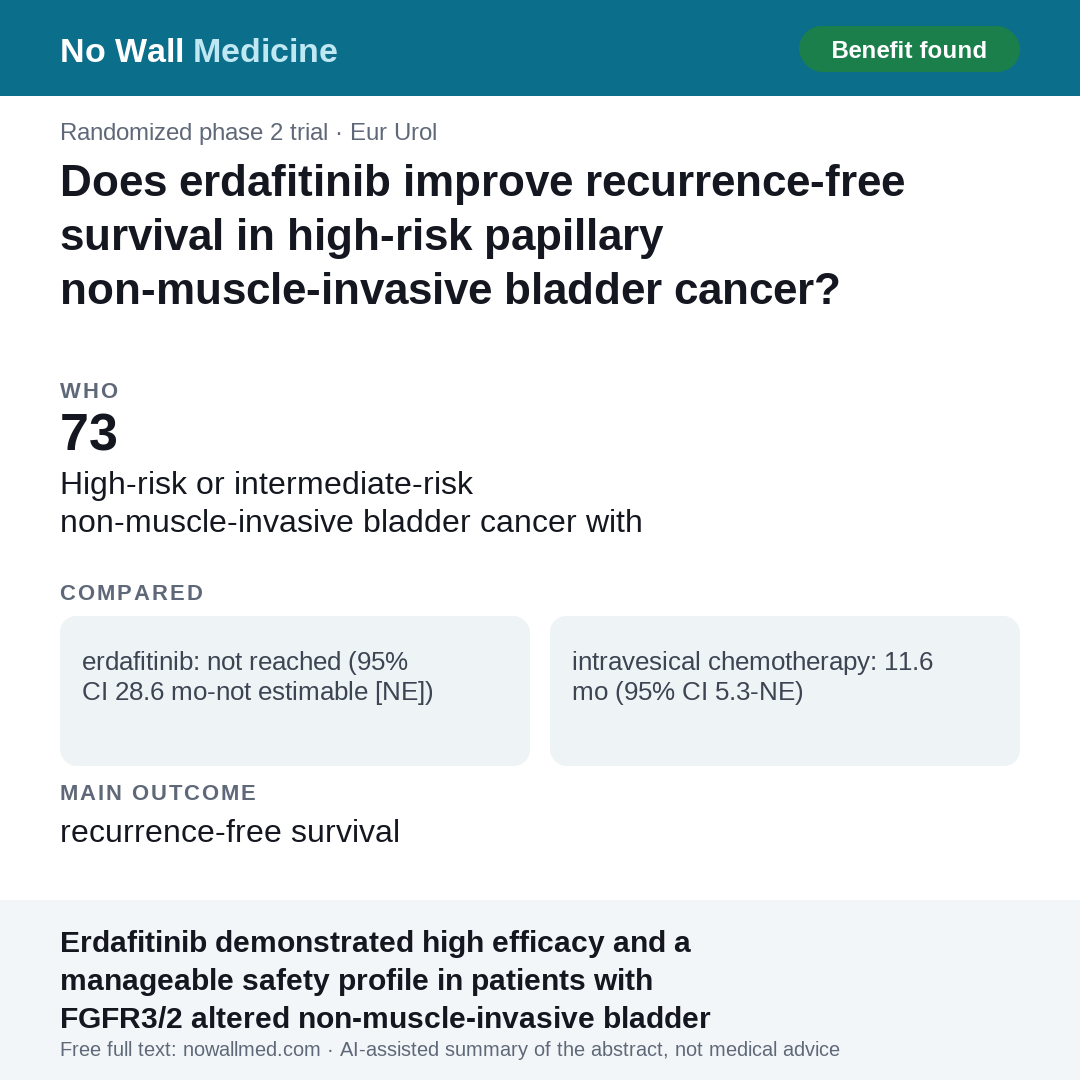
Clinical question: Does erdafitinib improve recurrence-free survival in high-risk papillary non-muscle-invasive bladder cancer?
Why it matters: Patients with high- or intermediate-risk non-muscle-invasive bladder cancer and fibroblast growth factor receptor 3/2 alterations face a high probability of cancer recurrence or progression.
Key points
- In a phase 2 trial, 73 patients with high-risk papillary bladder cancer were randomized to receive erdafitinib or intravesical chemotherapy.
- Median recurrence-free survival was not reached for erdafitinib compared to 11.6 months for chemotherapy in the first cohort.
- Hyperphosphatemia, or high blood phosphate levels, was the most common treatment-related adverse event in 76% of patients receiving erdafitinib.
Limitation the authors note: The study had an early termination in cohort 1 and a small sample size that precluded prespecified hypothesis testing.
Headline and key points written with AI from the paper’s abstract, with every number checked against it. Read the paper before relying on them.
Was this summary helpful?
Subject terms
Cite this article
Daneshmand S, Zaucha R, Catto JWF, et al. Erdafitinib in Patients with High- and Intermediate-risk Non-muscle-invasive Bladder Cancer: Final Analysis of THOR-2 Study. Eur Urol. 2025. doi:10.1016/j.eururo.2025.09.4152
Spotted a mistake? Suggest a correction