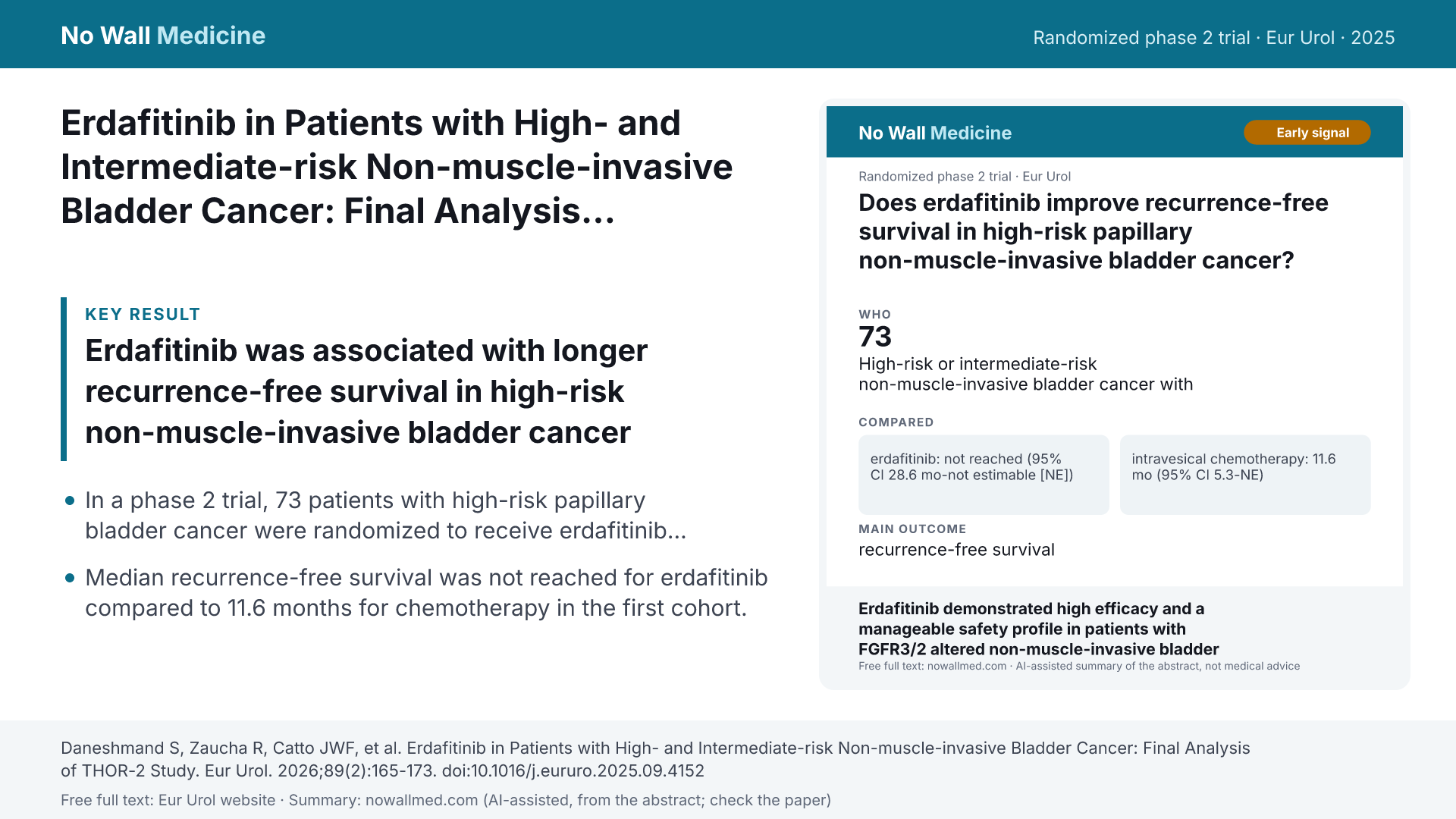
Erdafitinib in Patients with High- and Intermediate-risk Non-muscle-invasive Bladder Cancer: Final Analysis of THOR-2 Study
Key result: Erdafitinib was associated with longer recurrence-free survival in high-risk non-muscle-invasive bladder cancer
Key points
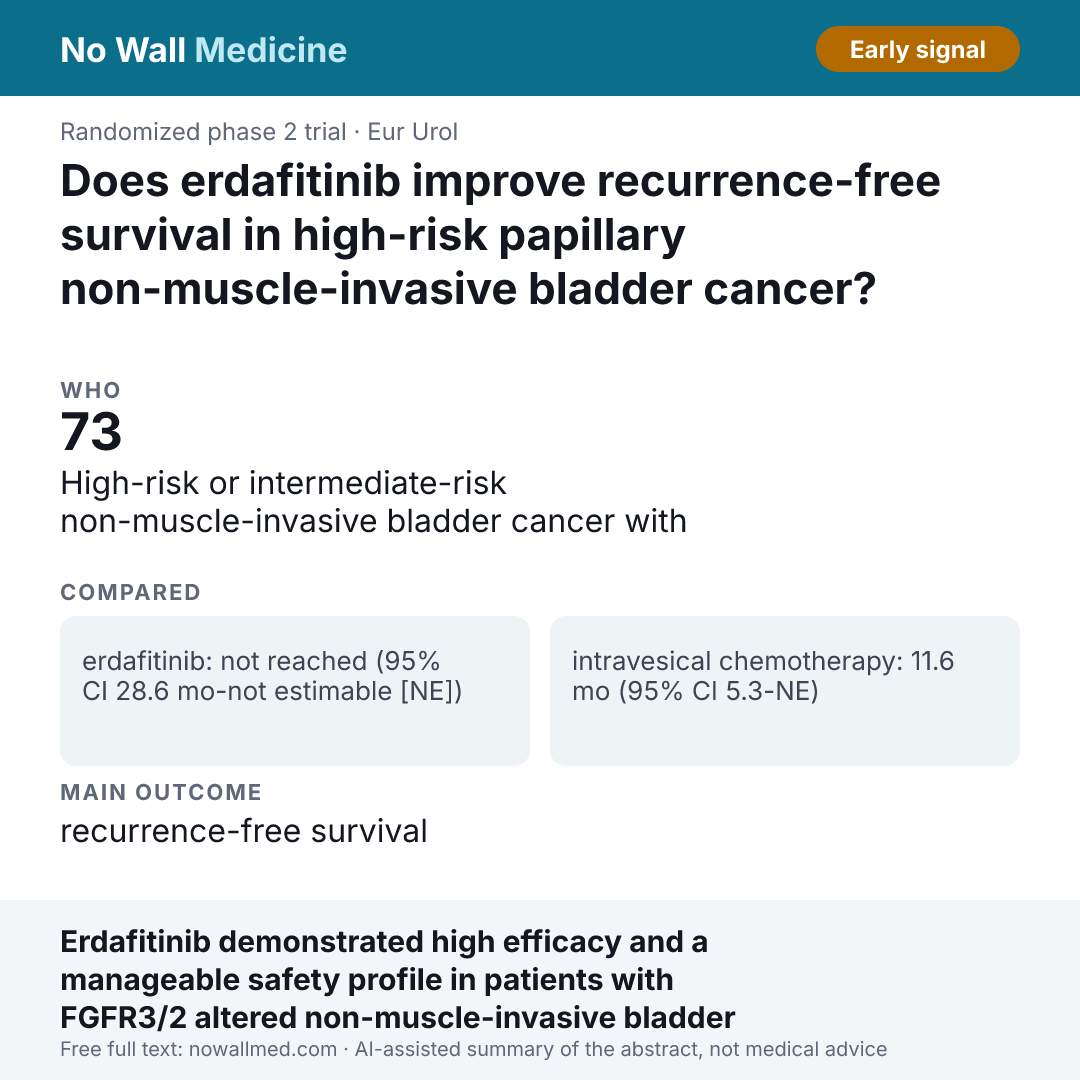
- In a phase 2 trial, 73 patients with high-risk papillary bladder cancer were randomized to receive erdafitinib or intravesical chemotherapy.
- Median recurrence-free survival was not reached for erdafitinib compared to 11.6 months for chemotherapy in the first cohort.
- Hyperphosphatemia, or high blood phosphate levels, was the most common treatment-related adverse event in 76% of patients receiving erdafitinib.
Why it matters: Patients with high- or intermediate-risk non-muscle-invasive bladder cancer and fibroblast growth factor receptor 3/2 alterations face a high probability of cancer recurrence or progression.
Limitation the authors note: The study had an early termination in cohort 1 and a small sample size that precluded prespecified hypothesis testing.
Discussion prompts
- Would these patients look like yours? Who was left out?
- Is the main outcome one that matters to patients?
- Is the difference large enough to change what you do?
Cite: Daneshmand S, Zaucha R, Catto JWF, et al. Erdafitinib in Patients with High- and Intermediate-risk Non-muscle-invasive Bladder Cancer: Final Analysis of THOR-2 Study. Eur Urol. 2026;89(2):165-173. doi:10.1016/j.eururo.2025.09.4152
Free full text: Eur Urol website · Summary and visual abstract: nowallmed.com/a/erdafitinib-in-patients-with-high-and-intermediate-risk-non-muscle-1448ubj/ (AI-assisted from the abstract; check the paper before relying on it).