Robotic surgical training curricula commonly include didactic teaching, dry laboratory skills, and virtual reality simulation
Essential components and validation of multi-specialty robotic surgical training curricula: a systematic review
Systematic reviewMixed results
What are the essential components and validity of multi-specialty robotic surgical training curricula?
Who
66
Studies reporting on robotic surgical training curricula · MEDLINE, EMBASE, Emcare, and CINAHL databases
Compared
Common curriculum components: didactic teaching (n = 48, 72.7%)
Common curriculum components: dry laboratory skills (n = 46, 69.7%)
Common curriculum components: virtual reality simulation (n = 44, 66.7%)
Main outcome
Essential components and validity of robotic training curricula
Bottom line: Robotic training includes didactic teaching, dry lab, and simulation, but assessment methods vary and validation gaps remain.
Limitation: Majority of studies were single-center and observational with moderate methodological quality.
Int J Surg · 2025-04-01Download image
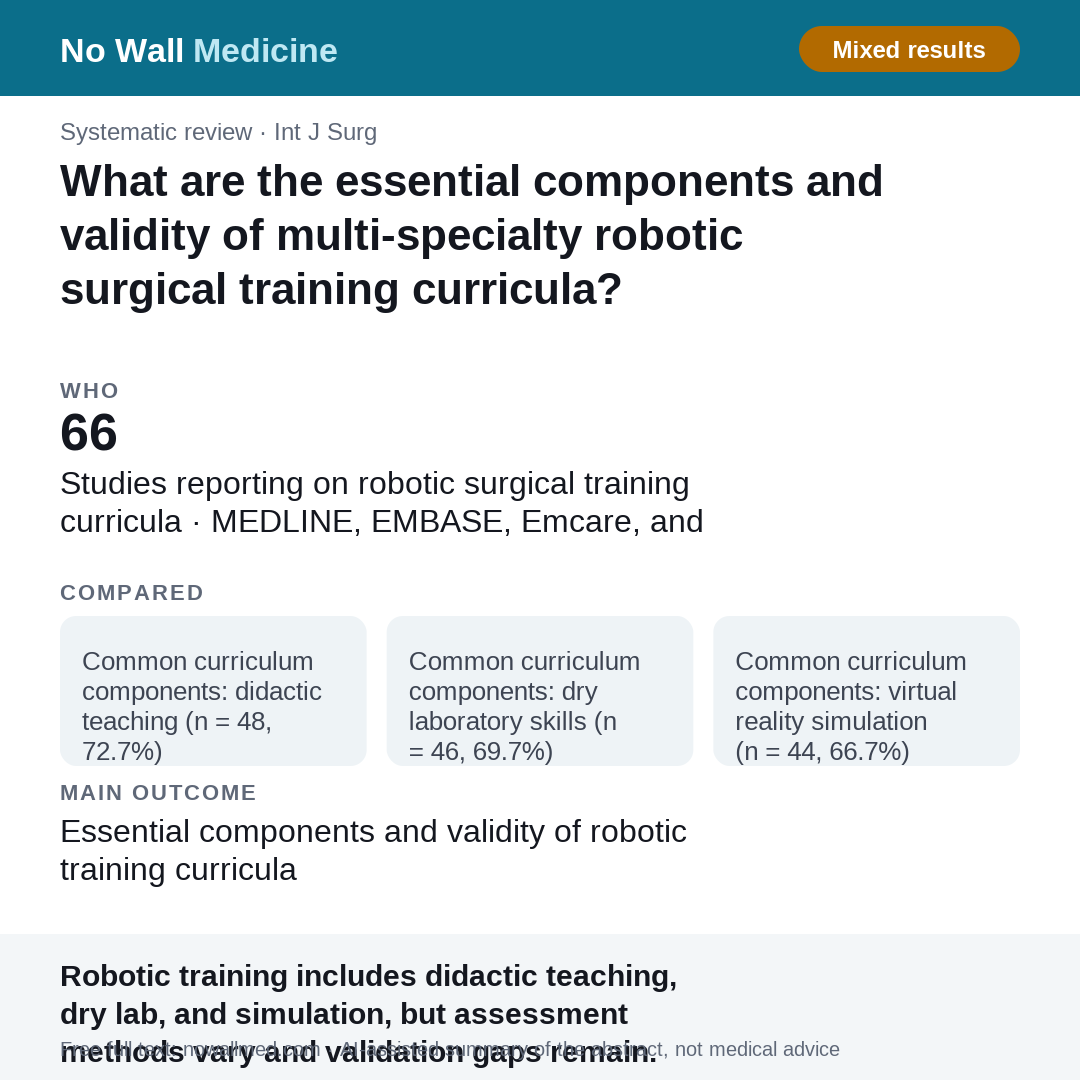
Clinical question: What are the essential components and validity of multi-specialty robotic surgical training curricula?
Why it matters: Standardized training and competency assessment for surgeons have not kept pace with the rapid adoption of robotic surgical systems.
Key points
- Researchers reviewed 66 articles from 3687 studies to identify essential components and validity of robotic surgical training curricula across various specialties.
- Common training components included didactic teaching in 72.7% of studies, dry laboratory skills in 69.7%, and virtual reality simulation in 66.7%.
- Only 7.6% of studies were fully evaluated using Messick's framework for validity, and none were fully evaluated using Kirkpatrick's model.
Limitation the authors note: The majority of included studies were single-center (78.8%) and observational (87.9%) in nature.
Headline and key points written with AI from the paper’s abstract, with every number checked against it. Read the paper before relying on them.
Was this summary helpful?
Subject terms
Cite this article
Walshaw J, Fadel MG, Boal M, Yiasemidou M, Elhadi M, Pecchini F. Essential components and validation of multi-specialty robotic surgical training curricula: a systematic review. Int J Surg. 2025. doi:10.1097/JS9.0000000000002284
Spotted a mistake? Suggest a correction
Top studies every Monday
The week’s key trials and guidelines in your specialties, plus any topics you follow. By email, free.
Get the weekly digest