Establishing an efficacy hierarchy for breakthrough cancer pain management: a network meta-analysis of rapid-onset fentanyl formulations and morphine
Network meta-analysisBenefit found
What works best for breakthrough cancer pain?
Who
1463
Adults with advanced malignancy
Compared
Intranasal fentanyl spray
Fentanyl buccal tablet
Oral morphine
Main outcome
Pain intensity difference
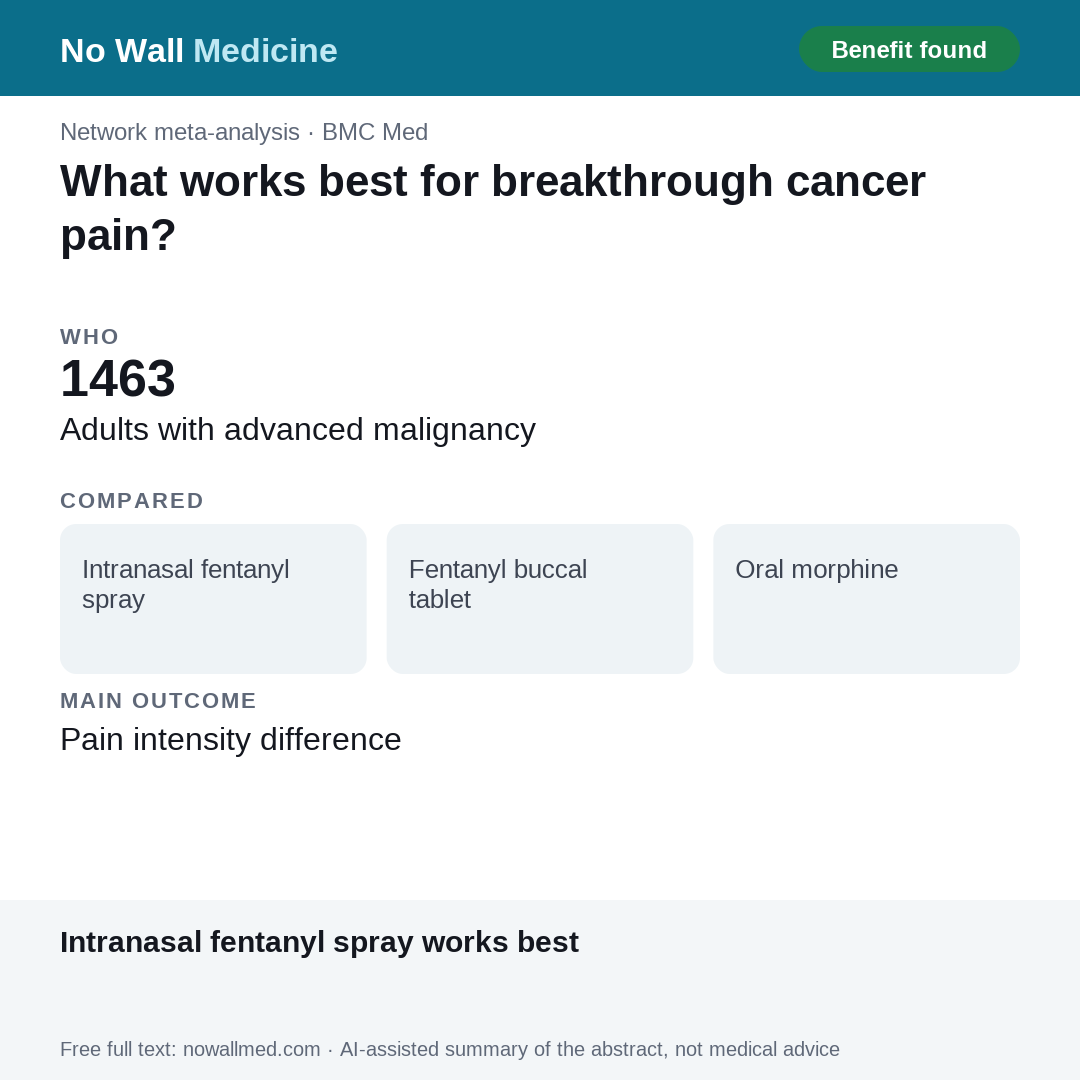
Bottom line: Intranasal fentanyl spray works best
BMC Med · 2026-07-08Download image
Clinical question: What works best for breakthrough cancer pain?
Abstract
Background
Breakthrough cancer pain (BTP) is a common and debilitating condition affecting most patients with advanced malignancy. While multiple rapid-onset opioid formulations are available, a lack of comprehensive comparative evidence has hindered evidence-based treatment selection. We conducted a network meta-analysis (NMA) to evaluate the relative efficacy of all available formulations and characterize their temporal analgesic profiles for BTP management. Methods
We performed a systematic search of PubMed, Embase, and the Cochrane Library for randomized controlled trials (RCTs) evaluating rapid-onset fentanyl formulations (intranasal fentanyl spray [INFS], fentanyl buccal tablet [FBT], fentanyl pectin nasal spray [FPNS], fentanyl sublingual tablet [FST], fentanyl buccal soluble film [FBSF], and oral transmucosal fentanyl citrate [OTFC]) and morphine preparations (oral morphine sulfate immediate release [MSIR] and subcutaneous morphine [SCM]) for BTP in adults. The primary outcome was the standardized mean difference (SMD) in pain intensity difference (PID) at 10, 15, 30, and 60 min post-administration. A frequentist random-effects NMA was conducted for each time point, and treatments were ranked using P-scores, a frequentist metric ranging from 0 to 1 that reflects the probability of a treatment being superior to competitors (higher values indicate better ranking; distinct from p-values for statistical significance). Results
Seventeen RCTs involving 1,463 patients were included. Intranasal fentanyl spray (INFS) was consistently the most effective treatment across all time points, demonstrating statistically significant pain relief within 10 min (SMD: 0.85; 95% CI: 0.59-1.10) and showing its peak effect at 15 min (SMD: 1.05; 95% CI: 0.67-1.42). Fentanyl buccal tablet (FBT) consistently ranked as the second most effective agent. In contrast, immediate-release oral morphine (MSIR) did not achieve statistical superiority over placebo until the 30-minute mark (SMD: 0.20; 95% CI: 0.01-0.39; p = 0.036), confirming a comparatively delayed onset of action. Conclusions
This analysis provides evidence for a relative efficacy hierarchy among rapid-onset opioids for BTP. INFS demonstrated the most rapid and sustained analgesia across all evaluated time points, while FBT consistently ranked second. The delayed onset of MSIR warrants consideration when selecting agents for rapid pain relief. Treatment selection should integrate these efficacy data with safety profiles, route feasibility, and patient-specific factors.
Topics
Cite this article
Tsao PH, Lee CH, Chen JH, Ho CL, Jhou HJ, Chen PH. Establishing an efficacy hierarchy for breakthrough cancer pain management: a network meta-analysis of rapid-onset fentanyl formulations and morphine. BMC Med. 2026. doi:10.1186/s12916-026-04993-8
Spotted a mistake? Suggest a correction