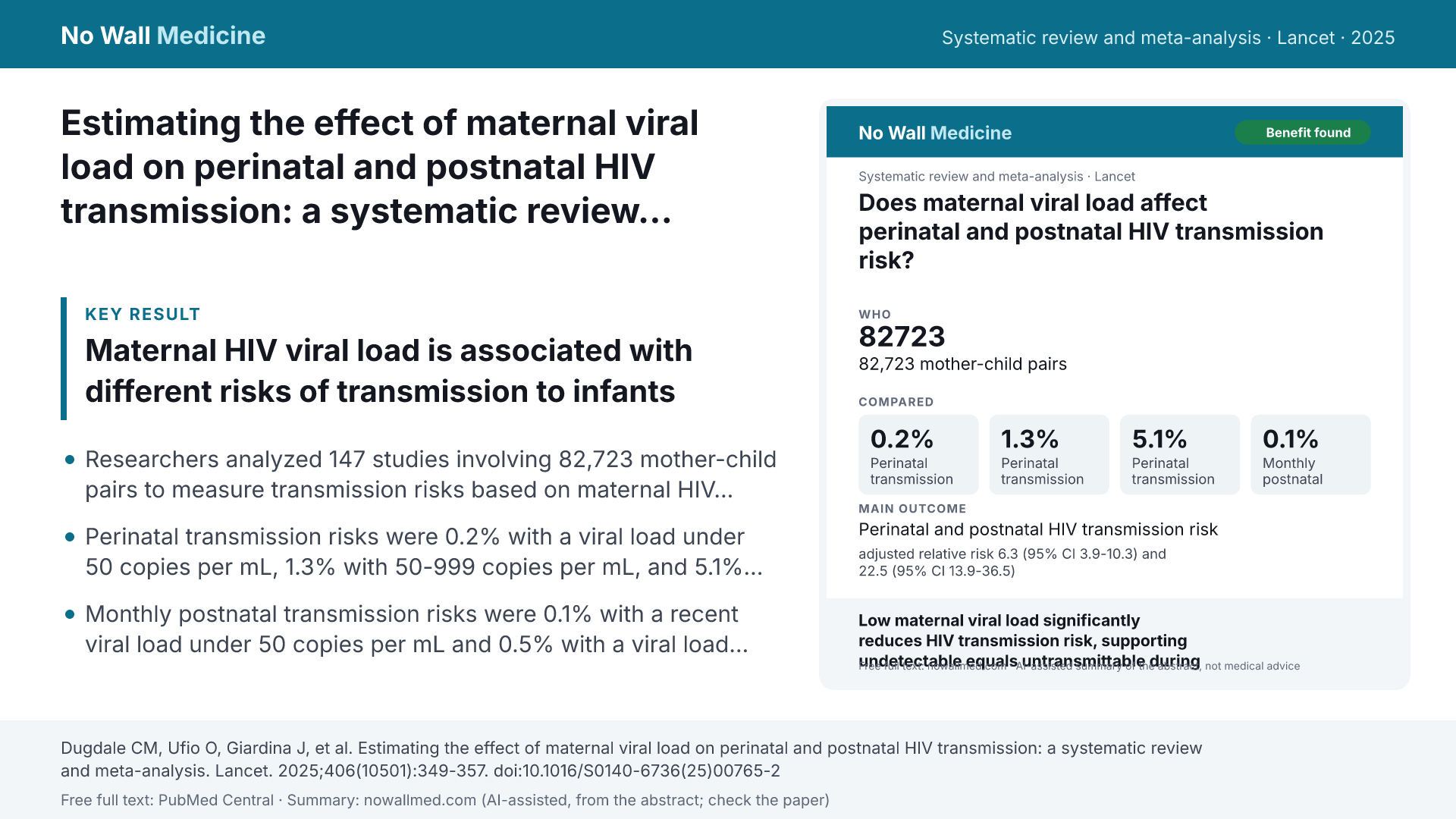
Maternal HIV viral load is associated with different risks of transmission to infants
Estimating the effect of maternal viral load on perinatal and postnatal HIV transmission: a systematic review and meta-analysis
Systematic review and meta-analysisBenefit found
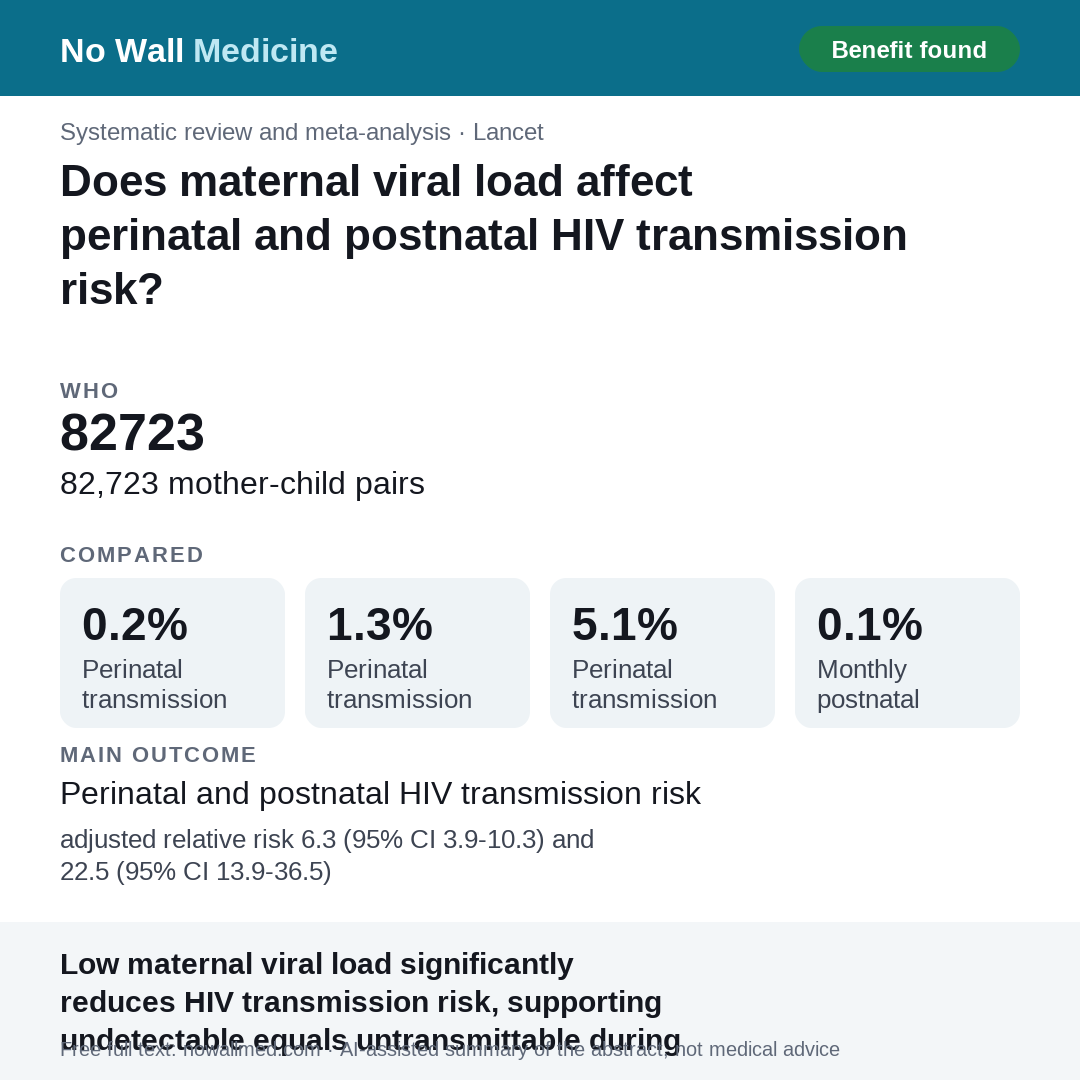
Does maternal viral load affect perinatal and postnatal HIV transmission risk?
Who
82723
82,723 mother-child pairs
Compared
0.2%Perinatal transmission <50 copies per mL (95% CI 0.2-0.3)
1.3%Perinatal transmission 50-999 copies per mL (1.0-1.7)
5.1%Perinatal transmission ≥1000 copies per mL (2.6-7.9)
0.1%Monthly postnatal transmission <50 copies per mL (0.0-0.4)
Main outcome
Perinatal and postnatal HIV transmission risk
Result: adjusted relative risk 6.3 (95% CI 3.9-10.3) and 22.5 (95% CI 13.9-36.5)
Bottom line: Low maternal viral load significantly reduces HIV transmission risk, supporting undetectable equals untransmittable during pregnancy and birth.
Funded by: National Institutes of Health, WHO, and Massachusetts General Hospital
Lancet · 2025-07-10Download image
Clinical question: Does maternal viral load affect perinatal and postnatal HIV transmission risk?
Why it matters: It is unclear if the principle of undetectable equals untransmittable applies to the transmission of HIV from mother to child during pregnancy, birth, or breastfeeding.
Key points
- Researchers analyzed 147 studies involving 82,723 mother-child pairs to measure transmission risks based on maternal HIV viral load, which is the amount of virus in the blood.
- Perinatal transmission risks were 0.2% with a viral load under 50 copies per mL, 1.3% with 50-999 copies per mL, and 5.1% with 1000 copies per mL or more.
- Monthly postnatal transmission risks were 0.1% with a recent viral load under 50 copies per mL and 0.5% with a viral load of 50 copies per mL or more.
Headline and key points written with AI from the paper’s abstract, with every number checked against it. Read the paper before relying on them.
Was this summary helpful?
Abstract
Background
Although a growing body of evidence supports zero risk of sexual HIV transmission from a person with sustained virological suppression, known as U=U (undetectable equals untransmittable), data have been insufficient to determine whether this is also true for vertical HIV transmission. We conducted a systematic review and meta-analysis to quantify vertical transmission risk by maternal HIV viral load (mHVL) and to evaluate the applicability of U=U to perinatal and postnatal HIV transmission. Methods
In this systematic review and meta-analysis, we searched PubMed, Embase, Web of Science, Cochrane Library, Cumulative Index of Nursing and Allied Health Literature, the WHO Global Health Library, and abstracts from the International AIDS Society Conference and the Conference on Retroviruses and Opportunistic Infections (2016-24) for studies published from Jan 1, 1989, to Dec 31, 2024, reporting the relationship between mHVL near birth (to estimate perinatal transmission risk by 6 weeks) or during breastfeeding (to estimate monthly postnatal transmission risk by mHVL within the past 6 months) and vertical transmission. We pooled risks of perinatal and postnatal transmission across prespecified mHVL categories. We also conducted comparative analyses to determine the adjusted relative risk (aRR) of transmission by mHVL using Poisson meta-regression. The protocol for this analysis is registered on the International Prospective Register of Systematic Reviews (PROSPERO; CRD42019146768). Findings
147 studies were included in the analysis; 138 studies contributed to perinatal analyses and 13 studies contributed to postnatal analyses. Data on 82 723 mother-child pairs were included across all analyses. Pooled perinatal transmission risks were 0·2% (95% CI 0·2-0·3) with a mHVL of <50 copies per mL, 1·3% (1·0-1·7) with 50-999 copies per mL, and 5·1% (2·6-7·9) with ≥1000 copies per mL. aRRs of perinatal transmission were 6·3 (3·9-10·3) with a mHVL of 50-999 copies per mL and 22·5 (13·9-36·5) with ≥1000 copies per mL versus <50 copies per mL. In subgroup analyses, in five studies reporting on 4675 women receiving pre-conception antiretroviral therapy (ART) with a mHVL of <50 copies per mL near birth, there were zero (0%, 0·0-0·1) perinatal transmissions. Monthly postnatal transmission risks were 0·1% (0·0-0·4) with recent mHVL <50 copies per mL and 0·5% (0·1-1·8) with a mHVL of ≥50 copies per mL. Interpretation
Perinatal transmission with a mHVL of <50 copies per mL is ≤0·2% overall. Zero transmissions were observed among women receiving ART before pregnancy with a mHVL of <50 copies per mL near birth, supporting U=U in pregnancy and birth. Postnatal transmission was very low-but not zero-among women with a recent mHVL of <50 copies per mL. Current data, largely from studies lacking frequent mHVL monitoring or modern first-line ART regimens, are insufficient to assess U=U during breastfeeding. Funding
National Institutes of Health, WHO, and Massachusetts General Hospital.
Abstract reproduced under the article’s CC BY NC licence.
Subject terms
Cite this article
Dugdale CM, Ufio O, Giardina J, et al. Estimating the effect of maternal viral load on perinatal and postnatal HIV transmission: a systematic review and meta-analysis. Lancet. 2025. doi:10.1016/S0140-6736(25)00765-2
Spotted a mistake? Suggest a correction