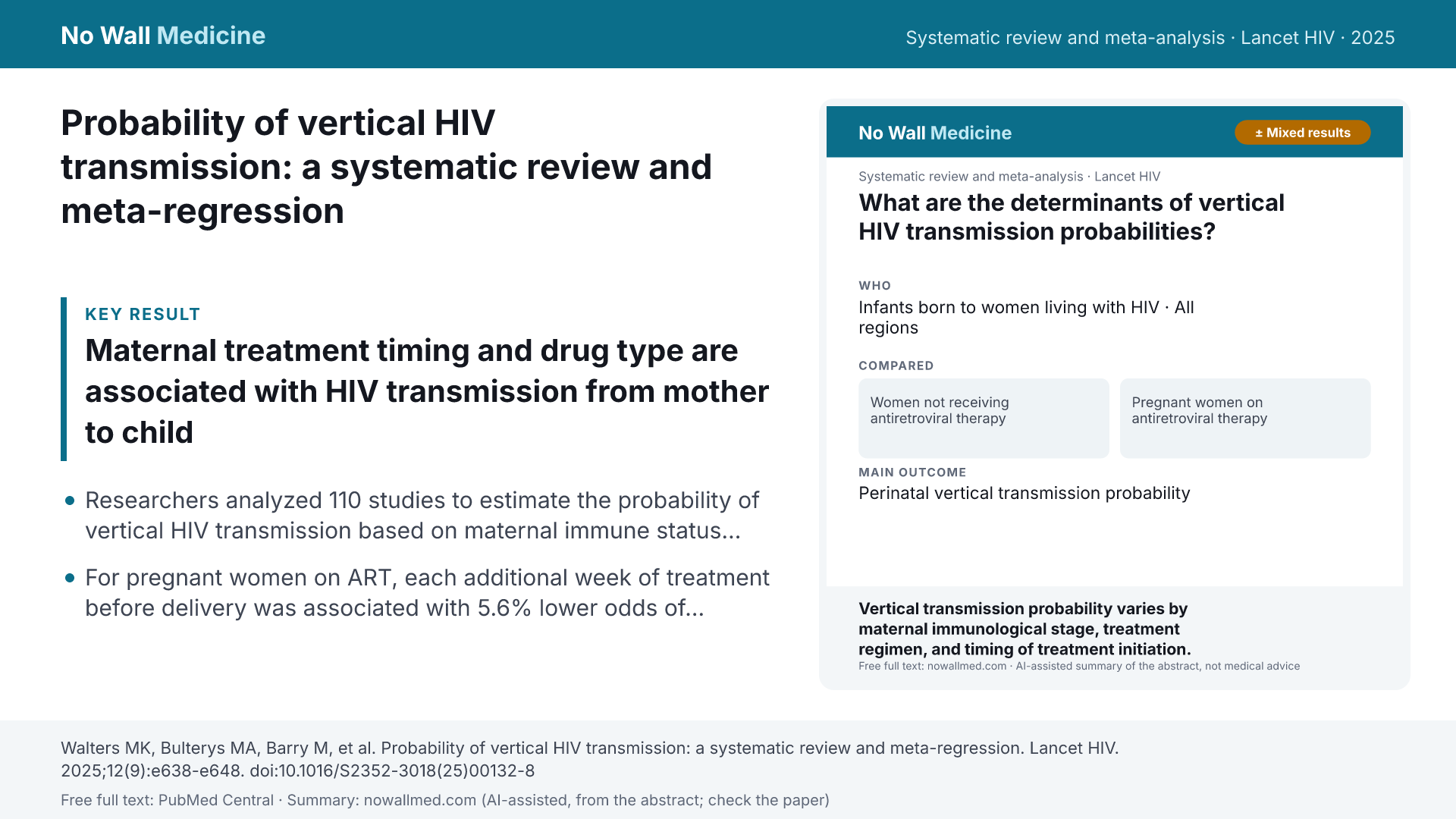
Maternal treatment timing and drug type are associated with HIV transmission from mother to child
Probability of vertical HIV transmission: a systematic review and meta-regression
Systematic review and meta-analysisMixed results
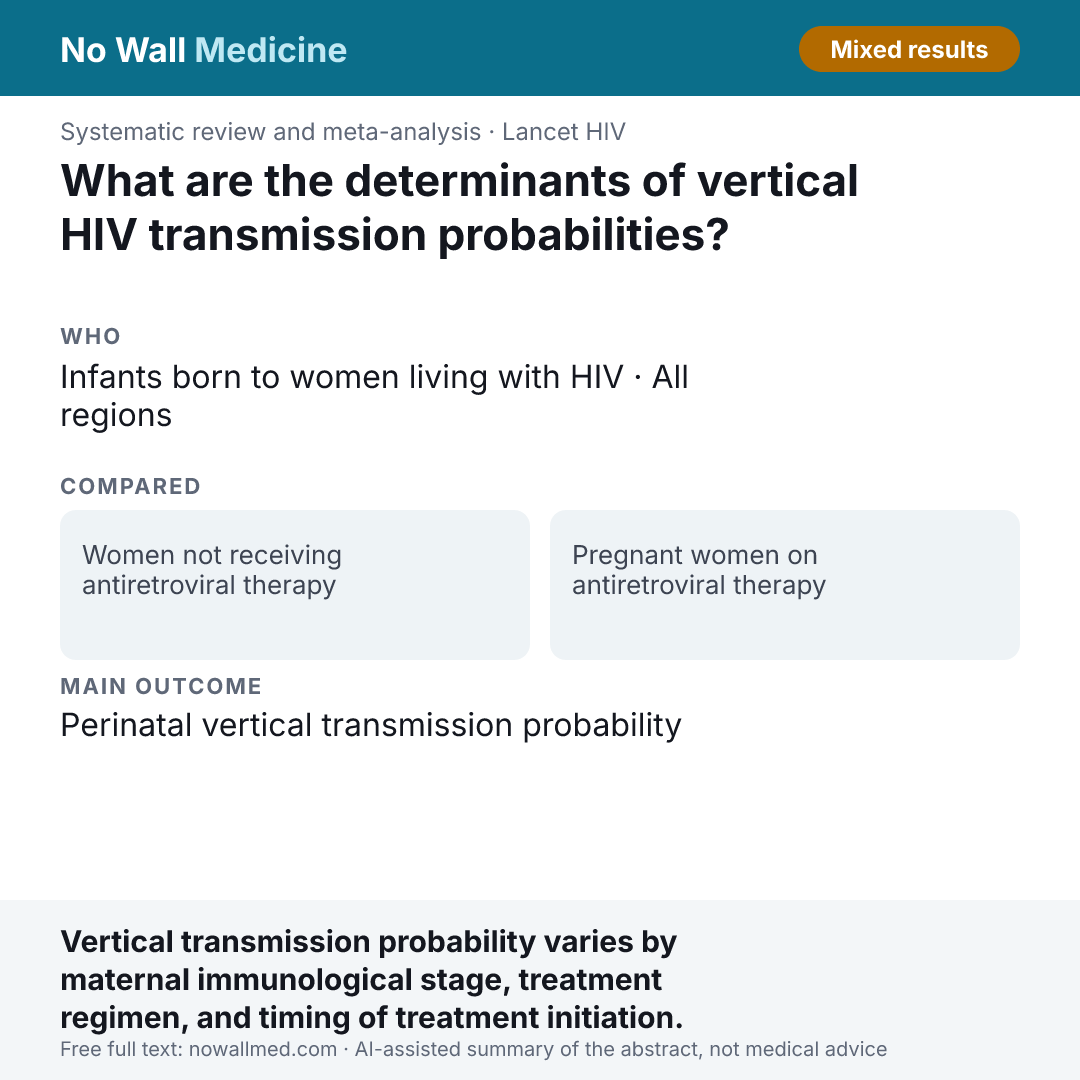
What are the determinants of vertical HIV transmission probabilities?
Who
Infants born to women living with HIV · All regions
Compared
Women not receiving antiretroviral therapy
Pregnant women on antiretroviral therapy
Main outcome
Perinatal vertical transmission probability
Bottom line: Vertical transmission probability varies by maternal immunological stage, treatment regimen, and timing of treatment initiation.
Limitation: Further evidence is needed on the effects of recent antiretroviral therapy innovations.
Funded by: National Institutes of Health, UNAIDS, and UK Research and Innovation
Lancet HIV · 2025-07-31 · Save PNG
Clinical question: What are the determinants of vertical HIV transmission probabilities?
Why it matters: Estimates of vertical HIV transmission are used to monitor global elimination goals, but probabilities vary by maternal immune status, treatment regimen, and timing of treatment initiation.
Key points
- Researchers analyzed 110 studies to estimate the probability of vertical HIV transmission based on maternal immune status and antiretroviral therapy (ART) use.
- For pregnant women on ART, each additional week of treatment before delivery was associated with 5.6% lower odds of vertical transmission.
- Initiating integrase inhibitor-based ART 20 weeks before delivery was associated with an odds ratio of 0.36 for vertical transmission compared to non-nucleoside reverse transcriptase inhibitor-based ART.
Limitation the authors note: The association between ART class and transmission was confounded by study region.
Headline and key points written with AI from the paper’s abstract, with every number checked against it. Read the paper before relying on them.
Was this summary helpful?
Abstract
Background
Eliminating HIV vertical transmission is a global priority and monitored by estimating paediatric HIV infections with the UNAIDS-supported Spectrum AIDS Impact Module (Spectrum-AIM). Recent innovations in antiretroviral therapy (ART) service-delivery models and first-line regimens aimed to reduce vertical transmission probabilities. We did a systematic review and meta-analysis to estimate vertical transmission probabilities by maternal immunological and treatment status. Methods
In this systematic review and meta-regression, we combined an updated systematic review with previous data in meta-regression models to estimate vertical transmission probabilities and determinants. We searched PubMed, Embase, the Global Health Database, WHO Global Index Medicus, CINAHL Complete, and Cochrane CENTRAL for peer-reviewed English-language studies from all regions published between Jan 1, 2018 and Feb 8, 2024, with search term domains mentioning "HIV", "transmission", "perinatal", and "breastfeeding periods", and "infants born to women living with HIV" or related terms from randomised trials, cohort studies, or observational studies. Four meta-regression models estimated vertical transmission probabilities. We assessed model sensitivity and compared estimates to Spectrum-AIM's previous results. Finally, we fit a meta-regression model to assess the association of ART class and initiation timing on viral load suppression (VLS) at delivery. Findings
Of 12 588 potential studies, we identified 24 new studies, which along with the 86 from previous reviews yielded 110 total studies included in meta-regression analysis. For women not receiving ART, higher CD4 count was associated with lower odds of perinatal vertical transmission (odds ratio [OR] 0·80, 95% CI 0·75-0·84, per 100 cells per μL increase). For pregnant women on ART, each additional week on ART before delivery reduced odds of vertical transmission by 5·6% (95% CI 4·2-7·0). The OR of perinatal vertical transmission among pregnant women initiating integrase inhibitor-based ART 20 weeks before delivery was 0·36 (0·14-0·94) compared with those initiating non-nucleoside reverse transcriptase inhibitor (NNRTI)-based ART. This association was confounded by study region. Odds of VLS were lower when ART was initiated late in pregnancy (OR 0·37, 0·21-0·68) for the reference regimen [NNRTI]), without significant difference by ART regimen. Interpretation
Vertical transmission probability varies by maternal immunological stage, treatment regimen, and timing of treatment initiation. These estimates have been incorporated into Spectrum-AIM for UNAIDS 2025 HIV estimates. Earlier ART initiation is associated with higher odds of VLS at delivery. Further evidence is needed on the effects of recent ART innovations on vertical transmission outcomes. Funding
National Institutes of Health, UNAIDS, and UK Research and Innovation.
Abstract reproduced under the article’s CC BY licence.
Subject terms
Headline, design, result, key points, caveat and citation as plain text.
Cite this article
Walters MK, Bulterys MA, Barry M, et al. Probability of vertical HIV transmission: a systematic review and meta-regression. Lancet HIV. 2025;12(9):e638-e648. doi:10.1016/S2352-3018(25)00132-8
Spotted a mistake? Suggest a correction