Multi-component interventions increased vaccination rates by 54.3% in a global meta-analysis
Estimating the effects of interventions on increasing vaccination: systematic review and meta-analysis
Systematic review and meta-analysisBenefit found
What is the effectiveness of different intervention themes on increasing vaccination rates?
Who
6125795
Approximately 6 125 795 participants · 41 countries
Compared
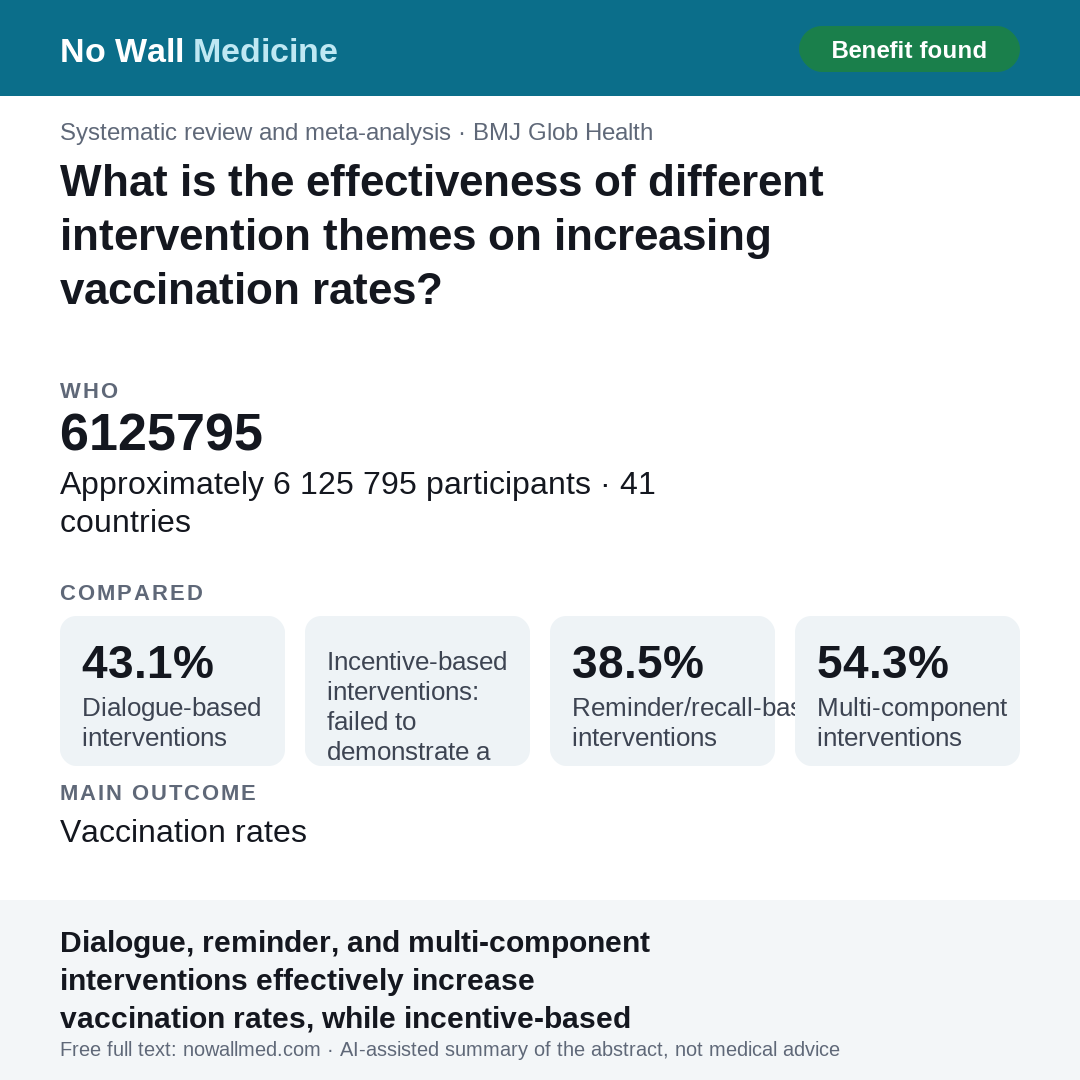
43.1%Dialogue-based interventions (95% CI: 29.8 to 57.9%)
Incentive-based interventions: failed to demonstrate a significant effect
38.5%Reminder/recall-based interventions (95% CI: 28.9 to 48.9%)
54.3%Multi-component interventions (95% CI: 40.5 to 69.6%)
Main outcome
Vaccination rates
Bottom line: Dialogue, reminder, and multi-component interventions effectively increase vaccination rates, while incentive-based interventions showed no significant effect in children.
Limitation: Interventions may not be effective in adolescents or populations with high initial vaccination rates.
BMJ Glob Health · 2025-04-09Download image
Clinical question: What is the effectiveness of different intervention themes on increasing vaccination rates?
Why it matters: Global vaccination rates have reached their lowest point in nearly 15 years, but there is a lack of rigorous evaluation regarding which interventions effectively increase vaccination.
Key points
- Researchers analyzed data from approximately 6 125 795 participants across 319 studies in 41 countries to evaluate the effectiveness of different vaccination promotion strategies.
- Multi-component interventions showed a 54.3% increase in vaccination rates, while dialogue-based interventions increased rates by 43.1% and reminder/recall interventions increased rates by 38.5%.
- Incentive-based interventions, whether used alone or combined with other methods, failed to demonstrate a significant effect in children.
Headline and key points written with AI from the paper’s abstract, with every number checked against it. Read the paper before relying on them.
Was this summary helpful?
Abstract
As global vaccination rates have reached their lowest point in nearly 15 years, effective interventions are being required globally to promote vaccination; however, there is a lack of rigorous evaluation of the effect of various interventions. Through a global synthesis, we analysed data from approximately 6 125 795 participants across 319 studies in 41 countries to reveal the global landscape of four intervention themes and to assess their effectiveness in increasing vaccination rates. We found an overall positive effect of the interventions across four main themes on improving vaccination. Specifically, dialogue-based interventions increased vaccination rates by 43.1% (95% CI: 29.8 to 57.9%, with effect sizes measured as relative risks (RRs)), though they may not always be effective in adolescents or in the sample with a higher percentage of male participants. Incentive-based interventions, whether implemented alone or combined with other intervention themes, failed to demonstrate a significant effect in children. Reminder/recall-based interventions were also effective for promoting vaccination (38.5% increase, 95% CI: 28.9 to 48.9%), particularly for completing vaccine series. Multi-component interventions exhibited excellent effectiveness in vaccination (54.3% increase, 95% CI: 40.5 to 69.6%), with the combination of dialogue, incentive and reminder/recall proving more effective than other multi-component interventions, but showing no significant effects in populations with high initial vaccination rates. However, we found that in most cases combining additional interventions with a single intervention may not significantly improve their effectiveness, especially for incentive-based interventions, but dialogue-based and reminder/recall-based interventions appear to be beneficial in some specific combinations. These findings underscore the importance of governments, public health officials and advocacy groups implementing appropriate vaccine interventions by selecting interventions tailored to specific populations, strategically promoting the completion of vaccine series and effectively combining interventions to promote global vaccination and save more lives.
Abstract reproduced under the article’s CC BY NC licence.
Subject terms
Cite this article
Liu J, Zhang Y, Zhang H, Tan H. Estimating the effects of interventions on increasing vaccination: systematic review and meta-analysis. BMJ Glob Health. 2025. doi:10.1136/bmjgh-2024-017142
Spotted a mistake? Suggest a correction
Top studies every Monday
The week’s key trials and guidelines in your specialties, plus any topics you follow. By email, free.
Get the weekly digest