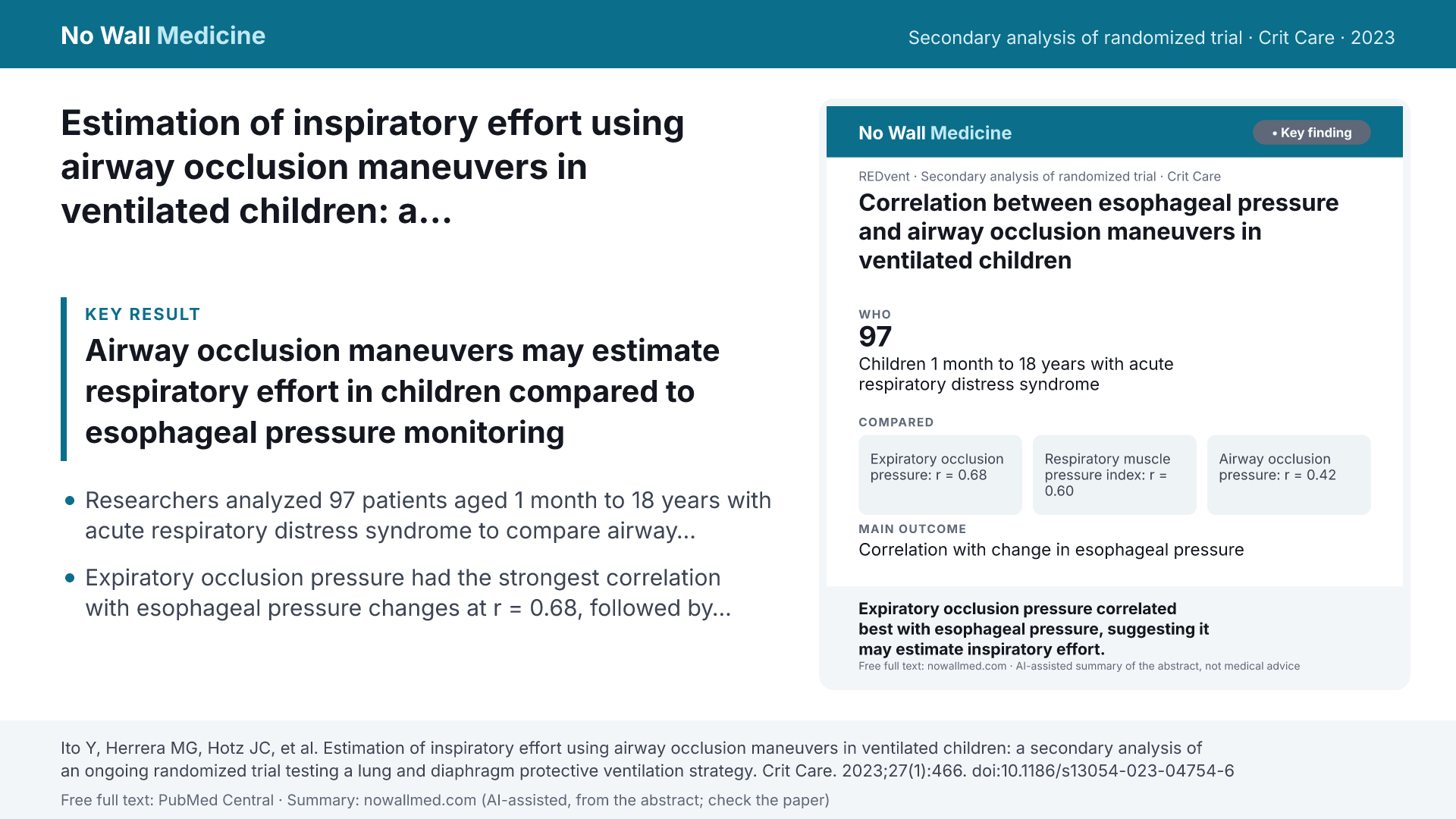
Estimation of inspiratory effort using airway occlusion maneuvers in ventilated children: a secondary analysis of an ongoing randomized trial testing a lung and diaphragm protective ventilation strategy
Key result: Airway occlusion maneuvers may estimate respiratory effort in children compared to esophageal pressure monitoring
Key points
- Researchers analyzed 97 patients aged 1 month to 18 years with acute respiratory distress syndrome to compare airway pressures with esophageal pressure changes.
- Expiratory occlusion pressure had the strongest correlation with esophageal pressure changes at r = 0.68, followed by the respiratory muscle pressure index at r = 0.60.
- The expiratory occlusion pressure could reliably estimate esophageal pressure changes using a regression equation with an R2 = 0.82.
Why it matters: Esophageal manometry is the gold standard for monitoring respiratory effort but is invasive and requires specialized expertise to measure and interpret.
Discussion prompts
- Would these patients look like yours? Who was left out?
- Is the main outcome one that matters to patients?
- Is the difference large enough to change what you do?
Cite: Ito Y, Herrera MG, Hotz JC, et al. Estimation of inspiratory effort using airway occlusion maneuvers in ventilated children: a secondary analysis of an ongoing randomized trial testing a lung and diaphragm protective ventilation strategy. Crit Care. 2023;27(1):466. doi:10.1186/s13054-023-04754-6
Free full text: PubMed Central · Summary and visual abstract: nowallmed.com/a/estimation-of-inspiratory-effort-using-airway-occlusion-maneuvers-in-bngsih/ (AI-assisted from the abstract; check the paper before relying on it).