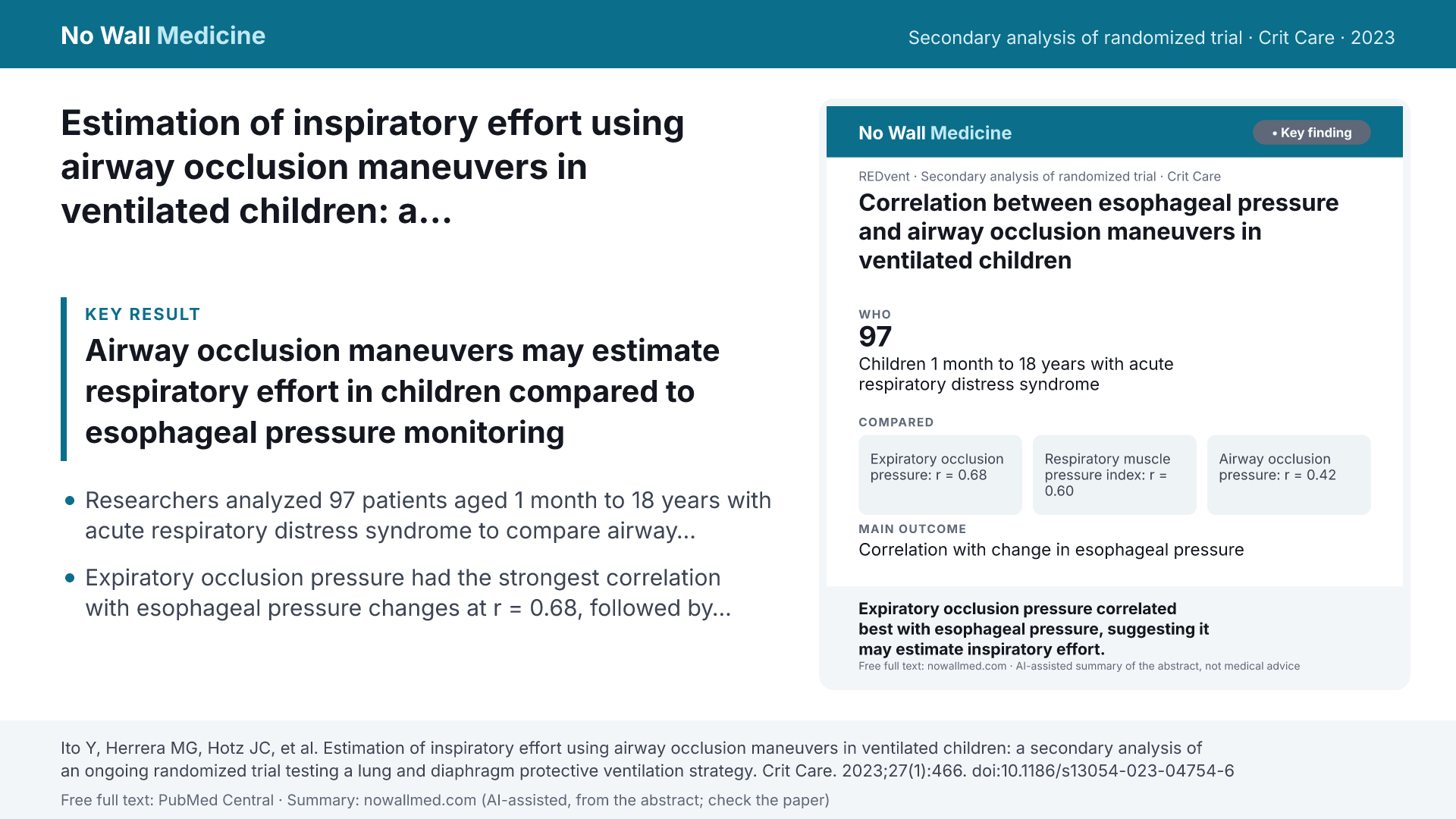
Airway occlusion maneuvers may estimate respiratory effort in children compared to esophageal pressure monitoring
Estimation of inspiratory effort using airway occlusion maneuvers in ventilated children: a secondary analysis of an ongoing randomized trial testing a lung and diaphragm protective ventilation strategy
Secondary analysis of a randomized clinical trialBenefit found
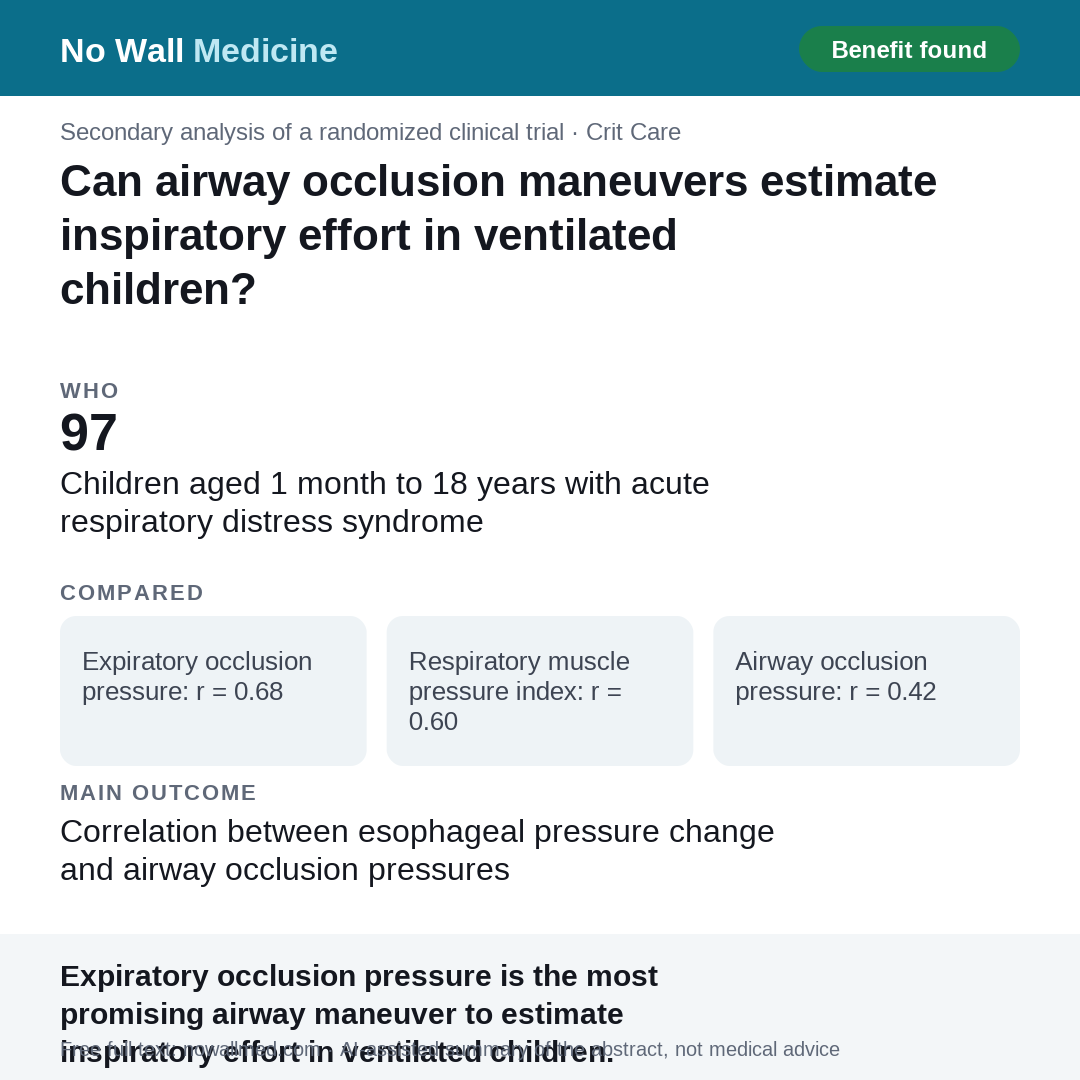
Can airway occlusion maneuvers estimate inspiratory effort in ventilated children?
Who
97
Children aged 1 month to 18 years with acute respiratory distress syndrome
Compared
Expiratory occlusion pressure: r = 0.68
Respiratory muscle pressure index: r = 0.60
Airway occlusion pressure: r = 0.42
Main outcome
Correlation between esophageal pressure change and airway occlusion pressures
Bottom line: Expiratory occlusion pressure is the most promising airway maneuver to estimate inspiratory effort in ventilated children.
Limitation: This is a secondary analysis of an ongoing randomized clinical trial.
Crit Care · 2023-11-29Download image
Clinical question: Can airway occlusion maneuvers estimate inspiratory effort in ventilated children?
Why it matters: Esophageal manometry is the gold standard for monitoring respiratory effort but is invasive and requires specialized expertise to measure and interpret.
Key points
- Researchers analyzed 97 patients aged 1 month to 18 years with acute respiratory distress syndrome to compare airway pressures with esophageal pressure changes.
- Expiratory occlusion pressure had the strongest correlation with esophageal pressure changes at r = 0.68, followed by the respiratory muscle pressure index at r = 0.60.
- The expiratory occlusion pressure could reliably estimate esophageal pressure changes using a regression equation with an R2 = 0.82.
Headline and key points written with AI from the paper’s abstract, with every number checked against it. Read the paper before relying on them.
Was this summary helpful?
Subject terms
Cite this article
Ito Y, Herrera MG, Hotz JC, et al. Estimation of inspiratory effort using airway occlusion maneuvers in ventilated children: a secondary analysis of an ongoing randomized trial testing a lung and diaphragm protective ventilation strategy. Crit Care. 2023. doi:10.1186/s13054-023-04754-6
Spotted a mistake? Suggest a correction