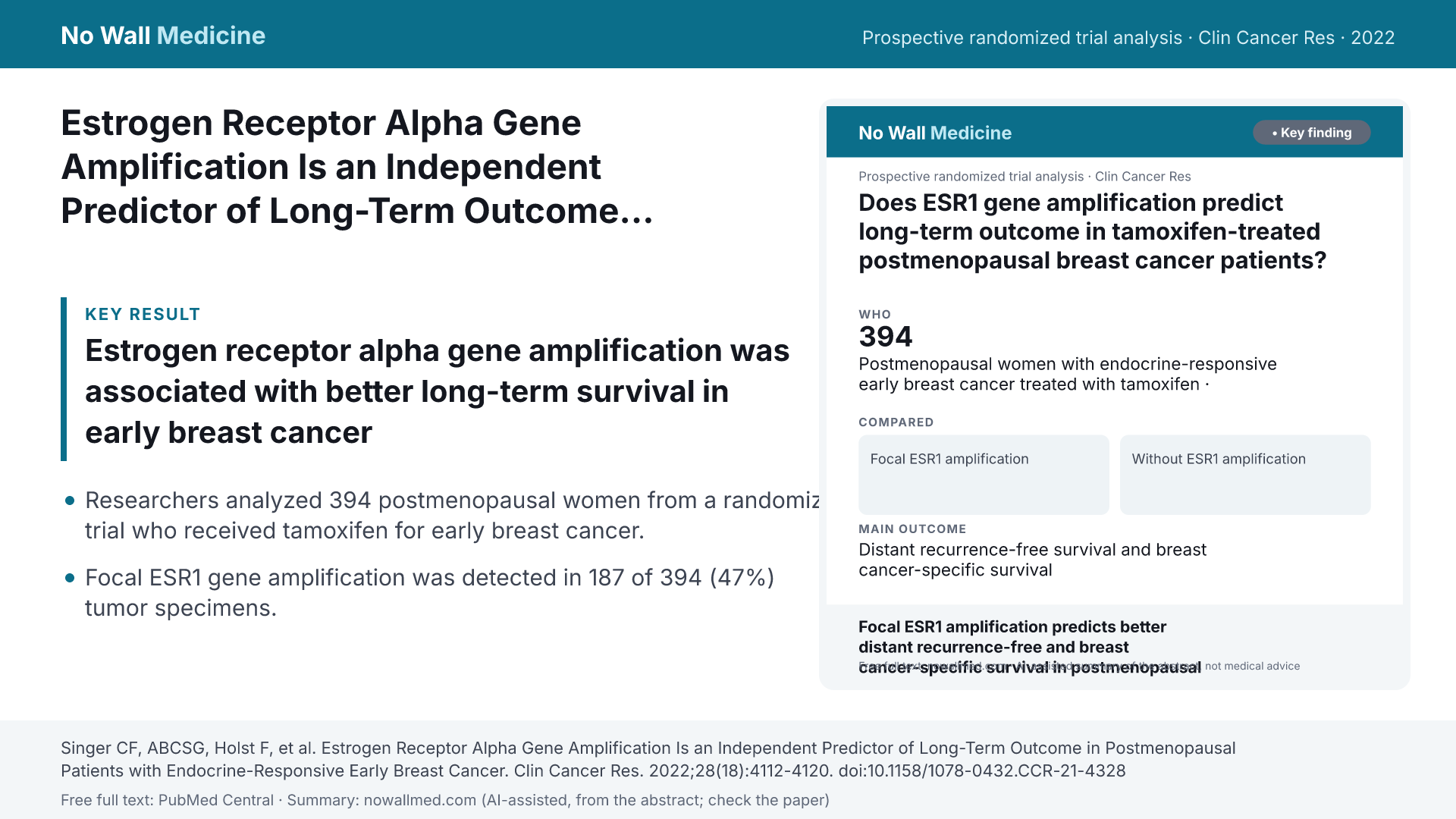
Estrogen receptor alpha gene amplification was associated with better long-term survival in early breast cancer
Estrogen Receptor Alpha Gene Amplification Is an Independent Predictor of Long-Term Outcome in Postmenopausal Patients with Endocrine-Responsive Early Breast Cancer
Prospective randomized trial analysisKey finding
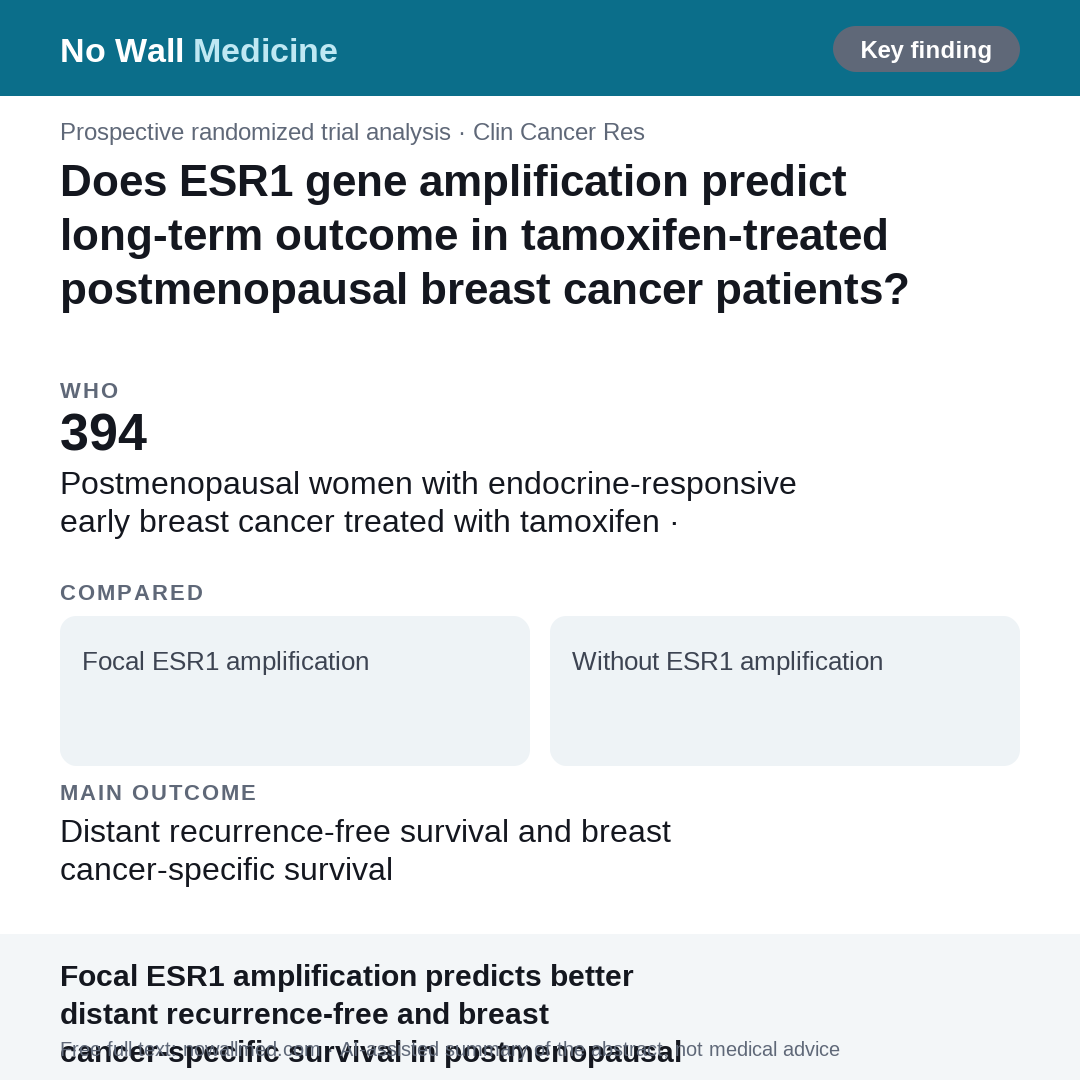
Does ESR1 gene amplification predict long-term outcome in tamoxifen-treated postmenopausal breast cancer patients?
Who
394
Postmenopausal women with endocrine-responsive early breast cancer treated with tamoxifen · ABCSG-06 trial
Compared
Focal ESR1 amplification
Without ESR1 amplification
Main outcome
Distant recurrence-free survival and breast cancer-specific survival
Result: adjusted HR 0.48 (95% CI 0.26-0.91) for distant recurrence-free survival
Bottom line: Focal ESR1 amplification predicts better distant recurrence-free and breast cancer-specific survival in postmenopausal women.
Clin Cancer Res · 2022-08-04Download image
Clinical question: Does ESR1 gene amplification predict long-term outcome in tamoxifen-treated postmenopausal breast cancer patients?
Why it matters: No receptor-associated biomarker currently exists to identify patients with early breast cancer who have a particularly favorable outcome.
Key points
- Researchers analyzed 394 postmenopausal women from a randomized trial who received tamoxifen for early breast cancer.
- Focal ESR1 gene amplification was detected in 187 of 394 (47%) tumor specimens.
- After a median follow-up of 10 years, ESR1 amplification was associated with longer distant recurrence-free survival and breast cancer-specific survival.
Headline and key points written with AI from the paper’s abstract, with every number checked against it. Read the paper before relying on them.
Was this summary helpful?
Subject terms
Headline, design, result, key points, caveat and citation as plain text.
Cite this article
Singer CF, ABCSG, Holst F, et al. Estrogen Receptor Alpha Gene Amplification Is an Independent Predictor of Long-Term Outcome in Postmenopausal Patients with Endocrine-Responsive Early Breast Cancer. Clin Cancer Res. 2022. doi:10.1158/1078-0432.CCR-21-4328
Spotted a mistake? Suggest a correction