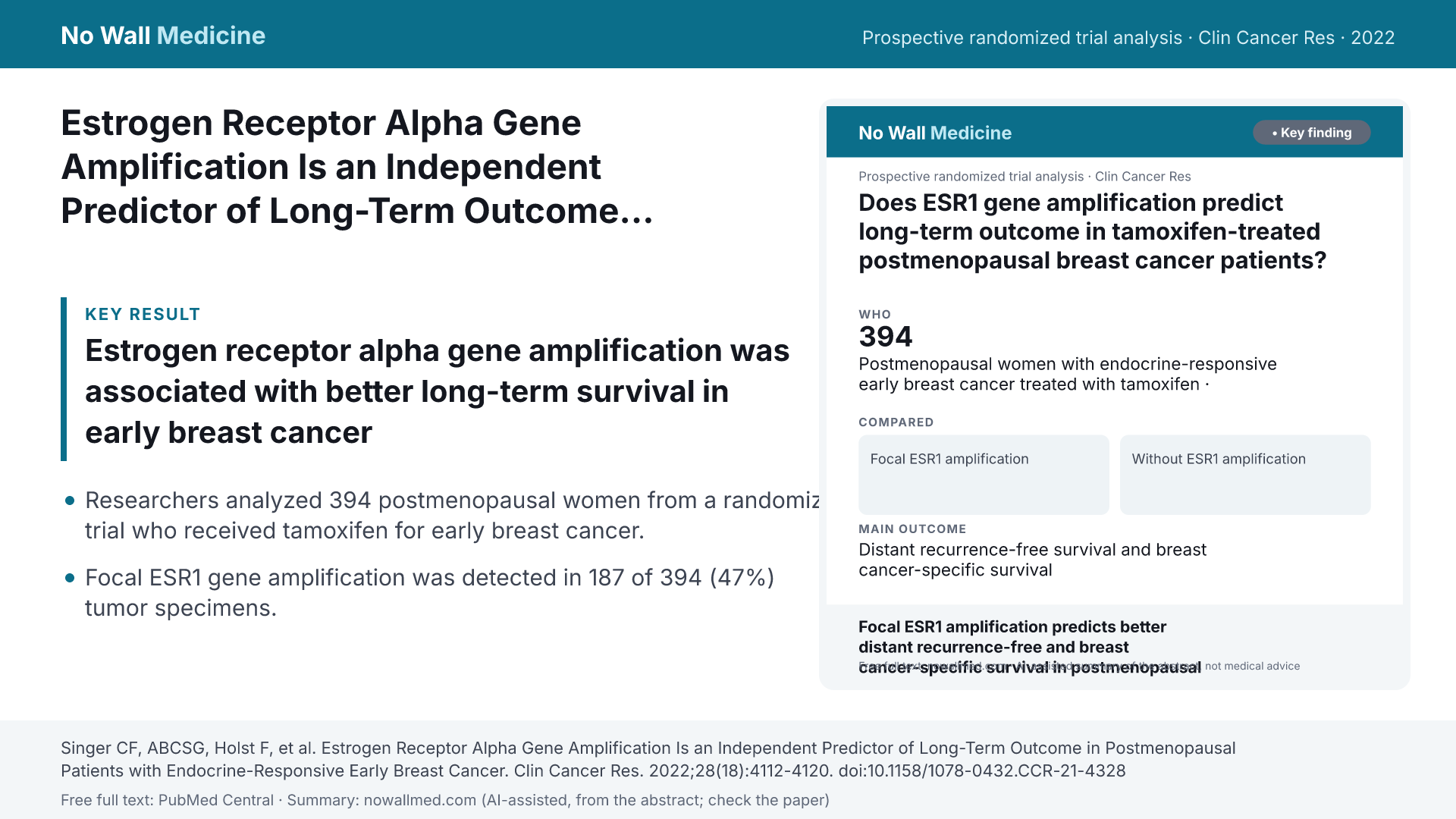
Estrogen Receptor Alpha Gene Amplification Is an Independent Predictor of Long-Term Outcome in Postmenopausal Patients with Endocrine-Responsive Early Breast Cancer
Key result: Estrogen receptor alpha gene amplification was associated with better long-term survival in early breast cancer

Key points
- Researchers analyzed 394 postmenopausal women from a randomized trial who received tamoxifen for early breast cancer.
- Focal ESR1 gene amplification was detected in 187 of 394 (47%) tumor specimens.
- After a median follow-up of 10 years, ESR1 amplification was associated with longer distant recurrence-free survival and breast cancer-specific survival.
Why it matters: No receptor-associated biomarker currently exists to identify patients with early breast cancer who have a particularly favorable outcome.
Discussion prompts
- Would these patients look like yours? Who was left out?
- Is the main outcome one that matters to patients?
- Is the difference large enough to change what you do?
Cite: Singer CF, ABCSG, Holst F, et al. Estrogen Receptor Alpha Gene Amplification Is an Independent Predictor of Long-Term Outcome in Postmenopausal Patients with Endocrine-Responsive Early Breast Cancer. Clin Cancer Res. 2022;28(18):4112-4120. doi:10.1158/1078-0432.CCR-21-4328
Free full text: PubMed Central · Summary and visual abstract: nowallmed.com/a/estrogen-receptor-alpha-gene-amplification-is-an-independent-1r08xle/ (AI-assisted from the abstract; check the paper before relying on it).