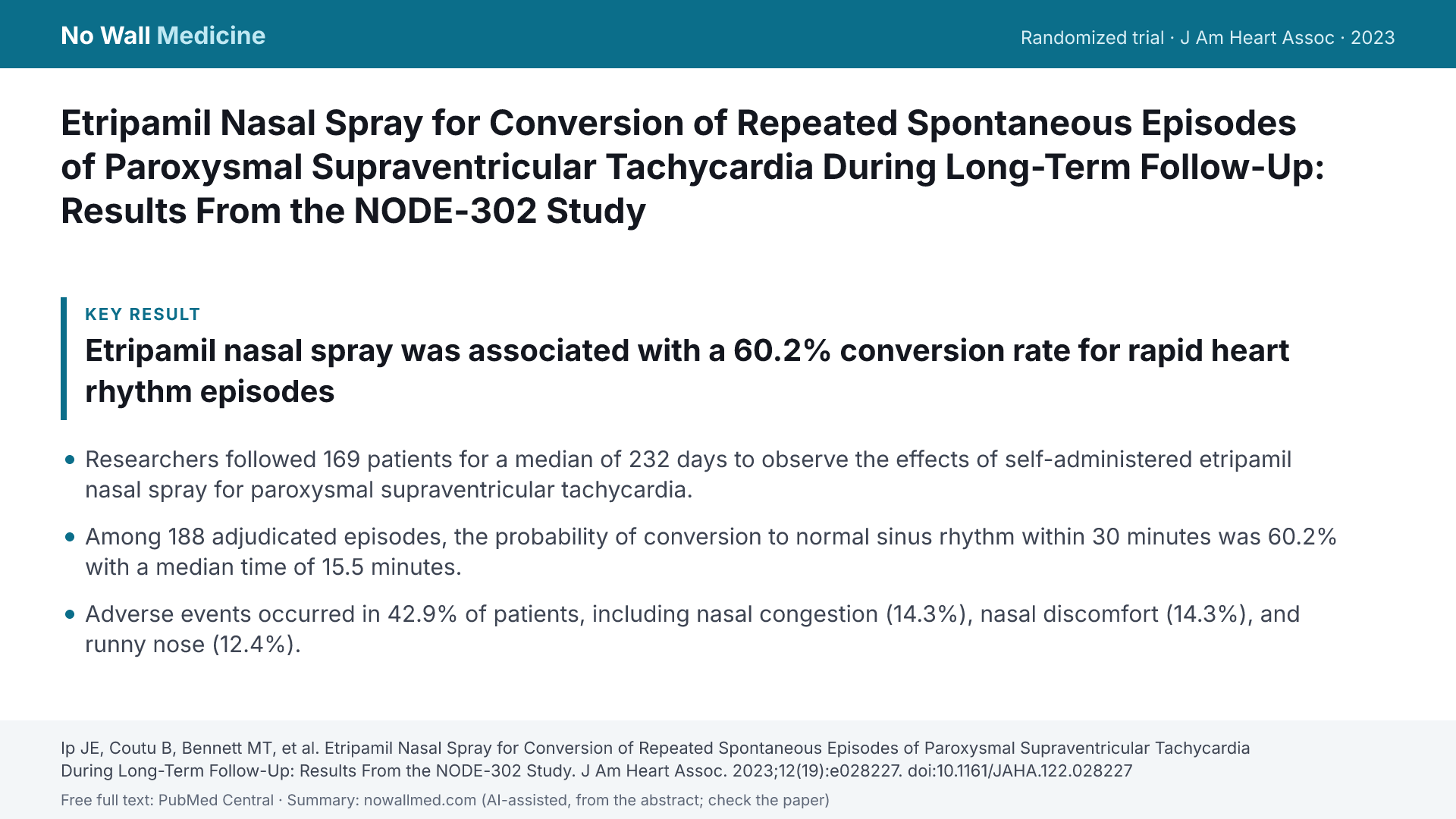
Etripamil Nasal Spray for Conversion of Repeated Spontaneous Episodes of Paroxysmal Supraventricular Tachycardia During Long-Term Follow-Up: Results From the NODE-302 Study
Key result: Etripamil nasal spray was associated with a 60.2% conversion rate for rapid heart rhythm episodes
Key points
- Researchers followed 169 patients for a median of 232 days to observe the effects of self-administered etripamil nasal spray for paroxysmal supraventricular tachycardia.
- Among 188 adjudicated episodes, the probability of conversion to normal sinus rhythm within 30 minutes was 60.2% with a median time of 15.5 minutes.
- Adverse events occurred in 42.9% of patients, including nasal congestion (14.3%), nasal discomfort (14.3%), and runny nose (12.4%).
Discussion prompts
- Would these patients look like yours? Who was left out?
- Is the main outcome one that matters to patients?
- Is the difference large enough to change what you do?
Cite: Ip JE, Coutu B, Bennett MT, et al. Etripamil Nasal Spray for Conversion of Repeated Spontaneous Episodes of Paroxysmal Supraventricular Tachycardia During Long-Term Follow-Up: Results From the NODE-302 Study. J Am Heart Assoc. 2023;12(19):e028227. doi:10.1161/JAHA.122.028227
Free full text: PubMed Central · Summary and visual abstract: nowallmed.com/a/etripamil-nasal-spray-for-conversion-of-repeated-spontaneous-episodes-5p0xm2/ (AI-assisted from the abstract; check the paper before relying on it).