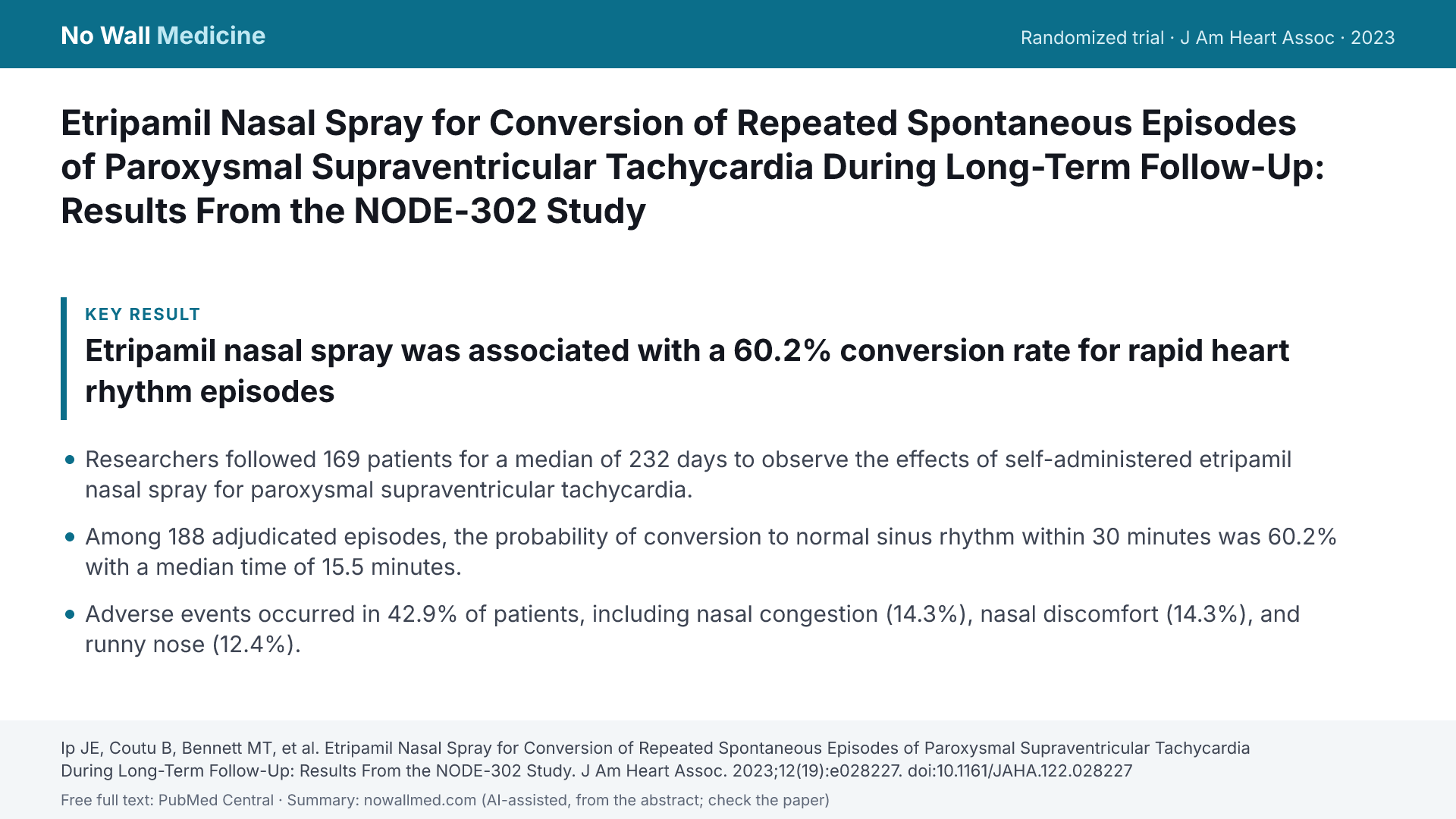
Etripamil nasal spray was associated with a 60.2% conversion rate for rapid heart rhythm episodes
Etripamil Nasal Spray for Conversion of Repeated Spontaneous Episodes of Paroxysmal Supraventricular Tachycardia During Long-Term Follow-Up: Results From the NODE-302 Study
Why it matters: It was unknown if the safety and efficacy of etripamil nasal spray could be maintained during long-term, unsupervised self-administration for recurrent rapid heart rhythms.
Key points
- Researchers followed 169 patients for a median of 232 days to observe the effects of self-administered etripamil nasal spray for paroxysmal supraventricular tachycardia.
- Among 188 adjudicated episodes, the probability of conversion to normal sinus rhythm within 30 minutes was 60.2% with a median time of 15.5 minutes.
- Adverse events occurred in 42.9% of patients, including nasal congestion (14.3%), nasal discomfort (14.3%), and runny nose (12.4%).
Headline and key points written with AI from the paper’s abstract, with every number checked against it. Read the paper before relying on them.
Was this summary helpful?
Subject terms
Cite this article
Ip JE, Coutu B, Bennett MT, et al. Etripamil Nasal Spray for Conversion of Repeated Spontaneous Episodes of Paroxysmal Supraventricular Tachycardia During Long-Term Follow-Up: Results From the NODE-302 Study. J Am Heart Assoc. 2023. doi:10.1161/JAHA.122.028227
Spotted a mistake? Suggest a correction