Neural network models predicted life-threatening heart rhythms better than traditional statistical methods
Predicting Malignant Ventricular Arrhythmias Using Real-Time Remote Monitoring
Post hoc analysis of a randomized controlled trialBenefit found
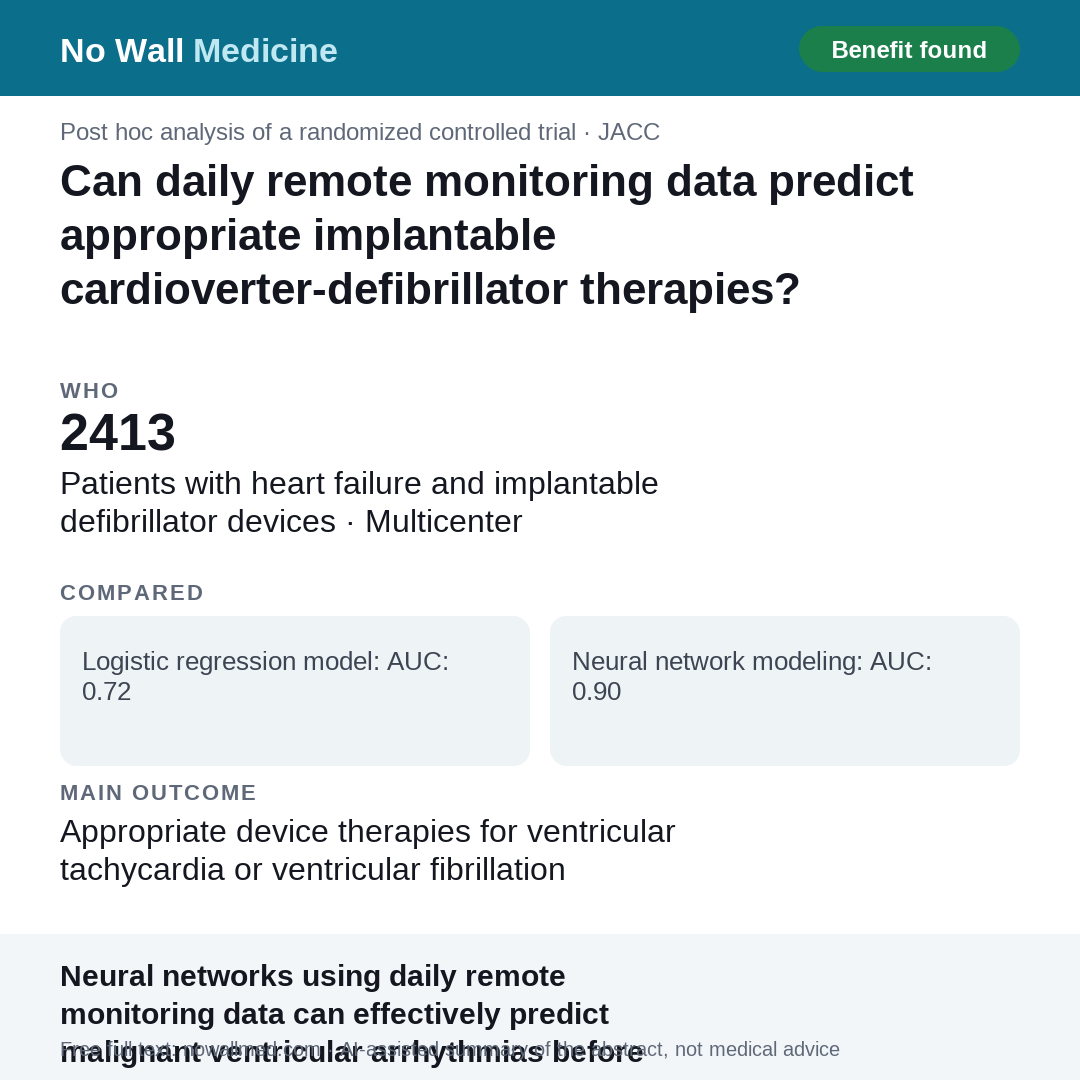
Can daily remote monitoring data predict appropriate implantable cardioverter-defibrillator therapies?
Who
2413
Patients with heart failure and implantable defibrillator devices · Multicenter
Compared
Logistic regression model: AUC: 0.72
Neural network modeling: AUC: 0.90
Main outcome
Appropriate device therapies for ventricular tachycardia or ventricular fibrillation
Result: AUC: 0.90 (P < 0.01 for comparison)
Bottom line: Neural networks using daily remote monitoring data can effectively predict malignant ventricular arrhythmias before device therapies.
JACC · 2023-03-08Download image
Clinical question: Can daily remote monitoring data predict appropriate implantable cardioverter-defibrillator therapies?
Why it matters: Predicting malignant ventricular arrhythmias, which are life-threatening heart rhythms, has remained difficult despite the risks associated with implantable cardioverter-defibrillator therapies.
Key points
- Researchers analyzed 59,807 device transmissions from 2,413 patients with implanted defibrillators or cardiac resynchronization therapy devices.
- Neural network modeling achieved a sensitivity of 54% and specificity of 96% in predicting appropriate device therapies for ventricular tachycardia or ventricular fibrillation.
- Traditional logistic regression models showed lower predictive performance with a sensitivity of 39% and specificity of 91%.
Headline and key points written with AI from the paper’s abstract, with every number checked against it. Read the paper before relying on them.
Topics
Cite this article
Ginder C, Li J, Halperin JL, Akar JG, Martin DT, Chattopadhyay I. Predicting Malignant Ventricular Arrhythmias Using Real-Time Remote Monitoring. JACC. 2023. doi:10.1016/j.jacc.2022.12.024
Spotted a mistake? Suggest a correction
Top studies every Monday
The week’s key trials and guidelines in your specialties, plus any topics you follow. By email, free.
Get the weekly digest