Artificial intelligence assistance improved sensitivity for detecting specific fetal brain malformations during ultrasound scans
Evaluating AI-assisted detection of fetal intracranial malformations in prenatal ultrasound practice: a multicentre, self-crossover, randomised controlled trial in China
Multicentre, self-crossover, randomised controlled trialBenefit found
Does AI assistance improve detection of fetal intracranial malformations in prenatal ultrasound?
Who
1584
High risk singleton pregnancies between 11-32 weeks' gestation · Five Chinese centres
Compared
Independent diagnosis
Artificial Intelligence assisted diagnosis
Main outcome
Sensitivity and specificity in detecting ten specific fetal intracranial malformations
Result: sensitivity increased by 0·087 (95% CI 0·029 to 0·147)
Bottom line: Artificial intelligence assistance improves sonographers' sensitivity for detecting specific fetal intracranial malformations while preserving specificity.
Funded by: National Natural Science Foundation of China and others
Lancet Digit Health · 2026-09-10 · Save PNG
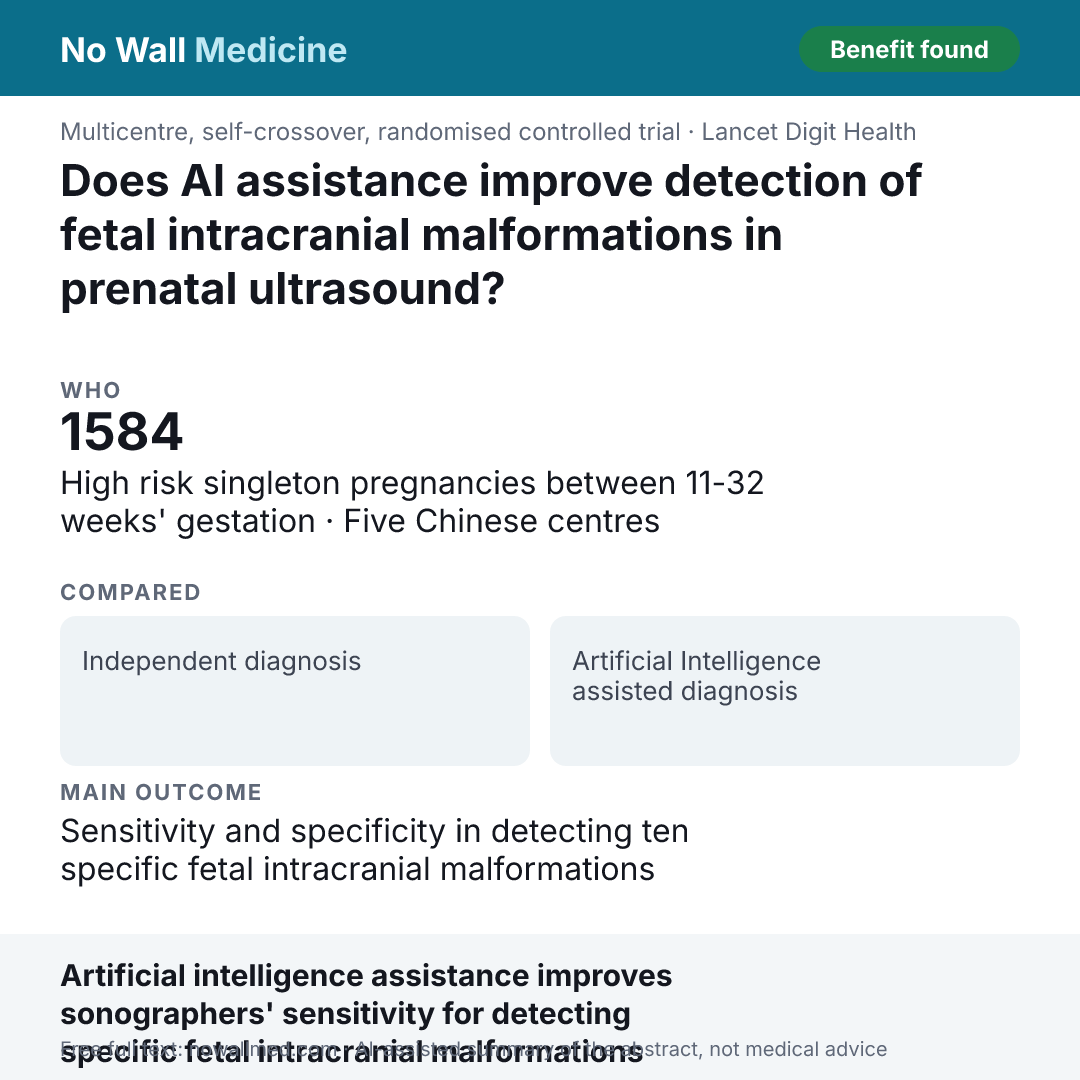
Clinical question: Does AI assistance improve detection of fetal intracranial malformations in prenatal ultrasound?
Key points
- Researchers conducted a multicentre trial involving 1584 scans of high-risk singleton pregnancies between 11 and 32 weeks of gestation.
- The artificial intelligence system increased sensitivity for detecting specific intracranial malformations by 0.087 in fetal-based analysis and 0.118 in malformation-targeted analysis.
- The system met the non-inferiority criterion for specificity, meaning it did not significantly increase the rate of false positive results.
Headline and key points written with AI from the paper’s abstract, with every number checked against it. Read the paper before relying on them.
Was this summary helpful?
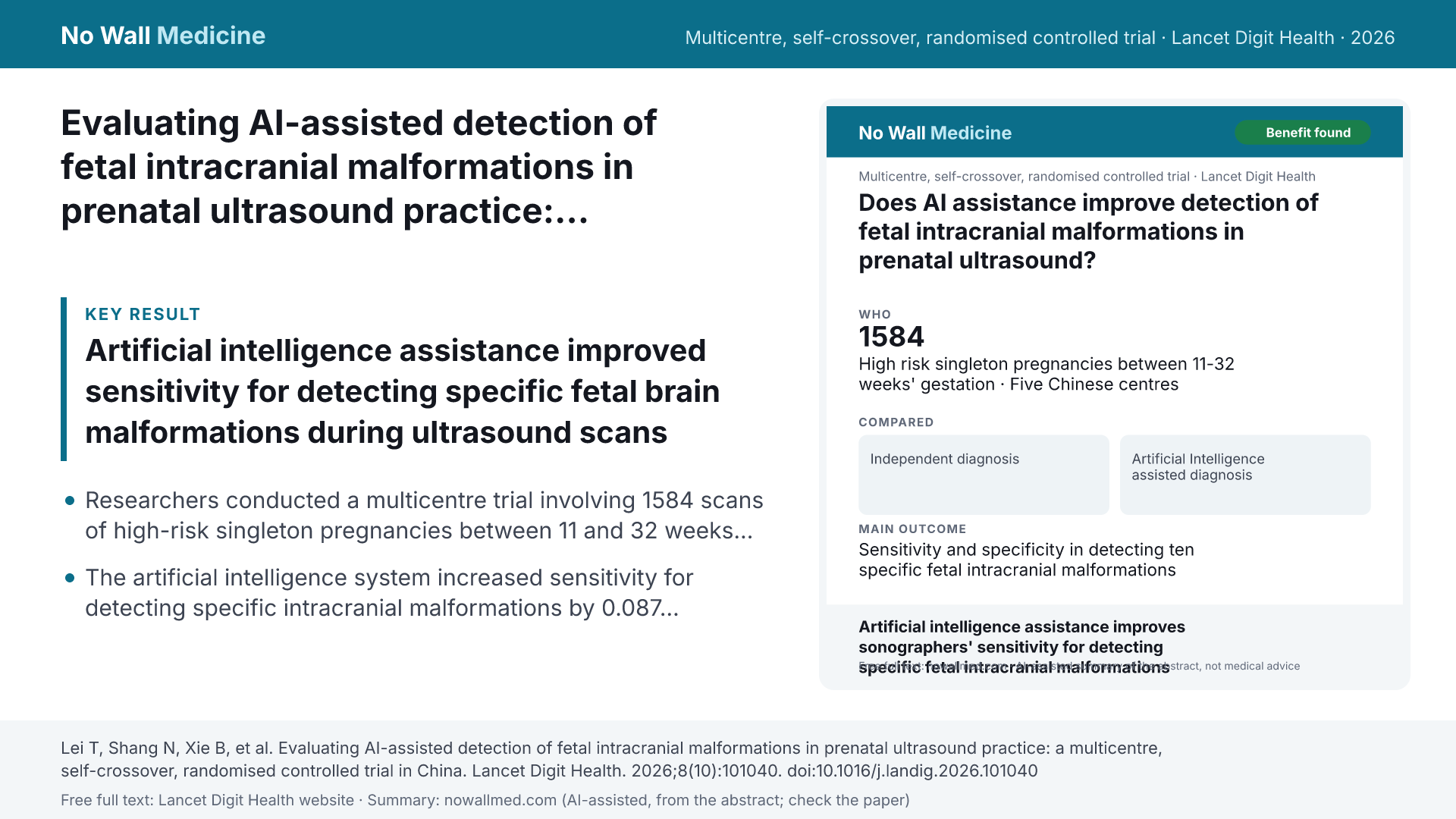
Subject terms
Headline, design, result, key points, caveat and citation as plain text.
Cite this article
Lei T, Shang N, Xie B, et al. Evaluating AI-assisted detection of fetal intracranial malformations in prenatal ultrasound practice: a multicentre, self-crossover, randomised controlled trial in China. Lancet Digit Health. 2026;8(10):101040. doi:10.1016/j.landig.2026.101040
Spotted a mistake? Suggest a correction