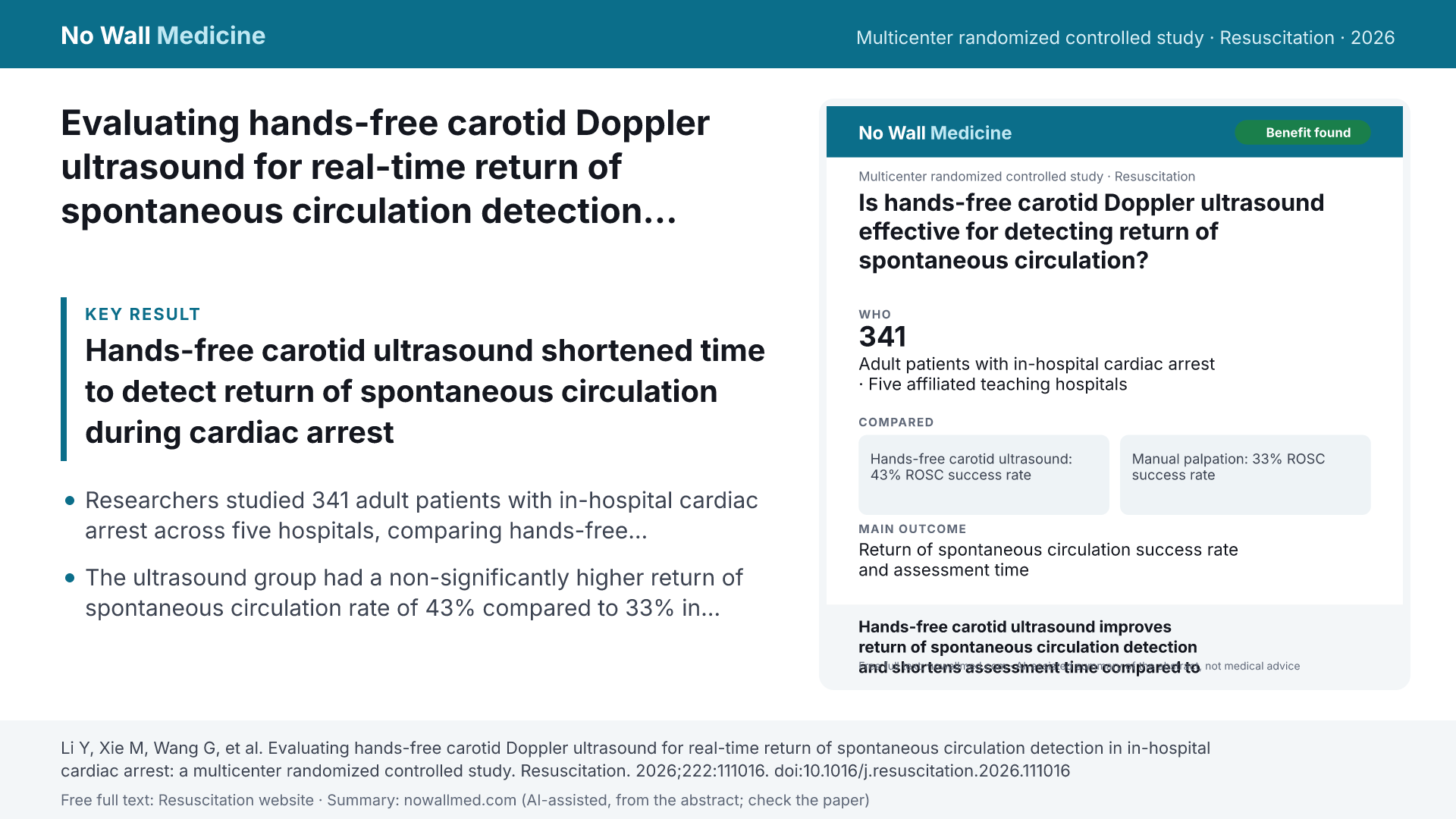
Evaluating hands-free carotid Doppler ultrasound for real-time return of spontaneous circulation detection in in-hospital cardiac arrest: a multicenter randomized controlled study
Key result: Hands-free carotid ultrasound shortened time to detect return of spontaneous circulation during cardiac arrest
Key points
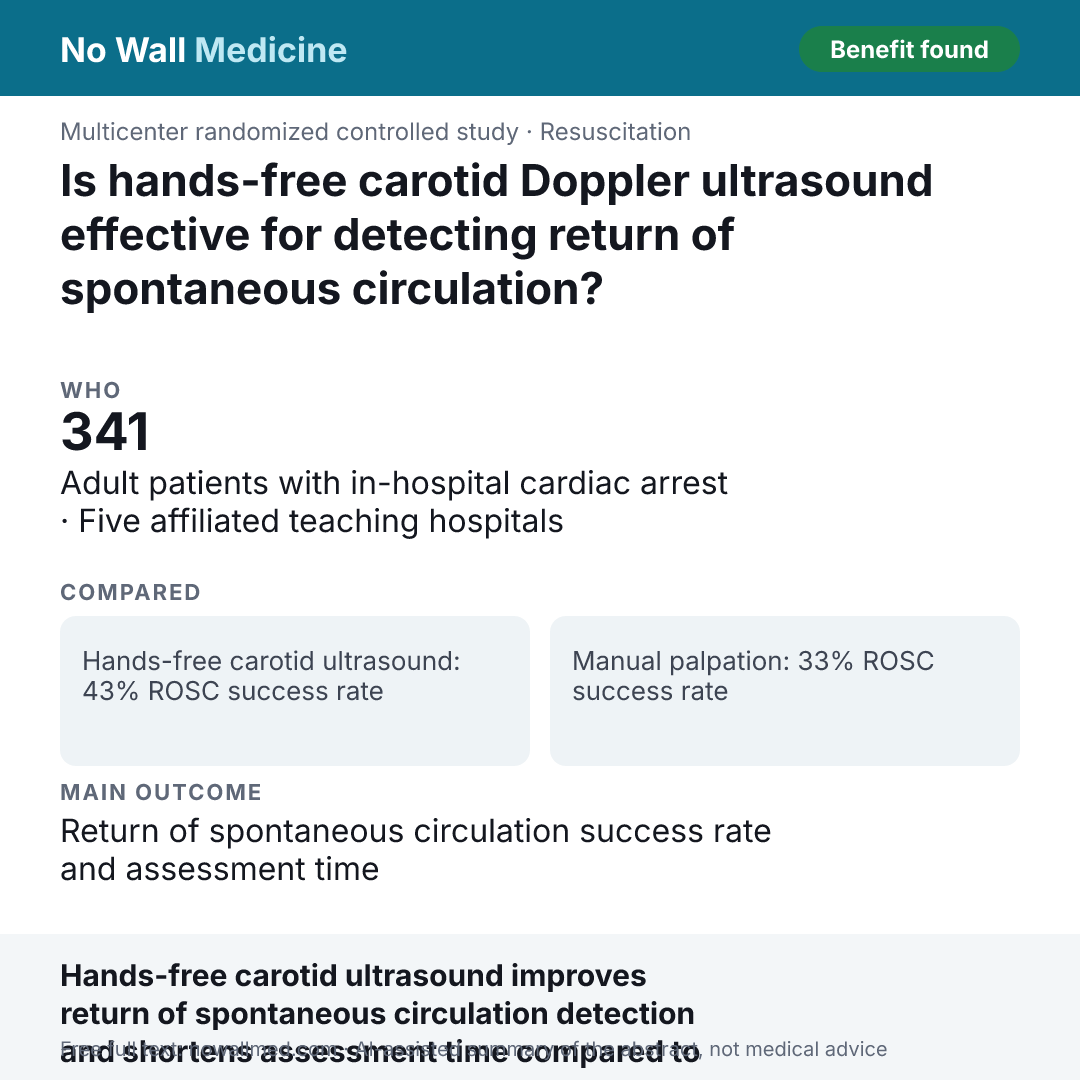
- Researchers studied 341 adult patients with in-hospital cardiac arrest across five hospitals, comparing hands-free carotid ultrasound to manual pulse checking.
- The ultrasound group had a non-significantly higher return of spontaneous circulation rate of 43% compared to 33% in the manual group.
- The mean time to assess carotid pulsation was significantly shorter using ultrasound at 2.9 (SD 0.8) s compared to 7.2 (SD 1.3) s for manual palpation.
Why it matters: Clinicians need efficient ways to detect the return of spontaneous circulation, which is the resumption of a heartbeat after cardiac arrest.
Discussion prompts
- Would these patients look like yours? Who was left out?
- Is the main outcome one that matters to patients?
- Is the difference large enough to change what you do?
Cite: Li Y, Xie M, Wang G, et al. Evaluating hands-free carotid Doppler ultrasound for real-time return of spontaneous circulation detection in in-hospital cardiac arrest: a multicenter randomized controlled study. Resuscitation. 2026;222:111016. doi:10.1016/j.resuscitation.2026.111016
Free full text: Resuscitation website · Summary and visual abstract: nowallmed.com/a/evaluating-hands-free-carotid-doppler-ultrasound-for-real-time-return-1aimu0m/ (AI-assisted from the abstract; check the paper before relying on it).