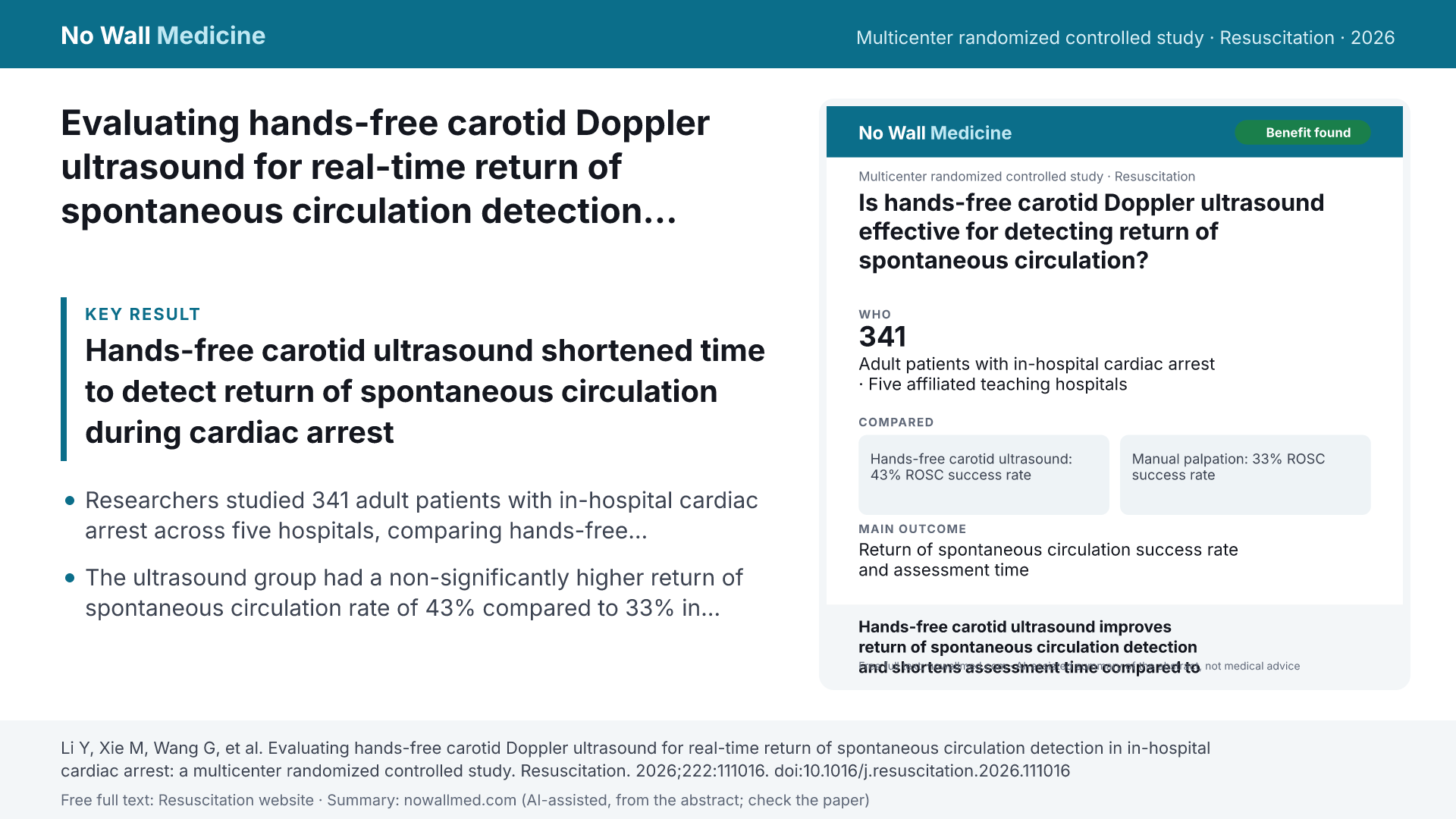
Hands-free carotid ultrasound shortened time to detect return of spontaneous circulation during cardiac arrest
Evaluating hands-free carotid Doppler ultrasound for real-time return of spontaneous circulation detection in in-hospital cardiac arrest: a multicenter randomized controlled study
Multicenter randomized controlled studyBenefit found
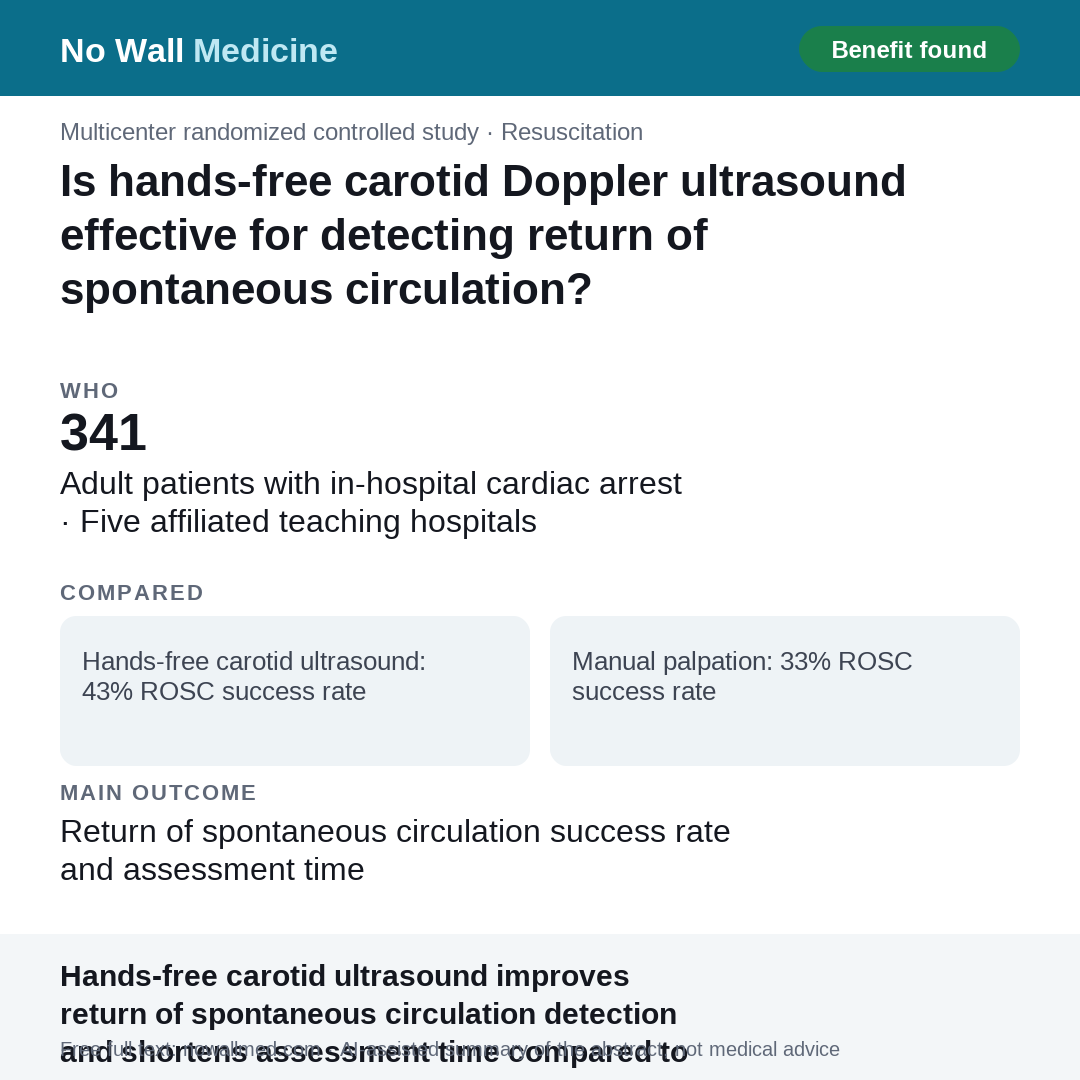
Is hands-free carotid Doppler ultrasound effective for detecting return of spontaneous circulation?
Who
341
Adult patients with in-hospital cardiac arrest · Five affiliated teaching hospitals
Compared
Hands-free carotid ultrasound: 43% ROSC success rate
Manual palpation: 33% ROSC success rate
Main outcome
Return of spontaneous circulation success rate and assessment time
Bottom line: Hands-free carotid ultrasound improves return of spontaneous circulation detection and shortens assessment time compared to manual palpation.
Resuscitation · 2026-02-18Download image
Clinical question: Is hands-free carotid Doppler ultrasound effective for detecting return of spontaneous circulation?
Why it matters: Clinicians need efficient ways to detect the return of spontaneous circulation, which is the resumption of a heartbeat after cardiac arrest.
Key points
- Researchers studied 341 adult patients with in-hospital cardiac arrest across five hospitals, comparing hands-free carotid ultrasound to manual pulse checking.
- The ultrasound group had a non-significantly higher return of spontaneous circulation rate of 43% compared to 33% in the manual group.
- The mean time to assess carotid pulsation was significantly shorter using ultrasound at 2.9 (SD 0.8) s compared to 7.2 (SD 1.3) s for manual palpation.
Headline and key points written with AI from the paper’s abstract, with every number checked against it. Read the paper before relying on them.
Was this summary helpful?
Subject terms
Cite this article
Li Y, Xie M, Wang G, et al. Evaluating hands-free carotid Doppler ultrasound for real-time return of spontaneous circulation detection in in-hospital cardiac arrest: a multicenter randomized controlled study. Resuscitation. 2026. doi:10.1016/j.resuscitation.2026.111016
Spotted a mistake? Suggest a correction