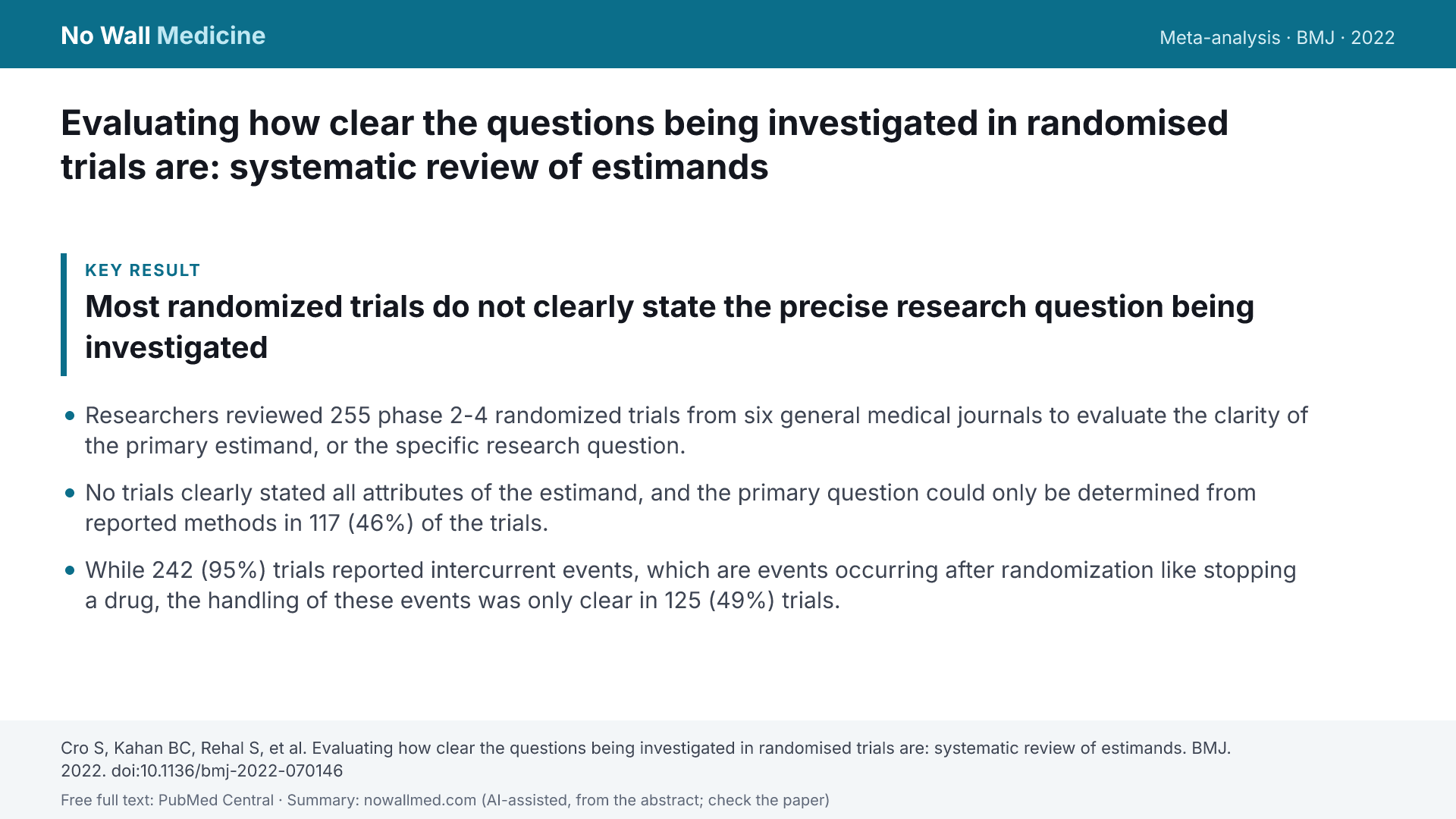
Most randomized trials do not clearly state the precise research question being investigated
Evaluating how clear the questions being investigated in randomised trials are: systematic review of estimands
Key points
- Researchers reviewed 255 phase 2-4 randomized trials from six general medical journals to evaluate the clarity of the primary estimand, or the specific research question.
- No trials clearly stated all attributes of the estimand, and the primary question could only be determined from reported methods in 117 (46%) of the trials.
- While 242 (95%) trials reported intercurrent events, which are events occurring after randomization like stopping a drug, the handling of these events was only clear in 125 (49%) trials.
Headline and key points written with AI from the paper’s abstract, with every number checked against it. Read the paper before relying on them.
Was this summary helpful?
Abstract
Objectives
To evaluate how often the precise research question being addressed about an intervention (the estimand) is stated or can be determined from reported methods, and to identify what types of questions are being investigated in phase 2-4 randomised trials. Design
Systematic review of the clarity of research questions being investigated in randomised trials in 2020 in six leading general medical journals. Data source
PubMed search in February 2021. Eligibility criteria for selecting studies
Phase 2-4 randomised trials, with no restrictions on medical conditions or interventions. Cluster randomised, crossover, non-inferiority, and equivalence trials were excluded. Main outcome measures
Number of trials that stated the precise primary question being addressed about an intervention (ie, the primary estimand), or for which the primary estimand could be determined unambiguously from the reported methods using statistical knowledge. Strategies used to handle post-randomisation events that affect the interpretation or existence of patient outcomes, such as intervention discontinuations or uses of additional drug treatments (known as intercurrent events), and the corresponding types of questions being investigated. Results
255 eligible randomised trials were identified. No trials clearly stated all the attributes of the estimand. In 117 (46%) of 255 trials, the primary estimand could be determined from the reported methods. Intercurrent events were reported in 242 (95%) of 255 trials; but the handling of these could only be determined in 125 (49%) of 255 trials. Most trials that provided this information considered the occurrence of intercurrent events as irrelevant in the calculation of the treatment effect and assessed the effect of the intervention regardless (96/125, 77%)-that is, they used a treatment policy strategy. Four (4%) of 99 trials with treatment non-adherence owing to adverse events estimated the treatment effect in a hypothetical setting (ie, the effect as if participants continued treatment despite adverse events), and 19 (79%) of 24 trials where some patients died estimated the treatment effect in a hypothetical setting (ie, the effect as if participants did not die). Conclusions
The precise research question being investigated in most trials is unclear, mainly because of a lack of clarity on the approach to handling intercurrent events. Clear reporting of estimands is necessary in trial reports so that all stakeholders, including clinicians, patients and policy makers, can make fully informed decisions about medical interventions. Systematic review registration
PROSPERO CRD42021238053.
Abstract reproduced under the article’s CC BY licence.
Subject terms
Cite this article
Cro S, Kahan BC, Rehal S, et al. Evaluating how clear the questions being investigated in randomised trials are: systematic review of estimands. BMJ. 2022. doi:10.1136/bmj-2022-070146
Spotted a mistake? Suggest a correction