Drug-coated balloons were associated with fewer interventions to maintain fistula patency than standard balloons
Evaluating Intervention Rates for Dysfunctional Arteriovenous Fistulas: Post-hoc Analysis of the IN.PACT AV Access Trial
Post-hoc analysis of a randomized clinical trialBenefit found
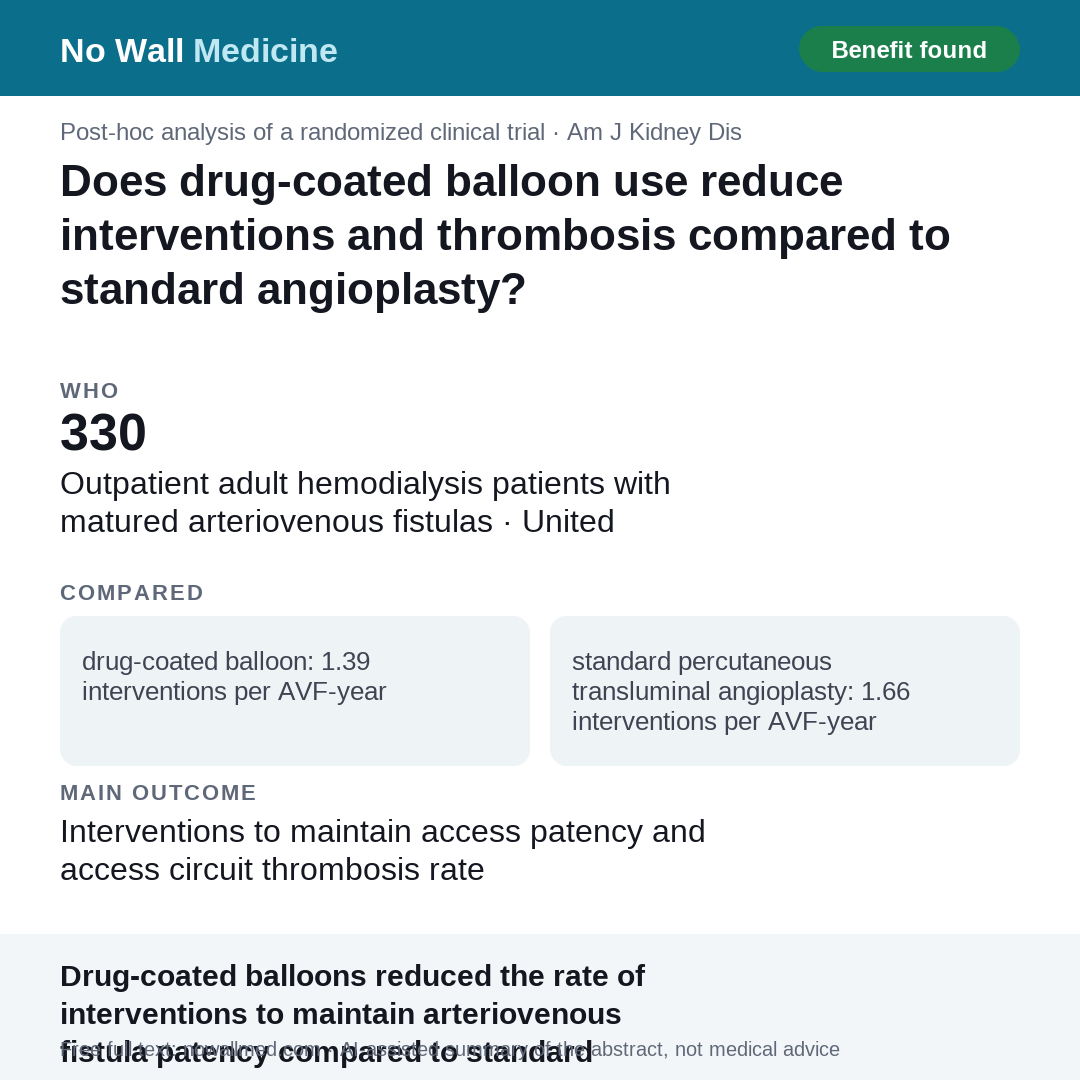
Does drug-coated balloon use reduce interventions and thrombosis compared to standard angioplasty?
Who
330
Outpatient adult hemodialysis patients with matured arteriovenous fistulas · United States, Japan, and New Zealand
Compared
drug-coated balloon: 1.39 interventions per AVF-year
standard percutaneous transluminal angioplasty: 1.66 interventions per AVF-year
Main outcome
Interventions to maintain access patency and access circuit thrombosis rate
Result: rate difference, -0.28 (95% CI, -0.47 to -0.08)
Bottom line: Drug-coated balloons reduced the rate of interventions to maintain arteriovenous fistula patency compared to standard angioplasty.
Limitation: Exclusion of arteriovenous fistulas with prior thrombosis and small sample size at 36 months.
Am J Kidney Dis · 2025-08-13Download image
Clinical question: Does drug-coated balloon use reduce interventions and thrombosis compared to standard angioplasty?
Why it matters: It was unclear if the use of drug-coated balloons could reduce the rate of thrombosis and the number of interventions needed to maintain fistula patency compared to standard balloon treatments.
Key points
- Researchers analyzed 330 outpatient hemodialysis patients randomized to receive either drug-coated balloons or standard percutaneous transluminal angioplasty, which is balloon widening of the vessel.
- The number of interventions per year to maintain access circuit patency through 36 months was 1.39 for the drug-coated balloon group and 1.66 for the standard group.
- Both treatment groups met the Kidney Disease Outcomes Quality Initiative target of 3 or fewer interventions per year to maintain fistula patency.
Limitation the authors note: The authors noted the exclusion of fistulas with prior thrombosis and a small sample size at 36 months.
Headline and key points written with AI from the paper’s abstract, with every number checked against it. Read the paper before relying on them.
Topics
Cite this article
Gopal A, Haruguchi H, Holden A, Lookstein R, Menk J, Wang P. Evaluating Intervention Rates for Dysfunctional Arteriovenous Fistulas: Post-hoc Analysis of the IN.PACT AV Access Trial. Am J Kidney Dis. 2025. doi:10.1053/j.ajkd.2025.05.013
Spotted a mistake? Suggest a correction
Top studies every Monday
The week’s key trials and guidelines in your specialties, by email. Free.
Get the weekly digest