Cell-impermeable endoprosthesis showed higher six-month patency rates than angioplasty for hemodialysis access stenosis
Six-month safety and efficacy outcomes from the randomized-controlled arm of the WRAPSODY Arteriovenous Access Efficacy (WAVE) trial
Prospective, international, multicenter pivotal randomized trialBenefit found
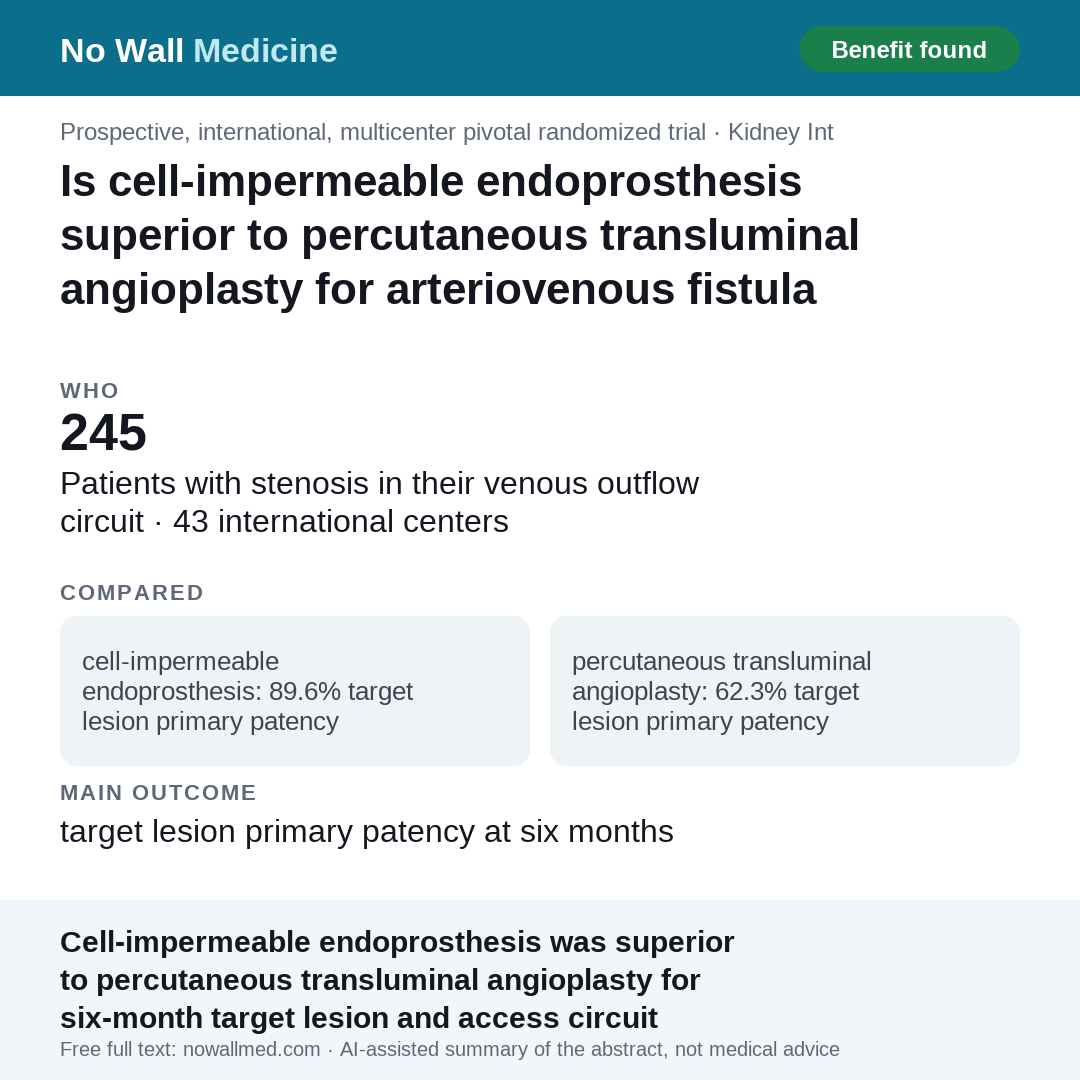
Is cell-impermeable endoprosthesis superior to percutaneous transluminal angioplasty for arteriovenous fistula stenosis?
Who
245
Patients with stenosis in their venous outflow circuit · 43 international centers
Compared
cell-impermeable endoprosthesis: 89.6% target lesion primary patency
percutaneous transluminal angioplasty: 62.3% target lesion primary patency
Main outcome
target lesion primary patency at six months
Bottom line: Cell-impermeable endoprosthesis was superior to percutaneous transluminal angioplasty for six-month target lesion and access circuit primary patency.
Kidney Int · 2025-01-23Download image
Clinical question: Is cell-impermeable endoprosthesis superior to percutaneous transluminal angioplasty for arteriovenous fistula stenosis?
Why it matters: Outcomes for cell-impermeable endoprostheses have not been investigated for treating stenosis in the venous outflow circuit of arteriovenous fistulas.
Key points
- Researchers studied 245 patients with stenosis in their venous outflow circuit, comparing a cell-impermeable endoprosthesis (a type of stent) to percutaneous transluminal angioplasty (balloon widening of the vessel).
- At six months, target lesion primary patency was 89.6% for the endoprosthesis compared to 62.3% for angioplasty, and access circuit primary patency was 72.2% versus 57.0%.
- There was no statistically significant difference in freedom from safety events at 30 days between the endoprosthesis group (96.6%) and the angioplasty group (95.0%).
Headline and key points written with AI from the paper’s abstract, with every number checked against it. Read the paper before relying on them.
Topics
Cite this article
Razavi MK, Balamuthusamy S, Makris AN, Hoggard JG, Harduin LO, Roy-Chaudhury P. Six-month safety and efficacy outcomes from the randomized-controlled arm of the WRAPSODY Arteriovenous Access Efficacy (WAVE) trial. Kidney Int. 2025. doi:10.1016/j.kint.2025.01.006
Spotted a mistake? Suggest a correction
Top studies every Monday
The week’s key trials and guidelines in your specialties, by email. Free.
Get the weekly digest